
An online bachelors in psychology is now one of the most-enrolled online degrees in the US, with more than 110,000 students finishing one in 2024 per NCES tabulations [1]. The degree doesn’t make someone a psychologist on its own — that requires graduate school — but the BA or BS opens roles in case management, HR, ABA therapy, and research assistance while serving as the prerequisite for clinical or counseling master’s programs. This guide covers APA accreditation, BS vs BA tracks, tuition data, and which licensure paths actually open after graduation.
APA-Accredited vs Regionally Accredited: The Key Online Bachelors in Psychology Distinction
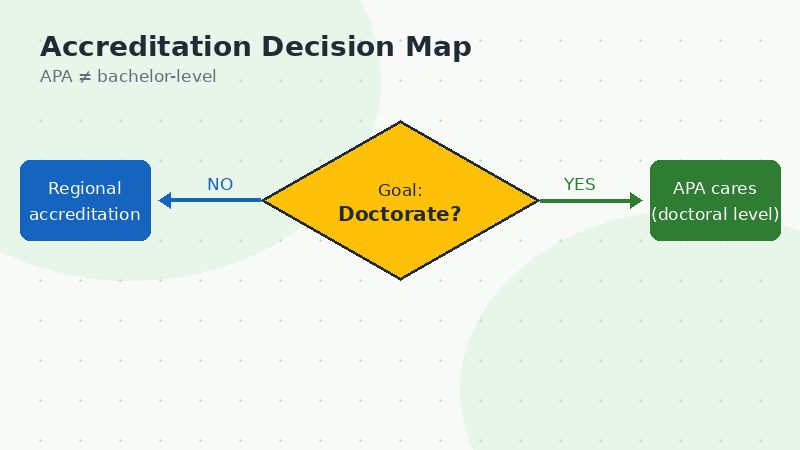
The American Psychological Association gets mentioned constantly in psychology degree searches, but APA accreditation only applies to doctoral programs in clinical, counseling, and school psychology [2]. No bachelor’s program — online or on-campus — is APA-accredited. The meaningful accreditation at the bachelor’s level is regional: the six regional accreditors (HLC, MSCHE, NECHE, NWCCU, SACSCOC, WSCUC) evaluate the institution as a whole. Any online BS or BA from one of these regionally accredited universities counts as “accredited.”
Regional accreditation matters for three specific reasons. Credits transfer between regionally accredited schools. Federal financial aid (Pell, Direct Loans) flows only to regionally or nationally accredited Title IV institutions. Master’s programs in clinical and counseling psychology almost universally require a regionally accredited bachelor’s — nationally accredited degrees sometimes get rejected. Check the institution’s accreditation before enrolling, using the Department of Education’s DAPIP database [3].
Online BS vs BA in Psychology: Which Track Fits Which Student
Most universities offer both a Bachelor of Science (BS) and Bachelor of Arts (BA) in psychology. The degree title matters less than the course mix, but the patterns are consistent across schools:
- BS in Psychology — Heavier on statistics, neuroscience, research methods, and lab coursework. Designed for students planning graduate school in experimental or clinical research psychology, or for those targeting ABA (Applied Behavior Analysis) roles.
- BA in Psychology — More flexibility, typically adds liberal arts requirements (foreign language, humanities). Better fit for students planning master’s programs in social work (MSW), counseling, HR, or education.
- Online specializations — Larger online programs now offer concentrations in forensic psychology, industrial-organizational (I-O), child development, health psychology, and addictions. A concentration adds 12-18 credits over the base degree.
A pragmatic rule: students planning to become a licensed clinical psychologist (PhD or PsyD) should pick the BS. Students planning to become an LCSW, LMHC, or to enter HR, education, or case management should pick the BA. The graduate programs on the social work and counseling side don’t require the heavier statistics sequence of the BS.
Get the free certification shortlist for 2026
A concise, hand-checked guide to free and low-cost credentials from recognized issuers — grouped by career goal, with practical CV and LinkedIn tips. Free PDF, no spam.
Accredited Online Bachelors in Psychology Programs: Tuition Comparison
Tuition varies by more than 3x for essentially the same degree. A sample of 2026 published rates for regionally accredited online BA/BS programs:
| Institution | Accreditor | Cost/Credit | Total (120 cr) | Notable |
|---|---|---|---|---|
| University of Florida Online | SACSCOC | $129 (in-state) | $15,480 | Public; BS with tracks in behavioral analysis or general |
| Arizona State University Online | HLC | $561 | $67,320 | BS and BA; 40+ concentrations |
| Southern New Hampshire University | NECHE | $330 | $39,600 | Most-enrolled online psychology bachelor’s in 2024 |
| Penn State World Campus | MSCHE | $654 | $78,480 | BA only; strong grad school prep |
| University of Massachusetts Amherst | NECHE | $560 | $67,200 | BA; offered through UMass Online |
| Purdue Global | HLC | $371 | $44,520 | BS; accelerated 12-week terms |
| Western Governors University | NWCCU | $4,085/6mo (flat) | ~$32,680 | BS; competency-based; finish as fast as skills allow |
Two numbers worth watching beyond the sticker: the transfer-credit cap and the residency requirement. Most schools cap transfer credits at 60-90 (of 120 needed). WGU and SNHU are generous with prior-learning assessment (CLEP, Sophia, StraighterLine) and knock $3,000-$8,000 off total cost for the average transfer student. Penn State World Campus and Arizona State are stricter with transfer credit.
- Regional accreditation verified in the Department of Education’s DAPIP database
- Transfer credits confirmed in writing — get the official evaluation before paying
- Graduate-school alignment — if planning a PhD, confirm the BS has at least 2 stats courses and 1 research methods course
- Licensure implications disclosed — the program’s state disclosures should match the student’s state of residence
- Cost per credit including fees — technology fees, exam proctoring, and lab fees aren’t always in the advertised rate
Time Commitment Including Practicum or Research Requirements
Most online bachelors in psychology require 120 semester credits — the same as any bachelor’s degree. Without transfer credit, full-time pace (15 credits/semester) takes 8 semesters, or about 48 months including summers. Three patterns that shift that number:
- Accelerated or competency-based programs (WGU, Purdue Global): can finish in 24-30 months for motivated students who pass competency assessments quickly.
- Transfer students with 60+ credits: routinely finish in 18-24 months.
- Part-time track (6 credits/semester): pushes total time to 60-72 months. Common for working parents.
The practicum question comes up regularly. Psychology bachelor’s degrees usually don’t require a formal practicum, unlike nursing or teaching degrees. A few programs do require a capstone internship (90-150 hours) at an approved site — a community mental health agency, school, or research lab. Online programs typically handle this by letting the student find a local site the program then approves. That’s worth confirming before enrolling if the student doesn’t live near a major metro area.
Licensure Paths: What an Online Bachelors in Psychology Actually Leads To
The bachelor’s alone doesn’t lead to a psychologist license. No state licenses psychologists at the BA/BS level. What the degree does open:
- Registered Behavior Technician (RBT) — 40-hour training + exam ($50) + competency assessment. Bachelor’s not strictly required but makes the hiring path easier. Starting pay $18-$24/hour for ABA agencies.
- Board Certified Assistant Behavior Analyst (BCaBA) — requires the BA plus 14 specific ABA courses (many schools offer a BCaBA track) and 1,300 hours of supervised fieldwork. Pay $55,000-$68,000.
- Case manager or mental-health technician roles — almost all require a bachelor’s in psychology, social work, or human services. No licensure but background checks apply.
- Master’s-level path — the BA/BS is the prerequisite for MSW, MS in Counseling, MS in Applied Behavior Analysis, MA in I-O Psychology. Graduate from one of these and the real licensure (LCSW, LMHC, BCBA) becomes reachable in 2-3 more years.
The most durable licensure paths from psychology bachelor’s are the LCSW (via MSW), the LMHC/LPC (via clinical counseling master’s), and the BCBA (via ABA master’s). Each has specific state variations in course requirements and supervised hours [4]. Confirm with the target state’s licensing board before committing to a master’s.
First-Year Salary Data and Job Prospects
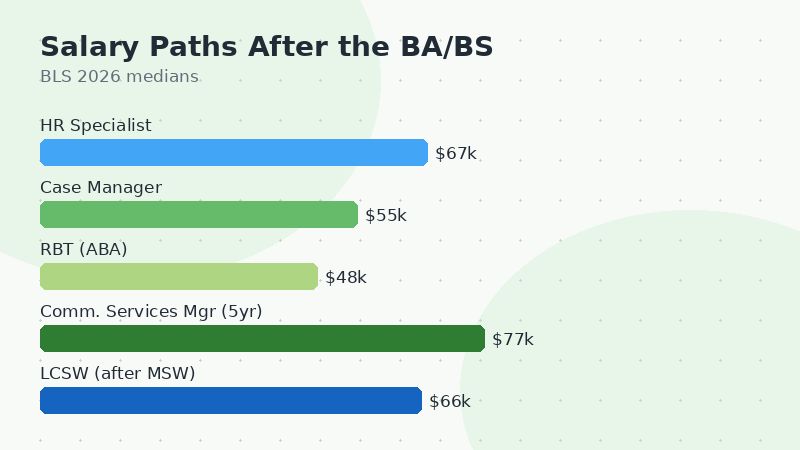
An online bachelors in psychology by itself doesn’t put a graduate into the BLS “psychologist” occupation — that’s a master’s-or-higher category. The jobs bachelor’s grads actually take show a different pay profile. Per BLS 2026 data crossed with 2024 NCES graduate surveys [5]:
- Social and community service managers (bachelor’s eligible): median $77,030 after 5+ years
- Human resources specialists: median $67,650 at entry with a psychology background
- Mental health and substance abuse social workers (bachelor’s-level positions): median $54,520
- Registered behavior technician and ABA staff: $41,600-$54,000 typical starting
- Market research analysts: median $74,680 (heavier on BS grads with stats coursework)
The graduate-school pipeline is the real economic play. A psychology bachelor’s earner who stops at the BA averages around $47,000 mid-career per the 2024 College Scorecard. The same graduate who completes an MSW averages $66,000. The jump to clinical PsyD adds another $25,000-$40,000 to the median. Viewing the bachelor’s as “step one of three” is the framing most career coaches use when working with psychology majors.
Admissions Requirements and Timeline
Online psychology bachelor’s admissions are typically open-enrollment for transfer students and closer to traditional undergraduate admissions for first-time freshmen. Common requirements:
- High school transcript or GED
- SAT/ACT waived at most online programs since 2020, still required at a few selective online BAs (UMass Amherst, Penn State)
- Application fee $25-$75 (often waived)
- Personal statement (250-750 words) at some programs
- FAFSA if using federal aid
Most rolling-admission programs decide within 2-4 weeks. Term-start dates vary — some schools start every 6-8 weeks (SNHU, Purdue Global), others follow a traditional fall/spring/summer calendar. Asking admissions advisors the right questions — total cost with all fees, transfer credit evaluation timeline, and state-specific licensure disclosures — saves real money. Written answers beat phone conversations if there’s any chance of later dispute.
Next Step: Master’s vs Workforce Entry After Graduation
The decision that shapes a psychology graduate’s next decade happens in senior year: go directly to a master’s program, or work for 1-3 years first. Each path has clear advantages.
Going directly into a master’s (MSW, MS Counseling, MA I-O) compresses the licensing timeline. An MSW takes 2 years, then 2 years of supervised practice for the LCSW. So a student finishing the online BA at 22 can be a licensed social worker at 26. The cost is real — MSW tuition runs $25,000-$75,000 — but federal loans cover most of it, and forgiveness programs like PSLF wipe out remaining balances after 10 years of nonprofit or government employment.
Working first builds clinical hours that some master’s programs count, provides income to reduce loan burden, and clarifies which specialty the graduate actually wants to pursue. RBT work for ABA master’s-bound students is especially valuable. Case manager work for MSW-bound students gives field experience most admissions committees weight heavily. The trade-off is time — the licensed-clinician milestone typically arrives at 28-30 instead of 26.
Related reading
- Online Bachelors in Nursing: Accredited RN-to-BSN Programs
- Online Masters in Psychology: MS vs MA Paths
- Best Accredited Online Colleges for 2026
Sources
- [1] National Center for Education Statistics — Digest of Education Statistics
- [2] American Psychological Association — Accreditation Program
- [3] U.S. Department of Education — Database of Accredited Postsecondary Institutions (DAPIP)
- [4] Association of State and Provincial Psychology Boards — State Licensing Boards
- [5] U.S. Bureau of Labor Statistics — Psychologists OOH (2026)
- [6] U.S. Department of Education — Federal Pell Grant Program
- [7] Council for Higher Education Accreditation — Regional Accreditors
Frequently Asked Questions
What’s the best online bachelor’s in psychology in 2026?
Top accredited online options: Arizona State Online ($42,000), Penn State World Campus ($57,000), University of Florida Online ($31,000), and Purdue Global ($32,000). ASU and Penn State carry the most brand weight; Florida and Purdue Global offer the best value-to-recognition ratio.
Can you practice psychology with just a bachelor’s degree?
No. Licensed psychology practice requires a master’s or doctorate plus state licensure. A bachelor’s opens roles as behavioral health technician, psychiatric tech, case manager, or research assistant ($38,000 to $52,000 entry salaries). It’s the required prerequisite for graduate psychology programs.
How long does an online psychology bachelor’s take?
Standard online psychology bachelor’s programs take 4 years. Accelerated programs like WGU allow 18 to 24 months completion for motivated self-paced learners. Many students complete psych bachelor’s while working full-time at 6-10 courses per year, finishing in 3-4 years part-time.
Get the free certification shortlist for 2026
A concise, hand-checked guide to free and low-cost credentials from recognized issuers — grouped by career goal, with practical CV and LinkedIn tips. Free PDF, no spam.