
This IT certification quiz exists because most people pick a credential by reading a “top 10” list and clicking the one that pays the most. That is a fast way to spend six months on a certification that does not match your background, available study time, or local job market.
The IT certification quiz weighs three signals that match what employers actually screen for: background fit, available study time, and budget. The taxonomy maps to the categories tracked by the U.S. Bureau of Labor Statistics and CompTIA.
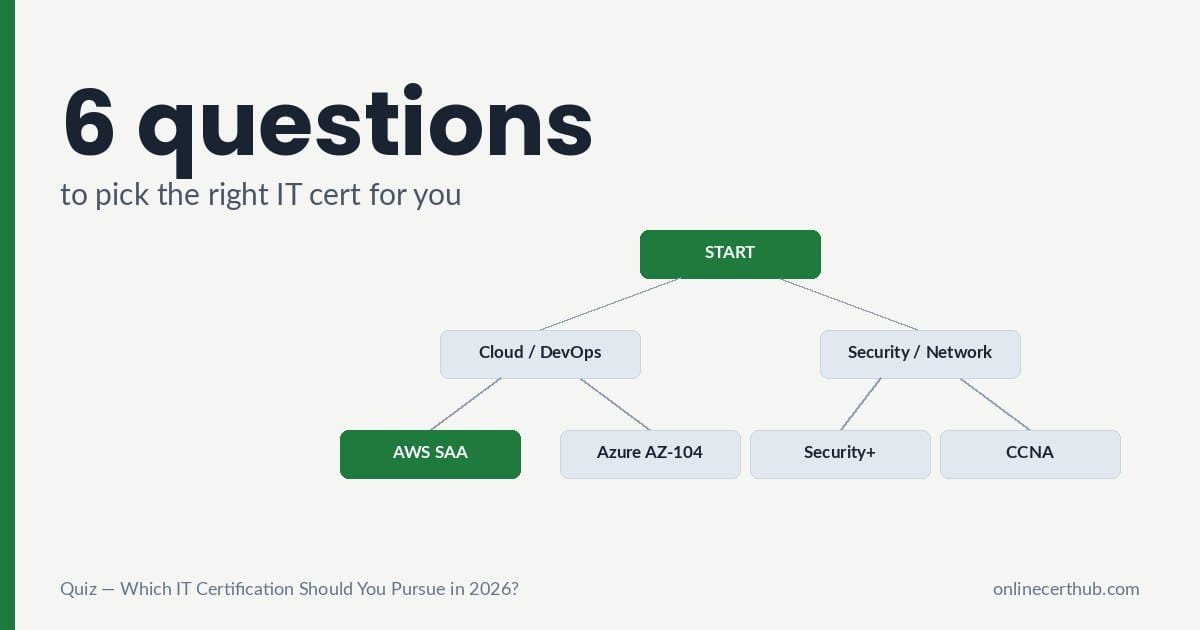
This is a 6-question decision tree. Each question routes the reader to a smaller set of viable options. By the end, the result is one recommended certification plus one backup, both based on the answer combination — not on a generic ranking.
The quiz takes about 3 minutes. There is no form to fill in: every step is below, and the reader simply scrolls to the result indicated by their previous choice.
How the IT certification quiz works
Each question has 2 to 3 answers labeled A, B, or C. Below each answer is the next step to scroll to. After 6 questions, the reader lands on a result block with a recommended certification, a backup option, and the reasoning behind both.
Get the free certification shortlist for 2026
A concise, hand-checked guide to free and low-cost credentials from recognized issuers — grouped by career goal, with practical CV and LinkedIn tips. Free PDF, no spam.
Before the recommendation kicks in, two ground rules:
- The recommendation reflects 2026 demand patterns. For country-specific demand, cross-check with the demand matrix by country.
- The recommendation is a starting point. Final enrollment should always be validated against current job postings in the reader's local market.
IT certification quiz results
Result X · Specialist track
Profile: already technical, working in cloud / dev / infra, has time to commit, looking for promotion or job change.
Why: the specialist track rewards depth over breadth. AWS SAA is the most-requested cloud credential in the US, UK, Spain, and Germany in 2026. AZ-104 is the equivalent in Microsoft-heavy environments. Both move the needle for promotion and external job moves.
Realistic timeline: 8 to 14 weeks at 5-12 hours per week.
Result Y · Cross-functional track
Profile: already adjacent to tech (PM, BA, ops), looking to formalize delivery skills or pivot into a more technical lane.
Why: the cross-functional track rewards credentials that travel across teams. PSM I is the most-cited Scrum credential in 2026 and is required for most Scrum Master openings in Europe. PMP remains the default for senior PM roles in the US and Mexico.
Realistic timeline: 4 to 8 weeks for PSM I; 12 to 20 weeks for PMP including application paperwork.
Result Z · Entry-level track
Profile: career switcher, limited time, goal is the first job in the new field.
Why: entry-level certs prioritize speed-to-first-job over salary. Cloud Practitioner is widely accepted as proof of cloud literacy for junior roles in Spain and Mexico. Security+ is the standard entry credential for SOC analyst roles. Google Data Analytics opens junior analyst roles via Coursera's placement network.
Realistic timeline: 6 to 10 weeks at 5-10 hours per week.
Result W · Default cloud entry track
Profile: mixed signals, no clear specialization yet, but motivated to move into IT.
Why: when the profile signal is unclear, a foundational cloud credential keeps the most doors open in 2026. Cloud Practitioner is short, affordable, and accepted across countries. It also creates an obvious next step (Solutions Architect Associate) once the reader has more clarity on direction.
Realistic timeline: 4 to 6 weeks at 5-8 hours per week.
After the IT certification quiz result
The recommendation is a starting point, not a final decision. Three things to do before enrolling:
- Validate against the country. Open the demand matrix by country and confirm the recommended cert is High or Medium in the target market. If it is Low, switch to the backup option.
- Validate against live postings. Search the cert name on LinkedIn Jobs filtered by country and target role. If fewer than 3 of the first 10 postings mention it, the cert may not be the right fit for that specific role.
- Compare the official enrollment routes. Each cert has multiple study paths (official provider, Coursera, Udemy, instructor-led). The blog reviews these route-by-route in the dedicated cert reviews.
Limits of this IT certification quiz
This is a decision tree, not an interactive quiz with branching logic. It uses 4 result profiles to keep the answer space readable. Edge cases — for example, a senior dev wanting to pivot into product management — will not match perfectly. In those cases, the closest profile (here: Profile Y) is the better starting point, and the recommendation should be cross-checked against the country matrix.
The quiz also does not cover sector-specific certifications (healthcare IT, financial services compliance) or vendor-specific credentials outside the top 12 listed in the demand matrix. Those should be researched role-by-role.
Disclosure: Some links on this page may be affiliate links. If you enroll in a course or certification through them, OnlineCertHub may earn a small commission at no extra cost to you. We only link to resources we have reviewed.
Frequently Asked Questions
How does the OnlineCertHub certification quiz work?
The quiz walks through six questions covering your country, prior experience, available study time per week, budget, preferred career direction, and learning style. Based on your answers it maps three best-fit certifications from the 2026 demand matrix with expected cost, duration, and salary outcomes.
Is the certification quiz accurate for real outcomes?
The matching logic is built on 2024-2026 BLS wage data, employer consortium lists from Google, Coursera and AWS, plus DoD 8570 baseline requirements. It points at credentials with documented ROI; actual hiring outcomes still depend on the local job market and portfolio effort.
Does the quiz save my results?
No. The quiz is fully anonymous and results are generated on the spot without storing personal data. If you subscribe to the newsletter after taking it, the matched credentials and 7-day email sequence are tailored to the outcome you received.
Get the free certification shortlist for 2026
A concise, hand-checked guide to free and low-cost credentials from recognized issuers — grouped by career goal, with practical CV and LinkedIn tips. Free PDF, no spam.