
What is the best online master’s in computer science in 2026?
Picking the best accredited online masters in computer science in 2026 comes down to a few simple questions: is the program regionally accredited, does the total cost land under $30K, and do graduates actually land the roles the program advertises? This guide maps the top 10 accredited options, their admissions quirks, and which ones still drop the GRE requirement.
Accredited Online MSCS Programs in 2026
Accreditation is the gate. A master’s degree from a regionally accredited U.S. university transfers credit, qualifies for federal financial aid, and shows up correctly in every ATS. An “online MSCS” from a non-accredited issuer carries no such status and, for most employers, doesn’t count as a graduate credential. The U.S. Department of Education maintains the authoritative accreditation database; any program worth considering appears there [3].
Ten programs dominate the 2026 shortlist by cost, graduation rate, and employer recognition:
- Georgia Tech OMSCS — $227 per credit hour in Fall 2026 (about $6,800 in tuition for the 30-credit degree) plus an online learning fee of $212 or $531 each semester; more than 10,000 graduates in its first 10 years; SACSCOC accredited [1].
- University of Illinois MCS Online — $21,440 total, HLC accredited, strong capstone.
- CU Boulder MS-CS on Coursera — $15,750, performance-based admissions, HLC accredited [4].
- University of Texas Austin MSDSO — ~$10,000, data science focused MSCS variant.
- Penn State MPS in Software Engineering — $38,700, ABET-related applied option.
- Arizona State MCS — $15,000, selective admit, fully online via Coursera.
- NC State MCS Online — $21,000, solid software systems curriculum.
- Johns Hopkins EP MSCS — $5,620 per graduate course in 2026-27, about $56,000 for the 10 courses, part-time professional model.
- Stanford HCP MSCS — $60,000+, honors coursework-only model.
- Columbia MS in Computer Science (video network) — $60,000+, elite but costly.
Admissions Requirements (GRE Status by School)
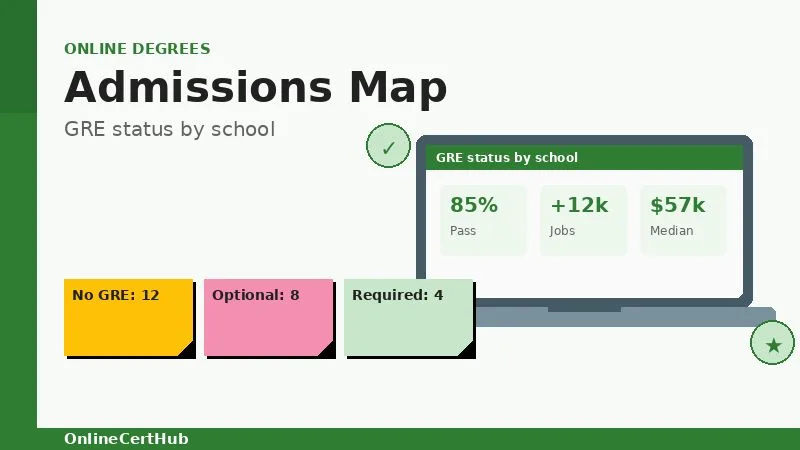
The GRE picture keeps shifting. In 2026, 12 of the top accredited online masters in computer science programs no longer require the GRE under any circumstance. Another 8 list it as optional — usually meaning a lower-GPA applicant can strengthen a file with a strong score. Four programs still require it, mostly the name-brand East Coast schools that use the test as a volume filter.
Get the free certification shortlist for 2026
A concise, hand-checked guide to free and low-cost credentials from recognized issuers — grouped by career goal, with practical CV and LinkedIn tips. Free PDF, no spam.
- No GRE required: Georgia Tech, UIUC, CU Boulder, Arizona State, UT Austin MSDSO, NC State.
- GRE optional: Johns Hopkins EP, Penn State MPS, USC Viterbi online.
- GRE still required: Stanford HCP, Columbia video network, most Ivy-adjacent programs.
Core admissions math across these programs: 3.0+ undergraduate GPA, a bachelor’s in CS or a related field (or a bridge of 3-5 CS prerequisites for non-majors), three letters of recommendation, a statement of purpose, and a resume. International applicants also show TOEFL/IELTS. Work experience helps but rarely replaces prereqs — most programs require data structures, algorithms, discrete math, and at least one systems course before admission [5].
Total Cost Comparison: $8K to $60K
Total cost varies by almost 8x across the accredited online masters in computer science field. The pattern sorts into three bands:
- Low cost ($8K-$16K): Georgia Tech, CU Boulder, UT MSDSO, Arizona State. These use a “flat per-course” model, sometimes on Coursera, with no out-of-state penalty. Ideal for career-changers paying out of pocket.
- Mid cost ($18K-$30K): UIUC, NC State, most state-school online MCS. Solid value; tuition reimbursement from employers usually covers the full bill.
- High cost ($35K-$65K): Johns Hopkins, Stanford HCP, Columbia, USC. Brand premium and small-cohort model. Worth it only when the employer pays or the brand is specifically the career lever.
- Verify the program in the U.S. Department of Education accreditation database (ope.ed.gov).
- Confirm regional accreditor name (SACSCOC, HLC, MSCHE, NWCCU, WSCUC, NEASC).
- Check the program’s self-reported graduation rate (target ≥75%) [2].
- Compare per-credit cost × total credits (most U.S. MSCS is 30-36 credits).
- Look for an ABET/CAC accreditation seal if switching industries (extra signal, not required).
- Read the student subreddit or Discord for real graduate outcomes, not marketing pages.
Curriculum Deep-Dive and Specializations
A well-designed online masters in computer science splits credit hours across three buckets: 40-50% foundation (algorithms, systems, theory), 30-40% specialization (ML, security, software engineering, HCI), and 10-20% capstone or thesis. Total credits sit at 30 in most programs; a few like Penn State MPS push to 33 and Johns Hopkins EP hits 36.
Specializations worth targeting based on 2026 job posting data: Machine Learning, Cybersecurity, Distributed Systems, and Human-Computer Interaction. ML saturates fast, so candidates pairing an ML specialization with applied systems coursework tend to clear recruiter screens more cleanly than pure-ML peers. Cybersecurity holds strong demand, particularly for candidates with prior systems experience. Distributed systems and HCI both show low supply relative to demand in 2026 [6].
Capstone structure varies. Georgia Tech OMSCS uses a mostly coursework model with optional projects. UIUC requires a 1-semester capstone. Johns Hopkins splits between thesis and project tracks. The capstone deliverable matters for recruiting only when it produces a public GitHub repo or a publishable result; otherwise it’s internal to the program.
Hidden Costs in an Online Masters in Computer Science
Posted tuition tells only part of the story. A full online masters in computer science budget should include several line items that graduate catalogs don’t emphasize:
- Technology fees — most programs charge $150-$500 per term in technology fees separate from tuition.
- Proctoring fees — some online exams require remote proctoring through services like ProctorU, billed per exam.
- Textbooks and software licenses — typically $200-$500 per term, though many courses use open-source materials.
- Per-credit fees outside tuition — activity fees, student services fees that sometimes hit even online students.
- Graduation and diploma fees — $50-$200 at the end of the program.
- Opportunity cost — 10-20 hours per week of study time during a 2-3 year window, often coming out of evenings and weekends.
Factoring these in shifts the real cost of a “low cost” program like OMSCS from about $9k-$9.5k in tuition and fees to closer to $11k-$12k over three years. Still the best deal in the accredited field, but the rougher number reflects what students actually pay out of pocket.
ROI and Employer Perception
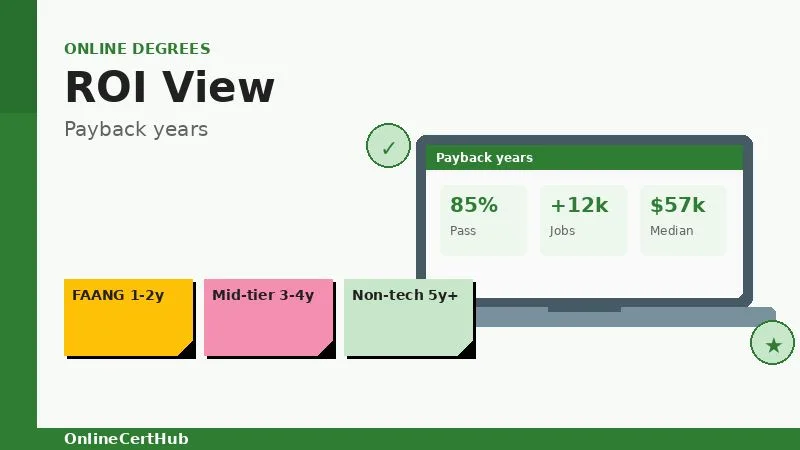
Payback timelines depend heavily on starting salary trajectory. A career-changer finishing Georgia Tech OMSCS for about $9,000 and landing a $140k base at a FAANG-adjacent employer pays off the tuition in weeks. A student paying about $56k at Johns Hopkins and landing a mid-tier $110k pays back over 1-2 years. A worker staying in the same role but using the credential for an internal promotion sees slower nominal payback but banks the lifetime pay uplift [6].
Employer perception bands in 2026 track brand first and accreditation second. Stanford, MIT (Sloan micromasters), Columbia, and Harvard (extension) carry outsized signal. Georgia Tech, UIUC, and CU Boulder are well-regarded inside the technical hiring funnels but slightly less known to non-technical recruiters. Bootcamp-adjacent programs marketed as “masters” from non-regionally-accredited schools carry the weakest signal and sometimes introduce doubt. The safest path: regionally accredited, under $30k, target-role-aligned specialization.
Application Timeline and Tips
Most accredited online masters in computer science programs run two or three intakes per year: Fall (applications due March-June), Spring (applications due September-November), and Summer (where offered, due January-February). A realistic timeline works backwards from a target start date: 6 months to prep (prereqs, GRE if required), 2-3 months to assemble application materials, 1-2 months for decisions, and 1 month for enrollment logistics.
Strongest applications share a few traits: prereq coursework with grades, a focused statement of purpose tied to a specialization (not “I love computers”), rec letters from people who have seen the candidate’s technical work, and a portfolio or GitHub with at least one substantial project. For non-CS undergrads, the bridge coursework on Coursera or edX — data structures, algorithms, discrete math — substitutes cleanly. Georgia Tech’s OMSCS admits explicitly accept this route [1][4].
How to Compare Online Masters in Computer Science Programs Side by Side
A structured comparison makes the decision cleaner. A four-column spreadsheet with the following headers covers 90% of what matters: Program, Total Cost, Graduation Rate, Target Specialization Strength. Fill it in from the programs’ own IPEDS-reported data, cross-referenced with Reddit/Discord student sentiment, and weighted by the target role. Each cell should have a source link so the comparison is auditable later.
Two additional columns tighten the filter: GRE requirement (yes/optional/no) and application deadline. GRE optional or waived programs remove a 3-6 month prep block. Earlier deadlines give more buffer for financial aid packaging and employer tuition reimbursement negotiations.
The single most underweighted factor in most comparisons is the student community. Programs with active Slack or Discord spaces (Georgia Tech OMSCS has one of the largest) provide peer support that correlates with higher graduation rates. Programs without active student communities trend toward lower completion, especially for part-time students balancing work and family. Before enrolling, lurking in the relevant community for two weeks reveals whether the program culture fits.
Final Take on Picking an online masters in computer science
The best accredited online masters in computer science in 2026 isn’t a single program — it’s whichever program matches three things: the candidate’s budget, the target role’s preferred specialization, and the admissions fit (GPA and prereq profile). Georgia Tech OMSCS wins on cost and breadth. UIUC MCS wins on systems rigor. CU Boulder’s performance-based admit wins for applicants without a formal CS background. Johns Hopkins and Stanford win when brand specifically matters for the target employer.
The most important filter in 2026 remains regional accreditation. Any program outside the six major U.S. regional accreditors should face extra scrutiny regardless of marketing. With accreditation confirmed, the remaining decision factors — cost, specialization, student community, application deadline — can be weighed against each individual candidate’s circumstances. The accredited online masters in computer science field is strong enough in 2026 that the real mistake is picking outside the top 10 [3][6].
Related reading
What is the cheapest accredited online master’s in computer science?
Georgia Tech’s OMSCS is the cheapest accredited option at roughly $7,000 total tuition. University of Illinois’ MCS-DS runs around $23,000. Both are regionally accredited with the same curriculum quality as on-campus versions.
Is an online master’s in computer science worth it?
Yes for most mid-career engineers and career changers. Salary bumps of $15,000 to $35,000 are common after graduation, and top programs like OMSCS and UT Austin MSCS are funded by many employers through tuition reimbursement.
Do employers accept online master’s degrees in CS?
Yes, when the program is accredited and the degree does not say “online” on the diploma. Georgia Tech OMSCS, UT Austin MSCS, and Stanford HCP all award identical diplomas to on-campus programs. Employer perception has shifted heavily since 2020.
Sources
- [1] Georgia Tech — Online Master of Science in Computer Science
- [2] National Center for Education Statistics — IPEDS graduation data
- [3] U.S. Department of Education — Accreditation Database
- [4] CU Boulder MS-CS on Coursera — program page
- [5] University of Illinois — MCS Online program
- [6] U.S. Bureau of Labor Statistics — OOH, Software Developers (2026)
- [7] ABET — accreditation for computing programs
Get the free certification shortlist for 2026
A concise, hand-checked guide to free and low-cost credentials from recognized issuers — grouped by career goal, with practical CV and LinkedIn tips. Free PDF, no spam.