
How to become a scrum master in 2026 breaks down to three parallel tracks: earning a recognized certification (CSM, PSM, or PMI-ACP), getting real agile exposure even without a scrum master job title, and then converting that exposure into a first role that typically pays $92,880 at the median per BLS 2026 data [1]. The process takes most career changers 4-9 months of focused work. This guide covers the realistic path, including what to do when the first 30 applications get ignored.
What a Scrum Master Actually Does
The role gets mischaracterized online. A scrum master is not the team lead, not the project manager, and not the person writing user stories. The scrum master’s actual job per the 2020 Scrum Guide [2] is to help the team apply scrum, facilitate the daily standup, sprint planning, review, and retrospective, and remove impediments that block the developers. The product owner owns the backlog; the developers own the work. The scrum master owns the process.
Day-to-day time split based on scrum.org survey data: about 30% in meetings facilitating scrum events, 25% coaching individuals and the team on agile practices, 20% removing impediments (chasing blockers across the organization), 15% working on team metrics and continuous improvement, and 10% on administrative tasks. The role is relational, not technical. Former developers sometimes struggle with the handoff of not writing code; former project managers sometimes struggle with giving up control of who does what. Knowing which pattern fits helps the career transition.
CSM vs PSM vs PMI-ACP: How to Become a Scrum Master by Certification
Three certifications dominate the hiring filters in 2026. Each has a different cost, prep time, and recognition profile.
- PSM I (Professional Scrum Master I) — Issued by Scrum.org. $200 exam fee. No mandatory class. 80 questions, 60 minutes, 85% pass score required. Most respected among engineering organizations because the exam is hard — first-attempt pass rate is 69% per Scrum.org public data. Lifetime credential with no renewal fee [3].
- CSM (Certified ScrumMaster) — Issued by Scrum Alliance. $400-$1,200 depending on the training provider. Requires a 2-day (16-hour) live class with a Certified Scrum Trainer before the exam. 50 questions, 74% pass score. More common in larger corporations. Requires renewal every 2 years ($100 + 20 SEUs of continuing education).
- PMI-ACP (Agile Certified Practitioner) — Issued by PMI. $435 for members, $495 for non-members. Requires 21 contact hours of agile training + 2,000 hours general project experience + 1,500 hours agile experience. Broader than scrum (covers XP, Kanban, Lean). Common in government and enterprise IT.
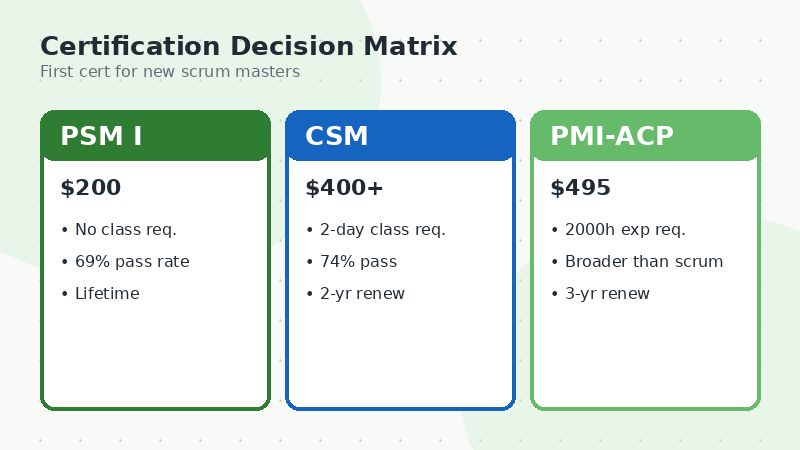
The PSM I is the fastest and cheapest path for self-studiers. A pragmatic study schedule: read the Scrum Guide 3 times, take Scrum.org’s Open Assessments until scoring 95% consistently, then sit the exam. Total time: 20-40 hours over 2-4 weeks. Cost: $200. The CSM path adds a 2-day class that most first-time scrum masters find valuable for the live interaction, worth the extra $200-$1,000 for learners who benefit from structured instruction. PMI-ACP is a later-career upgrade, not typically the first certification.
Get the free certification shortlist for 2026
A concise, hand-checked guide to free and low-cost credentials from recognized issuers — grouped by career goal, with practical CV and LinkedIn tips. Free PDF, no spam.
How to Become a Scrum Master: The 6-Month Path From Zero
A realistic path that’s worked for the 2024 cohort of career changers tracked on Scrum Alliance community forums:
- Month 1 — Read the Scrum Guide and 2 core books: Scrum: The Art of Doing Twice the Work in Half the Time by Jeff Sutherland and Coaching Agile Teams by Lyssa Adkins. Sit the PSM I exam at the end of the month.
- Month 2 — Find a volunteer agile project. Options: open-source projects with kanban boards that need coordination, nonprofit tech projects (CatchaFire, Taproot), or internal cross-functional initiatives at the current employer.
- Month 3 — Shadow an experienced scrum master. Scrum Alliance and Scrum.org both run user groups with shadowing programs. The LinkedIn #ScrumMasters hashtag surfaces practitioners willing to do virtual coffee chats.
- Month 4 — Start applying, but limit to 5-10 targeted applications per week. Tailor the résumé to emphasize facilitation, conflict resolution, and process improvement — skills transferrable from any prior role.
- Month 5 — Ramp up to 15-25 applications per week if no interviews yet. Add a second certification if reading signals demand (PSM II for deeper technical scrum masters, or SAFe SSM for Fortune 500 roles).
- Month 6 — Interview and accept. Most career changers land their first role between months 4 and 9, with a pronounced spike at month 6.
The job market in Q1 2026 was cooler than 2021-2022 for scrum masters — BLS monthly tech-employment data showed fewer net new scrum master roles. What that means practically: the 6-month path may extend to 9 months for career changers without a technical background, and candidates should widen the search to include “agile coach,” “delivery manager,” and “iteration manager” titles, which share 85-90% of the daily responsibilities.
- One certification completed — PSM I or CSM on the résumé within the last 12 months
- At least 3 months of real agile exposure — documented with specific team, cadence, outcomes
- Résumé uses facilitation language — replace “managed” with “facilitated,” “led meetings” with “ran scrum ceremonies”
- LinkedIn headline says “Scrum Master” — not “Aspiring Scrum Master” (recruiters search for the exact title)
- Portfolio of 2-3 case studies — 1-page write-ups of impediments removed, velocity improvements, retro outcomes
How to Get Agile Experience Without a Scrum Master Job
The chicken-and-egg problem is real: employers want experience, and new candidates need an employer to give it. Four paths have worked well in 2024-2025 based on community interviews:
- Internal rotation — If the current employer has any engineering or product teams running scrum, volunteer to shadow the scrum master and eventually facilitate 1-2 ceremonies. Most engineering leaders welcome free help.
- Nonprofit tech projects — Organizations like Code for America, DataKind, and CatchaFire all have projects that use agile or scrum and welcome scrum master volunteers. Typical commitment is 3-6 hours/week for 3-6 months.
- Open source coordination — Large open-source projects (Kubernetes SIGs, Apache projects, CNCF projects) run on informal agile. Volunteering as a release coordinator or sprint manager produces real résumé-worthy facilitation.
- Bootcamp and coding school partnerships — Some coding bootcamps hire part-time scrum masters to facilitate student project teams. Pay is modest ($20-$35/hour) but the experience translates directly.
Document every engagement. Keep a running log of impediments removed, conflicts facilitated, retros run, and measurable outcomes (velocity improvements, cycle time reductions). That log becomes the portfolio for the first real interview.
First-Year Salary and Remote Prospects
Scrum master pay varies by industry, location, and experience. Per a 2025 Scrum Alliance global compensation survey of 4,200 practitioners [4]:
- Entry-level (0-2 years): $72,000-$95,000 base salary in US metros. Rural and smaller-metro rates run 15-25% below.
- Mid-career (3-5 years): $92,000-$125,000.
- Senior (6-10 years): $118,000-$155,000, often with the “senior scrum master” or “agile coach” title.
- Principal/Enterprise Agile Coach: $140,000-$195,000, typically at Fortune 500 or large consulting firms.
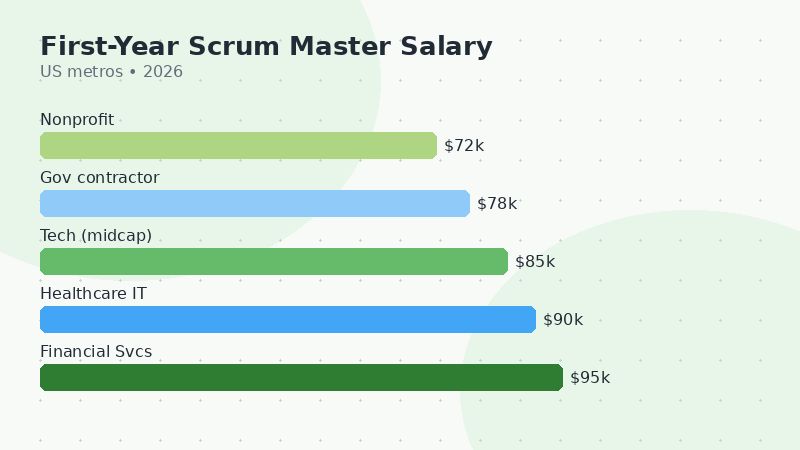
Remote prospects remain strong. Scrum master work is largely meeting-based and collaborative, which translates well to distributed teams. Approximately 58% of US scrum master postings sampled in Q1 2026 were fully remote or hybrid, compared to 38% for comparable project management roles. Financial services, healthcare IT, and government contractors are the three sectors where remote-only postings are hardest to find — those still lean hybrid with 2-3 days on site.
Interview Prep and Red-Flag Questions
Scrum master interviews follow a predictable pattern: a culture and behavioral round, a scrum-fluency round (case questions about how to handle team conflict, a blocked story, a missed sprint), and sometimes a mock scrum ceremony. A few high-signal interview prep priorities:
- Know the Scrum Guide cold. Roles, events, artifacts, and commitments. Interviewers do quiz this.
- Prepare 3-4 STAR stories about facilitating conflict, removing an impediment that crossed teams, and coaching someone who resisted change. These come up in almost every interview.
- Red-flag interview signals to watch for: the role description reads like a project manager’s job (managing dependencies across teams, holding team accountable to dates, reporting status to execs). That’s not scrum — that’s PM with a new title. If multiple interviewers describe accountability as the scrum master’s, the role won’t work as a scrum master role.
- Team ratio question. Healthy scrum masters work with 1-2 teams. Anything above 3 is usually a staffing shortfall, not a “growth opportunity,” and burns out new scrum masters fast.
- Ask about organizational agility. A scrum master role at an organization that doesn’t understand scrum becomes a frustration trap. “How does leadership engage with sprint reviews?” surfaces this quickly.
Related reading
- PMI-ACP Certification: Who It’s For and How to Pass
- How to Become a Project Manager From a Non-PM Role
- Agile vs Waterfall: Which Framework for Which Team
Sources
- [1] U.S. Bureau of Labor Statistics — Project Management Specialists OOH (2026)
- [2] Scrum Guide — Official 2020 Edition
- [3] Scrum.org — Professional Scrum Master I (PSM I)
- [4] Scrum Alliance — State of Agile Reports
- [5] Project Management Institute — PMI-ACP Certification
- [6] U.S. Bureau of Labor Statistics — Occupations With Most Job Growth
Frequently Asked Questions
How do you become a Scrum Master in 2026?
Earn a foundational cert like PSM I ($200, open book) or CSM ($1,000 with 2-day course), volunteer to scrum-master a team in your current role for 3 to 6 months, document 2 to 3 sprints as case studies, and apply for Scrum Master positions paying $85,000 to $115,000.
What is the cheapest Scrum Master certification?
PSM I from Scrum.org at $200 is the cheapest credible Scrum Master certification. It has no prerequisites and uses free preparation materials from Scrum.org. CSM from Scrum Alliance costs $1,000 to $1,500 (includes mandatory training) but is more widely recognized in U.S. corporate environments.
Is Scrum Master a good career in 2026?
Yes for agile-focused project managers. Median salary is $95,000 to $120,000 in the U.S. Scrum Masters are in demand across tech, finance, and healthcare. Career growth paths include Agile Coach ($130,000 to $170,000) and Release Train Engineer ($150,000+) in scaled agile organizations.
Get the free certification shortlist for 2026
A concise, hand-checked guide to free and low-cost credentials from recognized issuers — grouped by career goal, with practical CV and LinkedIn tips. Free PDF, no spam.