
An online masters in data science in 2026 has become one of the most crowded credential markets in U.S. higher ed, with more than 40 regionally accredited programs running at tuitions from $10,000 to $65,000. This guide breaks down which programs actually carry ABET or regional accreditation worth paying for, admissions trends (including the continued GRE optional wave), curriculum depth across Python and machine learning, capstone versus thesis paths, and realistic salary outcomes from 2026 BLS and NCES data.
What is the best online masters in data science program in 2026?
Online Masters in Data Science Programs With ABET or Regional Accreditation
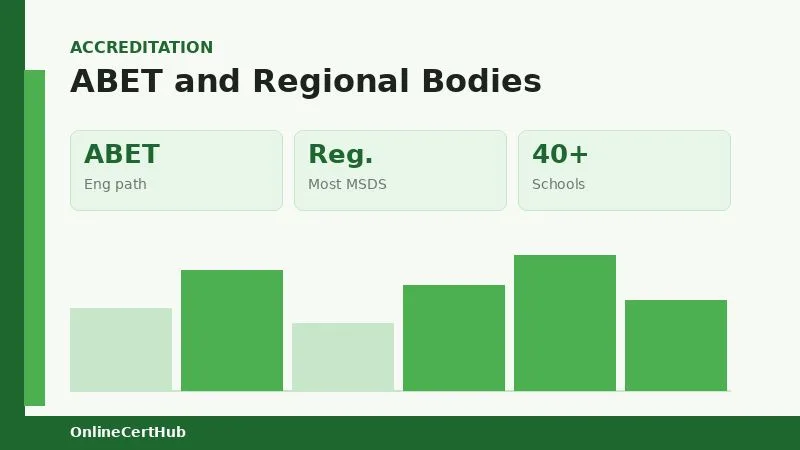
Accreditation sorts real programs from diploma mills. Two categories matter for an online masters in data science: regional accreditation (from one of the seven regional accreditors recognized by the U.S. Department of Education) and program-specific accreditation from ABET (Accreditation Board for Engineering and Technology) [3]. Regional accreditation is the baseline — without it, the degree usually doesn’t transfer, won’t satisfy employer reimbursement requirements, and isn’t Title IV federal aid eligible.
ABET’s Computing Accreditation Commission accredits some data science programs under its “Data Science” program criteria added in 2022. About 25 U.S. data science programs held ABET accreditation as of 2026 — mostly undergraduate degrees, with a growing list of master’s-level entrants [3]. Regional accreditation covers the broader set.
Top regionally accredited online MSDS programs with strong 2026 enrollment and outcome data:
- Georgia Tech Online Master of Science in Analytics (OMSA) — 36 credit hours at $11,880 to $12,960 in total tuition depending on residency, plus an online learning fee each semester; SACSCOC accredited, highly competitive admissions.
- UT Austin Online MS in Data Science — $10,000 total tuition via edX, SACSCOC accredited.
- University of Illinois Urbana-Champaign Online MSDS — $22,000 total, HLC accredited.
- Indiana University Online MS in Data Science — $17,000 total, HLC accredited.
- Northwestern University Online MSDS — $65,000 total, HLC accredited, includes a thesis track.
- University of Michigan Online MADS — $35,000 total, HLC accredited, applied focus.
- Johns Hopkins Online MS in Data Science — $55,000 total, MSCHE accredited.
- Boston University Online MS in Applied Data Analytics — $31,000 total, NECHE accredited.
Program length ranges from 18 to 36 months, with most full-time learners finishing in 24 months and part-time learners in 36 months. Credit-hour requirements sit between 30 and 36 credits across nearly all regionally accredited MSDS programs.
Get the free certification shortlist for 2026
A concise, hand-checked guide to free and low-cost credentials from recognized issuers — grouped by career goal, with practical CV and LinkedIn tips. Free PDF, no spam.
Admissions: GRE Trends and Math Prereqs
The GRE optional wave that started in 2020 held through 2026. Most online masters in data science programs no longer require GRE scores, though a subset still accept them for borderline applicants. Northwestern, Johns Hopkins, and a handful of engineering-tracked programs still recommend GRE submissions for candidates with non-quantitative undergraduate backgrounds [2].
What programs actually scrutinize in 2026:
- Math prerequisites — typically linear algebra, multivariable calculus, probability, and introductory statistics. Programs at UT Austin and Georgia Tech run open-admission prerequisite courses (low-cost, audit-friendly) for applicants who haven’t completed these.
- Programming proficiency — Python is the floor for nearly all MSDS programs. A small number still accept R-only candidates if paired with a strong statistics background.
- Professional or research experience — most programs weight 1-2 years of quantitative work experience heavily. Recent grads with a strong undergraduate GPA in a STEM field clear the bar without it.
- Letters of recommendation — standard ask is 2-3 letters. Online programs tend to prefer supervisor letters over purely academic ones.
- Statement of purpose — programs screen for a clear reason the applicant wants the degree. “I want to pivot into data science” without a specific target role or industry is the most common weak-SOP pattern.
Acceptance rates vary widely. Georgia Tech OMSA admits roughly 60% of qualified applicants; Northwestern sits closer to 35%; UT Austin’s MSDS through edX admits around 55%. The fully open-admission MicroMasters-style programs (edX MicroMasters, Coursera MasterTrack) admit anyone who completes the preparatory modules [2].
Cost Range: $10K to $65K for an Online Masters in Data Science
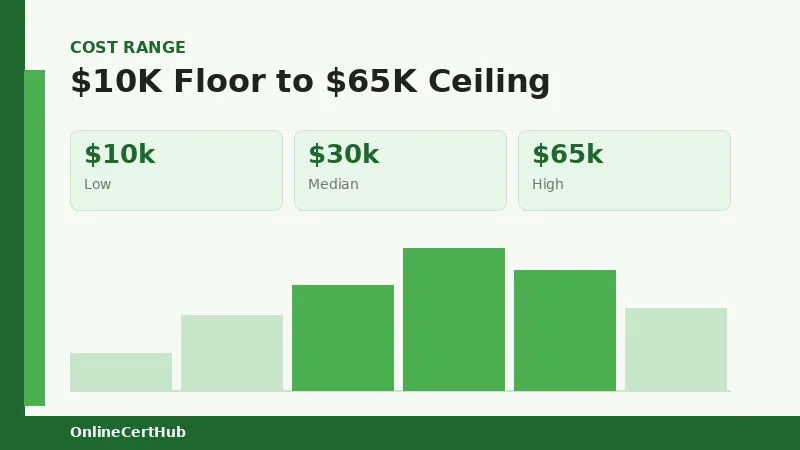
Tuition is the single biggest decision variable for most MSDS candidates. The 2026 market spans a 6.5x range:
- Under $15K total: Georgia Tech OMSA (about $12K-$13K), UT Austin MSDS ($10K), Eastern University, Dakota State. Mostly state-subsidized public programs.
- $15K-$30K total: Indiana University ($17K), UIUC MSDS ($22K), Oregon State, Iowa State. Good balance of public prestige and moderate cost.
- $30K-$45K total: University of Michigan MADS ($35K), Penn State World Campus, American University. Mid-tier private and selective public programs.
- $45K-$65K+ total: Northwestern ($65K), Johns Hopkins ($55K), Harvard Extension (pay-per-course, similar total). Premium brand, premium cost.
- Employer-reimbursed: Fortune 500 tuition reimbursement caps sat at $5,250/year in 2026 for tax-free benefits [4]. Most of a $12K Georgia Tech OMSA degree can be covered over 2-3 years; a $65K Northwestern program requires significant out-of-pocket.
Federal student aid covers accredited programs, but the rules changed on July 1, 2026: for periods of study starting on or after that date, graduate students can no longer take out Grad PLUS loans (a transition rule protects some students already enrolled), and Direct Unsubsidized Loans for a master’s are capped at $20,500 a year and $100,000 in total (Public Law 119-21). Scholarship aid varies — Georgia Tech OMSA offers limited scholarships, Northwestern and Johns Hopkins offer merit-based partial awards. State residents often see significantly discounted tuition at public programs, though online MSDS programs increasingly charge flat rates that ignore residency [4].
Curriculum: Python, ML, Big Data, Statistics
Core curriculum converges across programs despite brand differences. A 2026 MSDS student should expect:
- Foundations: Python programming (pandas, NumPy, scikit-learn), SQL, linear algebra refresher, probability and statistics, data wrangling.
- Core machine learning: supervised and unsupervised methods, regression, classification, clustering, cross-validation, model evaluation.
- Deep learning: neural networks, backpropagation, TensorFlow or PyTorch, one CV or NLP applied module.
- Big data systems: distributed computing with Spark, cloud platforms (AWS, GCP, or Azure), data pipelines and orchestration.
- Data visualization and communication: Tableau or Power BI, storytelling with data, stakeholder presentation.
- Electives: reinforcement learning, causal inference, time-series analysis, recommender systems, NLP, computer vision, MLOps.
Programs differ most at the electives and capstone level. Georgia Tech OMSA weights analytics and operations research heavier than pure ML. Northwestern leans applied business analytics. Johns Hopkins leans biostatistics-adjacent. Michigan MADS emphasizes applied projects over theory. A candidate should map their target role to the elective depth — an aspiring ML engineer picks differently than someone targeting a data analyst or business intelligence role [2].
Capstone vs Thesis Options
Almost every regionally accredited online masters in data science ends in a capstone project, and a subset add an optional thesis track for research-minded students. The split matters for learners considering a PhD afterward.
Capstone tracks typically ask students to complete an applied end-to-end project (dataset to model to stakeholder-ready deliverable) over 1-2 terms. Georgia Tech’s OMSA practicum pairs students with industry sponsors. Northwestern’s capstone runs as a team consulting engagement. UT Austin uses an individual portfolio-style deliverable.
Thesis tracks are rarer in fully online programs but exist at Northwestern, Indiana University, and Johns Hopkins. A thesis typically adds 3-6 credit hours, takes 2-3 terms, and requires an advising faculty committee. For students planning a PhD, a completed master’s thesis strengthens the application materially. For students targeting industry roles, a capstone with a public GitHub repo and a deployed model tends to carry more interview weight than a thesis [2].
Salary Outcomes and Employer Sponsorship
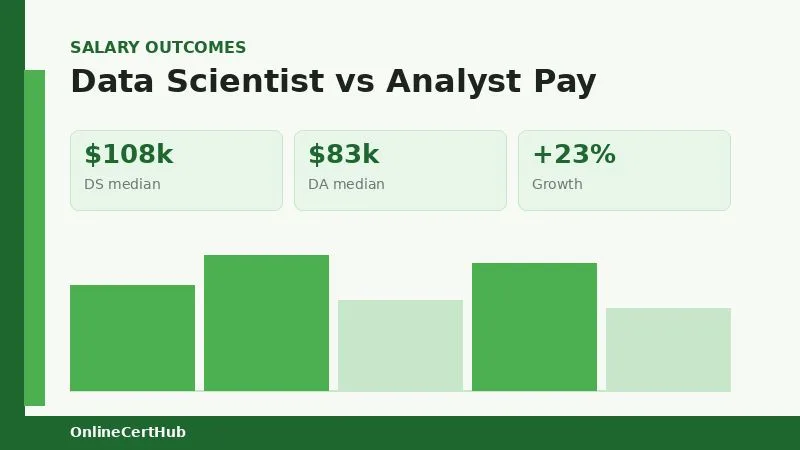
The BLS Occupational Outlook Handbook puts the median annual wage for data scientists at $120,230 (May 2025) and projects 35% employment growth from 2025 to 2035, much faster than average [1]. A related track, operations research analysts, had a median of $88,940; machine learning engineers are usually counted under software developers.
An online masters in data science tends to pay off most for career-changers moving into a data role and for analysts moving up to data scientist titles; recent STEM graduates usually see a smaller jump at first. How much pay rises depends on the job you land, so check salaries for your target role and city before you enroll.
Employer sponsorship remains a significant cost mitigator. The 2026 IRS Section 127 cap held at $5,250 annually for tax-free educational assistance — enough to cover most of a Georgia Tech OMSA degree (about $12K-$13K) over two to three years, or roughly offset 8% of a $65K Northwestern program. Fortune 500 employers increasingly extend MSDS sponsorship beyond the $5,250 cap in exchange for retention clauses (commonly 24-36 months of post-degree employment) [4].
Common Mistakes Choosing an Online Masters in Data Science
Four patterns show up in 2026 applicant outcome data. The first is chasing brand over curriculum fit. An aspiring ML engineer who picks Northwestern’s business-analytics-leaning MSDS because of the brand often finds the curriculum doesn’t map to their target role. A better curriculum fit at Georgia Tech or UIUC at 1/6 the cost produces stronger interview performance.
The second is underestimating the math prerequisite gap. Applicants who skipped linear algebra in undergrad routinely struggle in the first MSDS term. Most programs publish an open prereq refresher — taking it before matriculating cuts dropout risk meaningfully.
The third is ignoring the capstone. Programs where students can coast through a weak capstone produce weaker portfolio artifacts. Interview panels ask for the capstone repo and the hosted demo — programs that require both have better hire rates.
The fourth is skipping accreditation verification. A regionally accredited program is listed on the Department of Education’s CHEA database [3]. Any program that can’t be verified there is not Title IV aid eligible and isn’t a serious option.
Frequently Asked Questions
What is the best online master’s in data science in 2026?
Top-ranked options include University of Illinois MCS-DS ($23,000), UC Berkeley MIDS ($85,000), Georgia Tech OMSA (about $12,000-$13,000), and Johns Hopkins MS in Data Science. Georgia Tech OMSA is the best value-for-money; Berkeley is the most prestigious but expensive.
How much does an online master’s in data science cost?
Online master’s in data science programs range from about $10,000 (UT Austin) to $85,000 (Berkeley MIDS). Most programs fall in the $25,000 to $50,000 range. All must be from regionally accredited institutions to maintain respect with employers.
Is an online master’s in data science worth it?
Yes for mid-career engineers and analysts targeting senior data scientist or ML engineer roles. Average salary bump post-graduation is $20,000 to $40,000. Programs like OMSA and MIDS are widely funded by employer tuition reimbursement, often reducing out-of-pocket to under $10,000.
Transparency note: some links in this article are affiliate links. If you buy through them, OnlineCertHub may earn a commission at no extra cost to you.
Get the free certification shortlist for 2026
A concise, hand-checked guide to free and low-cost credentials from recognized issuers — grouped by career goal, with practical CV and LinkedIn tips. Free PDF, no spam.