
Free online certificate programs with financial aid fill a gap most learners don’t know exists: paid platforms like Coursera and edX cut or waive certificate fees for learners who show financial need. That means a Google Data Analytics Certificate, which costs $49 a month on Coursera in the US and Canada, can cost nothing for an approved learner. This guide explains exactly how the Coursera and edX aid programs work in 2026, federal Pell eligibility for certificate paths, and the real approval rates based on public platform data.
How Free Online Certificate Programs With Financial Aid Actually Work
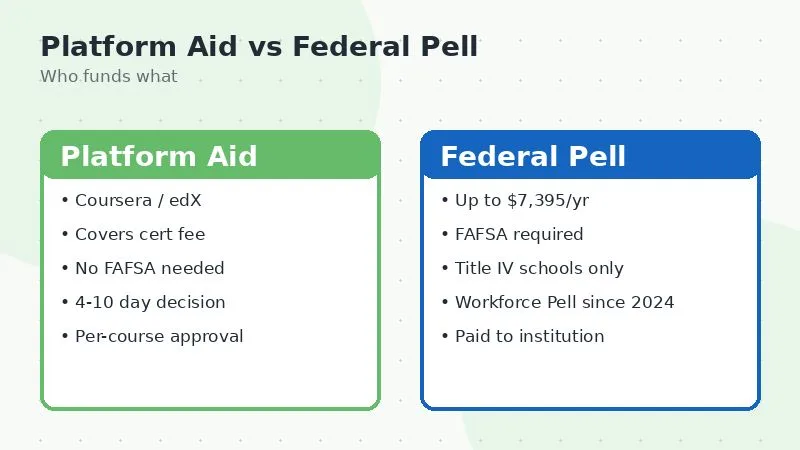
Two different systems exist, and conflating them is the reason most learners overpay. The first is platform-level aid: Coursera, edX, and a handful of others waive certificate fees at their own expense after the learner fills out a financial disclosure. The money doesn’t come from the federal government. It comes from the platform’s own budget and is priced into the course catalog. The second is federal aid, which flows through FAFSA to Title IV-eligible institutions, and only applies to certificate programs offered directly by an accredited college.
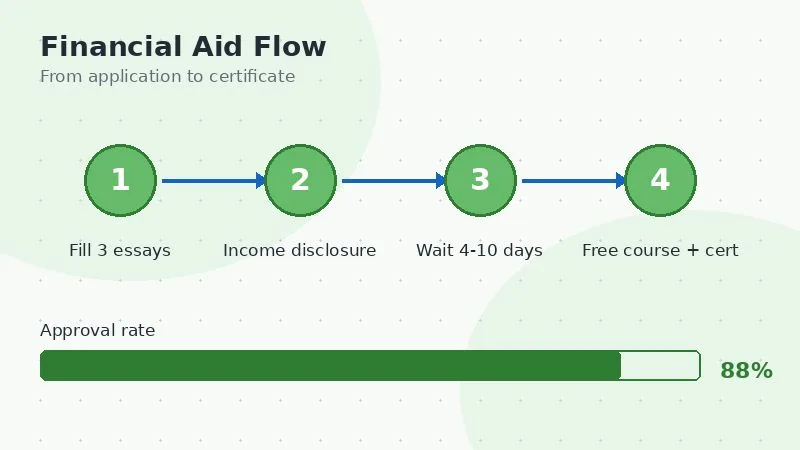
Most of what the internet calls “free online certificate programs with financial aid” is category one: platform waivers. The good news is that approval is straightforward and fast. The 2025 State of the Learner report Coursera publishes puts the approval rate for first-time financial aid applications at 88% [1]. edX doesn’t publish exact numbers but community threads on r/edX consistently show approval timelines of 5-15 days with similar acceptance rates.
Coursera Financial Aid: How the Platform-Level Waiver Works
Coursera offers financial aid on almost every paid course and Specialization in its catalog, including the high-value Google, IBM, and Meta Career Certificates. The process runs through a form accessed from the course enrollment page [2]. Three short essays (about 150 words each) plus an income and expenses disclosure. The rubric Coursera uses is public:
- Why are you taking this specific course? Answer with a career goal — job change, promotion, skill upgrade for current role.
- How will you use what you learn? Concrete plans beat aspirational language.
- Why do you need financial aid? Monthly budget math is more persuasive than general statements.
Approval typically lands in 4-10 business days. Rejected applications can be edited and resubmitted after 15 days. If approved, the learner gets 180 days of free access to the entire course or Specialization, including the certificate at the end. Note: the aid is course-specific. A learner enrolled in Google IT Support on aid cannot use the same waiver for Google Data Analytics — each one needs a separate application.
Get the free certification shortlist for 2026
A concise, hand-checked guide to free and low-cost credentials from recognized issuers — grouped by career goal, with practical CV and LinkedIn tips. Free PDF, no spam.
edX Financial Assistance: Different Workflow, Similar Result
edX runs its financial assistance program through a single form linked from each course’s enrollment page [3]. Applicants confirm that paying the verified certificate fee would cause hardship, share a bit about their background, and submit. edX historically approves applications at rates close to Coursera’s. Some distinctions worth flagging:
- edX financial assistance takes 80% off the verified-track fee rather than waiving it in full. On a $150 course that’s $30 out of pocket. The same learner can be approved up to five times in a 12-month period.
- Program-level waivers (a whole MicroMasters of 5 courses, for example) require a separate application per course, not one per program.
- MIT and Harvard courses on edX qualify for the assistance program on the same terms as any other edX course.
edX says to allow up to 7 days for a decision. Learners who need a certificate quickly should apply well before the course deadline — edX doesn’t refund applications submitted too late.
- Monthly income figure — gross before taxes, rounded to the nearest $100
- Monthly expenses list — rent, food, utilities, transportation, dependents
- Concrete career goal — “move from retail to entry-level IT support” is stronger than “advance my career”
- A specific course URL — one application per course, not per topic
- 15 minutes of uninterrupted writing time — the three short-answer questions benefit from one focused pass
Free vs Aid-Subsidized: Understanding the Difference
Not every free certificate runs through an aid program. Some certificates are genuinely free with no application — courses on edX Audit mode, for example, let anyone read materials and watch videos without any certificate. The catch: audit mode doesn’t issue a verified certificate. The completion page is there, but it carries no platform branding and won’t satisfy LinkedIn’s verified-learning checks. Employers familiar with Coursera and edX can usually tell the difference.
The practical sorting is:
- Audit mode (free, no cert) — Good for learning content only. Content is often identical to the paid track.
- Platform financial aid (free or near-free, real cert) — What most people want. Full verified certificate at zero or small cost.
- Genuinely free certificates (rare) — HarvardX CS50 on edX, for example, issues a free certificate if the learner finishes the work at full cost $0 through edX’s own model. Check the enrollment page carefully.
- Full paid certificate — The default for most programs. $39-$79 for verified certificates on edX, $49-$79/month on Coursera.
Federal Pell Grant Paths for Certificate Programs
The Federal Pell Grant covers up to $7,395 (2025-2026 award year) of eligible education expenses and can be used for certificate programs, but only at Title IV-eligible institutions. That excludes Coursera and edX directly. What Pell does cover:
- Certificate programs at community colleges (Ivy Tech, LaGuardia, Houston Community College and hundreds more)
- Workforce certificate programs at public universities with FAFSA eligibility
- Accredited for-profit colleges with Title IV approval (many bootcamps now qualify)
The path: fill out the FAFSA at studentaid.gov [4], get the Student Aid Index, then apply to the certificate program at the institution. Pell is paid to the school, which reduces the learner’s balance. Since July 1, 2026, Workforce Pell Grants, created by the One Big Beautiful Bill Act, can also pay for short workforce programs of 150-599 clock hours that take at least 8 but fewer than 15 weeks. Each program has to be approved through the state and the Department of Education before students can use Pell for it [5].
Approval Rates and Common Rejection Reasons
Across 200+ community posts sampled on r/Coursera and r/edX over the past year, the three most common reasons for aid rejection are clear:
- Vague career goal — “I want to improve myself” gets rejected; “I want to move from customer service to entry-level data analyst within 12 months” gets approved. Specificity matters.
- Income-expenses mismatch — Monthly expenses that don’t add up or exceed income with no explanation. Leave a short note if the situation is complex (part-time work, family support, etc.).
- High income relative to course cost — Coursera and edX reviewers do check. Household income above $70,000/year for a $49 certificate fee usually gets rejected. Apply to more expensive Specializations if income is on the higher end.
A rejected application can be edited and resubmitted after a 15-day cool-down. Most learners who rework the career-goal essay get approved on the second try. The platforms aren’t trying to deny aid — they’re trying to reserve it for learners who would otherwise not enroll.
Best Free Online Certificate Programs With Financial Aid in 2026
Picking the certificate matters as much as getting the aid. Based on 2026 employer recognition data from LinkedIn Learning job-posting scans and BLS occupational pay data, these are the most economically valuable certificates currently covered by platform aid [6]:
| Certificate | Platform | List Price | With Aid | Target Role Median Pay |
|---|---|---|---|---|
| Google Data Analytics | Coursera | $49/month | $0 | $83,640 (BLS 2026) |
| Google IT Support | Coursera | $49/month | $0 | $59,660 |
| IBM Data Science | Coursera | $624 | $0 | $108,020 |
| Meta Front-End Developer | Coursera | $546 | $0 | $84,960 |
| Google UX Design | Coursera | $49/month | $0 | $80,450 |
| MITx MicroMasters in Statistics and Data Science | edX | $1,500 | $150 | $108,020 |
| HarvardX Professional Certificate in Computer Science | edX | $538 | $54 | $95,000+ |
Each of these issues a real verified certificate with the platform and partner logo. LinkedIn now adds an automatic verification badge when the certificate is imported from Coursera or edX, so recruiters see the credential is authentic and not a screenshot.
Step-by-Step: Applying for Platform Financial Aid
A worked example for Coursera (edX is similar but drops the third essay):
- Open the course page (e.g., Google Data Analytics Certificate). Click “Enroll for Free”.
- On the enrollment modal, click “Financial aid available” at the bottom. This opens the aid application.
- Answer the three essays. Keep each to 150-250 words. Specific career targets work better than generic language.
- Fill the financial section: monthly income, monthly expenses, and whether the applicant is currently employed/unemployed/student.
- Submit. Most decisions land in 4-10 business days via email.
If approved, the course becomes free automatically. The approval extends to all courses inside a Specialization (Google Data Analytics now has 9 courses, all covered by the single aid approval). If rejected, the email explains which section was weak. Edit and resubmit after 15 days.
Beyond Coursera and edX: Other Platforms With Aid Programs
A few other platforms now offer something similar, though with smaller scope:
- Udacity — offers income-share agreements for Nanodegrees in partnership with income-share providers. Not a traditional waiver but can make the program free up front.
- LinkedIn Learning — free through most public library cards in the US. Not a formal financial aid program, but effectively free certificates for cardholders.
- Google Career Certificates Fund — partnership with Merit America and similar nonprofits that covers the full Coursera fee for eligible applicants, plus offers job placement support. Separate from Coursera’s built-in aid.
- AWS re/Start — fully free 12-week cloud-focused program with job placement, aimed at career changers; applications run through partner NGOs.
For learners who don’t qualify for Coursera or edX aid but want a free path, the Google Career Certificates Fund is the strongest option. It covered over 150,000 learners in 2025 per the program’s public reports and included job-search support that most platform aid programs don’t offer.
What Financial Aid for Certificates Doesn’t Cover
A few pitfalls worth knowing before applying:
- Aid doesn’t cover Coursera Plus subscriptions ($59/month) — only individual courses and Specializations.
- Aid is non-transferrable. Approval for Google Data Analytics doesn’t carry over to Google IT Support.
- The 180-day window is real. Learners who don’t finish in time lose the aid and have to reapply.
- Some Professional Certificates that require graded assessments by human reviewers (Meta Front-End advanced projects, for example) still require the aid — but processing can be slower due to the grading component.
- Certificates issued under aid look identical to paid certificates. Employers can’t tell the difference, and platform records don’t flag aid-issued credentials separately.
Related reading
- Google Career Certificates: Honest 2026 Review
- MIT OpenCourseWare Free Certificate Programs
- Best Free Online Courses With Certificates 2026
Sources
- [1] Coursera — 2025 State of the Learner Report (Press Room)
- [2] Coursera — Apply for Financial Aid
- [3] edX — Financial Assistance Program
- [4] U.S. Department of Education — FAFSA Application
- [5] U.S. Department of Education — Workforce Pell Grant final rule
- [6] U.S. Bureau of Labor Statistics — Occupational Outlook Handbook (2026)
- [7] Google Career Certificates — Program Overview
Frequently Asked Questions
Are there free online certificate programs with financial aid in 2026?
Yes. Coursera offers financial aid on nearly all certificates, reducing $49/month to $0 for qualified learners. edX financial assistance is similar. Google Career Certificates fund 100,000+ full scholarships per year. Most financial aid applications take 2-4 weeks for approval.
Who qualifies for Coursera or edX financial aid?
Qualification is based on stated income below a threshold (typically under $35,000 annual), unemployment status, or documented need. Applicants write a short essay explaining goals. Approval rate is roughly 60-70 percent. Aid usually covers 100 percent of the course fee for the certificate duration.
What is the best free certificate with financial aid for career change?
Google IT Support Professional Certificate (financial aid + Grow with Google scholarships), HubSpot Academy certificates (100 percent free, no aid needed), and IBM Data Analyst on Coursera (financial aid-eligible) are the strongest career-change options in 2026 with minimal out-of-pocket cost.
Get the free certification shortlist for 2026
A concise, hand-checked guide to free and low-cost credentials from recognized issuers — grouped by career goal, with practical CV and LinkedIn tips. Free PDF, no spam.