
A respiratory therapist certification is the credential that turns a CoARC-accredited graduate into a licensed clinician able to run ventilators, manage ICU airways, and bill under Medicare. Entry-level respiratory therapists earned a median of $77,960 in the BLS 2026 Occupational Outlook Handbook [1], with the top 10% above $102,300. This guide breaks down the two NBRC credentials, accredited online and hybrid programs, clinical hour reality, and what state licensure actually costs after the exams pass.
CRT vs RRT: What the NBRC Respiratory Therapist Certification Credentials Mean
The National Board for Respiratory Care issues two stackable credentials. The Certified Respiratory Therapist (CRT) comes first, after the Therapist Multiple-Choice (TMC) exam. The Registered Respiratory Therapist (RRT) is the higher tier, earned by hitting a higher cut score on the same TMC and then passing the Clinical Simulation Exam (CSE). Most hospital postings sampled in early 2026 specifically asked for the RRT; CRT-only roles still exist in physician offices and home care [2].
Exam fees as of 2026: TMC is $195 (or $295 with the CSE-bundled pathway), and the CSE is $200. Most candidates pay $490 total if they pass both on the first attempt. Retakes run $140 for TMC and $150 for CSE with a mandatory 15-day wait. Candidates don’t need to sit CRT-first if they’re going directly for the RRT — the NBRC allows a single TMC attempt to count toward both credentials.
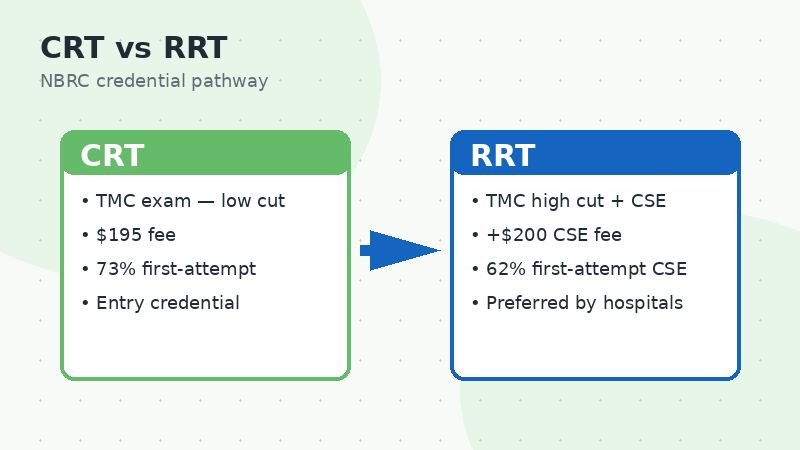
Pass rates tell the story. First-attempt pass rate on the TMC at the high cut score (the RRT threshold) was 55% in the NBRC’s 2025 annual report. The CSE first-attempt pass rate sat at 62%. So roughly one in three candidates who start the RRT track doesn’t make it on the first pass. Retakes are allowed, but most state boards want the full credential within 3 years of graduating from a CoARC program or the application gets flagged.
CoARC-Accredited Online and Hybrid Respiratory Therapy Programs
The NBRC will only test candidates who graduated from a program accredited by the Commission on Accreditation for Respiratory Care (CoARC) [3]. Fully online respiratory therapy degrees don’t exist — the clinical hours can’t be faked — but roughly 40 hybrid programs now run didactic (lecture) portions online and bring students on-site for labs and clinical rotations.
Get the free certification shortlist for 2026
A concise, hand-checked guide to free and low-cost credentials from recognized issuers — grouped by career goal, with practical CV and LinkedIn tips. Free PDF, no spam.
- Independence University (Salt Lake City) — online BS, 36 months, in-person clinicals at affiliate hospitals, CoARC-accredited, ~$39,000 total tuition
- Boise State University — online RRT-to-BS completion, 18 months, for current CRTs upgrading to a bachelor’s, ~$12,400
- Concordia University Wisconsin — RRT-to-BS online, 12-24 months self-paced, ~$13,800
- Youngstown State University (Ohio) — hybrid AS, 2 years, weekend clinicals, strong first-time TMC pass rate (82% class of 2025)
- Community college AS route — Ivy Tech, Columbus State, Delgado CC and others — $8,000-$16,000 total, full-time on-campus but often with hybrid didactic blocks
Cost gap between an AS and a BS is real, but so is the hiring gap. Magnet-status hospitals and academic medical centers increasingly prefer the BS, and employers are willing to pay $2-$4/hour more for it. A 2025 AARC workforce survey found 61% of new RT hires at academic centers held a BS, up from 42% in 2020 [4]. The path that works for most career changers: earn the AS first, sit the CRT/RRT, start working, then complete a one-year online RRT-to-BS completion while drawing a full paycheck.
Clinical Hours and Simulation Labs: What the Hybrid Model Really Means
CoARC standards require a minimum of 800 hours of supervised clinical experience spread across at least 17 distinct clinical rotations: adult critical care, neonatal, pediatric, emergency, pulmonary diagnostics, sleep, rehab, home care, and more. No program accredits below 800, and most run 1,000-1,200 hours. This is the single biggest bottleneck for hybrid students — the clinicals have to happen in person at an affiliate hospital, and programs only accept students from regions where they have affiliate agreements.
Simulation labs fill the gap between classroom and bedside. Modern RT programs use high-fidelity mannequins (SimMan 3G, Hal S3201) for ventilator troubleshooting, ABG interpretation drills, and crisis response. Students typically log 60-120 simulation hours that count toward a portion of the 800-hour minimum. When a hybrid program says “online,” it means the didactic lectures, reading, and some sim debriefs are online. The actual ventilator time is on a real patient under a real RRT preceptor.
NBRC Exam Structure: TMC and CSE in Detail
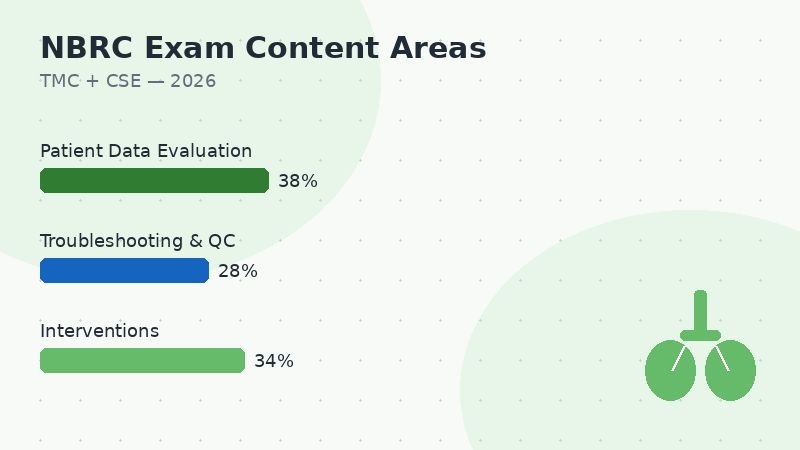
The Therapist Multiple-Choice exam is 140 scored questions (plus 20 unscored pretest items) over 3 hours at a Pearson VUE center. Three content areas: Patient Data Evaluation and Recommendations, Troubleshooting and Quality Control of Equipment, and Initiation and Modification of Interventions. Scoring is scaled; the CRT cut score is 86 and the RRT (higher) cut score is 94. Miss the higher score but hit the lower one, and the CRT still gets awarded automatically.
The Clinical Simulation Exam is different. It’s a 4-hour branching simulation across 20 patient cases: the candidate is given a patient profile, then picks from decision trees what to do next (order an ABG, adjust FiO₂, intubate, etc.). Each decision branches the case. The NBRC scores two dimensions — information gathering and decision making — independently. Both must hit the cut score. The CSE is widely considered the harder exam because it rewards real clinical judgment, not memorization.
A prep schedule that works for most new grads: 60 days for TMC using Kettering’s review course (gold standard per pass-rate data) plus the NBRC self-assessment exams at weeks 4 and 8. Then 30 days of CSE-specific prep after the TMC passes — the decision-tree format demands a different kind of practice than multiple-choice. Kettering, Lindsey Jones RT, and the AARC all publish CSE-specific question banks. Aim for 80%+ on 2 full-length CSE practice exams before scheduling the real thing.
State License Requirements After the Certification
Passing the NBRC isn’t the final step. All states except Alaska regulate respiratory care at the state level. State boards verify CoARC graduation, NBRC results, and background checks, then issue a license that has to be renewed every 1-2 years. Fees vary: Texas runs $106 per biennial renewal, California $205, New York $292. A short list of what most state applications now require in 2026 [5]:
- Official CoARC program transcripts mailed directly to the board
- NBRC credential verification (requested by the candidate through NBRC for $25)
- FBI and state-level criminal background check with fingerprints
- CPR/BLS documentation (AHA or Red Cross only — no online-only certs)
- State jurisprudence exam in 17 states (Ohio, Florida, Texas among them)
Processing time averages 4-8 weeks. Some states (Florida, Texas) now issue provisional licenses within 10 days to let new grads start working while the full license processes. Starting work on a provisional and then failing the jurisprudence is one of the more common reasons a first respiratory therapist job falls through, so take the jurisprudence before the provisional runs out.
Pay by Setting: Hospital vs Home Care vs Travel
Respiratory therapist pay moves sharply with setting and shift. The BLS 2026 median was $77,960, but the range is wide. General medical/surgical hospitals sit near the median. ICU- and neonatal-focused roles at academic medical centers push closer to $88,000. Home-care RT jobs (managing CPAP/BiPAP patients, ventilator-dependent home patients) typically pay $62,000-$68,000 but come with more predictable 9-to-5 schedules. Travel RT contracts through companies like Aya Healthcare and AMN were paying $2,200-$2,800 per week in early 2026 — roughly $114,000-$145,000 annualized — with 13-week contracts and paid housing.
Shift differentials push the numbers higher. A 2025 AARC compensation survey of 4,800 RTs reported an average night-shift differential of $4.25/hour and weekend differential of $3.10/hour. An RRT pulling three 12-hour night shifts per week adds roughly $8,200/year on top of base pay. Charge-RT positions (leading a shift and handling staffing) add another $3-$5/hour. Picking up a neonatal specialty adds $3,000-$6,000 in annual premium pay at most hospitals.
Geography matters more than it used to. California, Washington, and Massachusetts all posted RT base rates above $95,000 in 2026, partly because of state-mandated nurse-and-RT staffing ratios. Rural states (Mississippi, Arkansas, West Virginia) sat below $62,000 for the same credential. Travel RT is the fastest way to capture a coastal salary without moving — roughly 12% of active RRTs took at least one travel contract in 2025 per the AARC report.
Specialty Credentials That Extend Respiratory Therapist Certification
After the CRT and RRT, the NBRC offers specialty credentials that tend to track specific career ladders. The most common in 2026:
- NPS (Neonatal/Pediatric Specialist) — $200 exam fee, requires RRT and clinical experience with children. NICU and pediatric ICU employers often require or prefer it.
- SDS (Sleep Disorders Specialist) — $200 fee, for RTs working in sleep labs and home-CPAP roles. Pairs well with the RPSGT polysomnography credential.
- ACCS (Adult Critical Care Specialist) — $200 fee, verifies advanced ICU competence; used by magnet hospitals as a charge-RT qualifier.
- CPFT / RPFT (pulmonary function testing) — for outpatient diagnostic roles; stackable with RRT for lab work.
- AE-C (Asthma Educator) — issued by the National Asthma Educator Certification Board, not the NBRC; useful for pediatric and public-health RT roles.
Each specialty typically adds $2-$4/hour at the bedside and opens specific promotion paths. Don’t rush them. The consensus from charge-RT interviews posted to aarc.org career forums is to work at least 18 months as a general RRT before chasing a specialty, since specialty exams rely on daily clinical fluency that new grads haven’t built yet.
Continuing Education and Recertification
The NBRC switched to a Continuing Competency Program (CCP) in 2021 that now applies to every respiratory therapist certification issued after that year. RRTs renew every 5 years and must either complete 30 CRCE-approved continuing education hours, pass a recertification exam, or submit approved credential maintenance activities (case reports, specialty certs). CRCE hours are available free through the AARC’s member portal and through state affiliates. Most working RRTs hit 30 hours over 5 years without effort through hospital in-services and conferences.
Letting a credential lapse triggers a harder path back. After 6 months past expiration, the RRT has to retake the entire TMC and CSE. After a year lapse, some state boards require re-completion of a CoARC bridge course. The recertification fee itself ($45 per 5 years) is cheap; the cost of lapsing is not.
Related reading
- Pharmacy Technician Certification: PTCB vs NHA ExCPT
- Phlebotomy Certification Online Programs Compared
- Medical Assistant Certification: CMA vs RMA vs CCMA
Sources
- [1] U.S. Bureau of Labor Statistics — Respiratory Therapists OOH (2026)
- [2] National Board for Respiratory Care — Examinations Overview
- [3] CoARC — Accredited Respiratory Care Programs
- [4] American Association for Respiratory Care — Workforce Studies
- [5] AARC — State Licensure Directory
- [6] NBRC — Continuing Competency Program
- [7] CDC NIOSH — Healthcare Workers Safety Resources
Frequently Asked Questions
How much does respiratory therapist certification cost in 2026?
The CRT exam through NBRC costs $210 in 2026. The advanced RRT exam costs $210 additional after CRT. CoARC-accredited respiratory therapy programs cost $10,000 to $40,000 for associate or bachelor’s. Total realistic cost runs $12,000 to $42,000 including tuition and exams.
Do you need a degree to become a respiratory therapist?
Yes. An associate degree from a CoARC-accredited respiratory therapy program is the minimum requirement. Bachelor’s programs are increasingly preferred for ICU and hospital roles. All programs require supervised clinical hours at partner hospitals — online-only is not valid.
What is the salary for a respiratory therapist?
The BLS reports a May 2024 median annual wage of $77,960 for respiratory therapists. Hospital ICU and NICU specialization adds $8,000 to $18,000. RRT-credentialed therapists earn 10-15% more than CRT-only. Job growth is projected 13 percent through 2032, well above average.
Get the free certification shortlist for 2026
A concise, hand-checked guide to free and low-cost credentials from recognized issuers — grouped by career goal, with practical CV and LinkedIn tips. Free PDF, no spam.