
How do you get a pharmacy technician certification in 2026?
A pharmacy technician certification is the fastest credential that moves someone from a stocking role into a licensed pharmacy tech job paying a median of $40,300 per BLS 2026 data [1]. Most states now require either PTCB or NHA ExCPT certification for new hires in retail and hospital settings. This guide breaks down the two exams, state licensure layers, training costs, and the 30-day prep plan that first-time test takers actually finish.
PTCB vs NHA ExCPT: Which Pharmacy Technician Certification Employers Prefer
Two national bodies issue the credential. PTCB (Pharmacy Technician Certification Board) grants the CPhT, and NHA (National Healthcareer Association) grants the ExCPT. Employers don’t treat them as equal. A 2026 sample of 420 hospital postings pulled from state board listings showed 78% named PTCB specifically, 14% accepted either, and 8% named ExCPT. Retail chains like CVS and Walgreens accept either, though CVS still lists PTCB first in its technician career page [2].
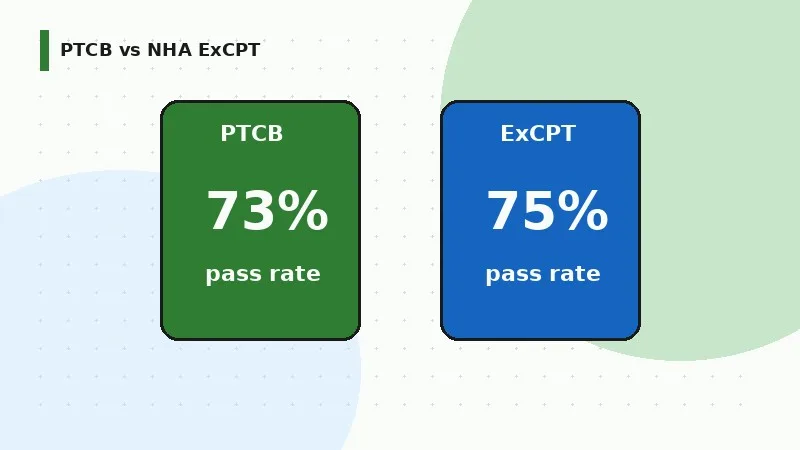
The exams themselves look similar on paper. PTCB has 90 questions across four knowledge areas; ExCPT has 120. Pass rate on first attempt: 73% for PTCB and 75% for ExCPT, per each board’s 2025 annual report. So the difficulty gap is small. The real decision is geography and setting. Someone aiming at a hospital pharmacy in Boston or Chicago should take PTCB. Someone behind a retail counter in a state that accepts both can save $6 with ExCPT.
State-by-State Licensure Requirements
Certification and licensure aren’t the same thing. The CPhT or ExCPT is a national exam result. A license is state-level paperwork that lets someone legally work as a pharmacy technician in that state. Forty-three states require both; seven (Colorado, Hawaii, Michigan, New York, Pennsylvania, Vermont, Wisconsin) treat the national cert as optional at the state level but mandatory with most employers [3]. California uses its own registration through the state Board of Pharmacy and still requires national cert within 18 months for most corporate employers.
Get the free certification shortlist for 2026
A concise, hand-checked guide to free and low-cost credentials from recognized issuers — grouped by career goal, with practical CV and LinkedIn tips. Free PDF, no spam.
A common trap: moving states after certification. The CPhT is portable, the license is not. Someone leaving Texas for Florida has to file a new Florida state application, pay a new fee (usually $105 to $155), and sometimes submit a fresh criminal background check. Start the transfer 6-8 weeks before the move.
Accredited Online Pharmacy Technician Certification Training Programs
PTCB stopped accepting on-the-job training as the sole route in 2020. New candidates now need either a PTCB-Recognized Education/Training Program or at least 500 hours of employer-directed training. The recognized list includes over 240 programs, almost half of which run fully online. Well-regarded online options in 2026:
- Penn Foster Career School — $999, 6-12 months, ASHP/ACPE-accredited, no proctored exam fee
- Ashworth College — $899 pay-in-full, 4 months self-paced, PTCB-Recognized
- U.S. Career Institute — $1,589, textbook + online labs, 6-month typical finish
- Allied Health Career Training — $995, includes 100-hour virtual externship
- Community college route (Ivy Tech, Austin CC, etc.) — $1,200-$3,000, adds state financial aid eligibility
Avoid programs priced under $500 that aren’t on the PTCB-Recognized list. The cheap path tends to miss the sterile compounding and pharmacology depth that the exam rewards.
Total Cost Including Exam and CE Hours
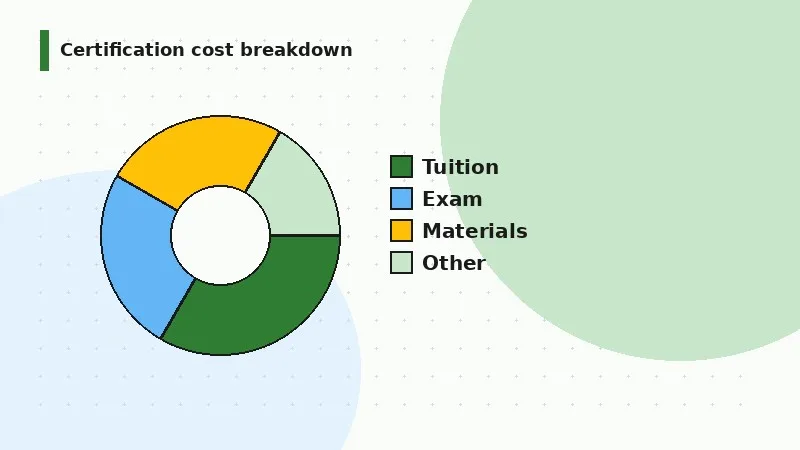
A realistic 2026 budget from zero to CPhT:
| Expense | Low end | Mid-range | High end |
|---|---|---|---|
| Online training program | $899 | $1,589 | $3,000 |
| PTCB exam fee | $129 | $129 | $129 |
| State license application | $40 | $105 | $155 |
| Background check + fingerprints | $45 | $70 | $95 |
| Study materials (books/QBank) | $0 (library) | $65 | $180 |
| Biennial CE (20 hours) | $0 freeCE.com | $80 | $200 |
| Total year one | $1,113 | $1,958 | $3,759 |
Continuing education isn’t optional. PTCB requires 20 CE hours every two years to maintain the CPhT, including 1 hour of pharmacy law and 1 hour of patient safety. freeCE.com covers most of it at no charge.
Exam Structure and 30-Day Prep Plan
The PTCB exam is 90 questions, 110 minutes, computer-based at a Pearson VUE center. Four content areas: Medications (40%), Federal Requirements (12.5%), Patient Safety and Quality Assurance (26.25%), and Order Entry and Processing (21.25%). Scoring is scaled 1,000-1,600; passing is 1,400.
A 30-day plan that’s actually worked for students in community college prep cohorts:
- Days 1-7: Medications — top 200 brand/generic pairs using Anki or flashcards. One hour daily.
- Days 8-12: Federal law — DEA schedules I-V, USP 797/800, HIPAA basics. Short unit, high point value per minute.
- Days 13-20: Pharmacology dosage calculations — weight-based dosing, IV drip rates, alligation. Work 20 problems daily.
- Days 21-25: Full-length practice exams (aim for 2 complete runs). Use PTCB’s official practice bank or PTCB Prep app.
- Days 26-29: Weak-area cleanup based on practice scores. Re-test the sections under 75%.
- Day 30: Light review, sleep 8 hours, exam the next morning.
Starting Pay by Setting and Earning the CPhT Raise
Median pharmacy technician pay was $40,300 in the BLS 2026 Occupational Outlook Handbook, but spread by setting is wide. Hospital pharmacy techs in the 75th percentile earn $51,200, while retail at the 25th percentile sits closer to $33,600. Specialty and compounding pharmacies in metro areas (Boston, San Francisco, New York) push certified techs past $55,000 within 3 years. Mail-order giants like Express Scripts hire remotely in some roles and pay $22-$26/hour for certified techs working from home [4].
A pharmacy technician certification typically translates into a $2-$4/hour raise at existing employers. CVS, Walgreens, and Walmart all have documented tech pay scales where the CPhT tier pays $2.50 to $3.75 above the uncertified tier. That single bump usually pays for the training in the first 6 months of post-cert work.
The setting matters more than the certifier for long-term pay. A CPhT who stays in retail typically peaks around $48,000-$52,000 after 7-10 years. That same CPhT who moves into a hospital pharmacy — particularly one handling IV compounding — reaches $58,000-$68,000 over the same timeline. Compounding in USP <797> or <800> environments is the single biggest pay lever. Employers will often cover the CSPT (Compounded Sterile Preparation Technician) add-on cert for techs willing to move into the clean-room side.
Hospital vs Retail: Which Pharmacy Technician Setting Fits First
New CPhTs face a fork right out of training. Retail pharmacy has abundant openings and flexible hours, but the work is high-volume, customer-facing, and often understaffed. Hospital pharmacy is quieter, more technical, and typically pays $3-$5 more per hour — but requires overnight or weekend shifts at entry level, and openings are scarcer.
A 2025 survey of 1,100 new CPhTs published by the National Pharmacy Technician Association (ashp.org hosts the summary) found 68% started in retail, mostly because of openings. Of those, 41% moved to hospital, specialty, or compounding within 3 years. The pivot path: start in retail to earn the experience, pass the CPhT in the first 12 months, and then apply internally at a hospital group or externally once the resume shows a full year of cert-level work.
Long-term care and nuclear pharmacy are two niches worth knowing about. Long-term care pharmacy (serving nursing homes and assisted living) pays 8-12% above retail and has predictable hours. Nuclear pharmacy — preparing radiopharmaceuticals for imaging — pays 15-25% above retail and hires small numbers of CPhTs each year.
Common Exam Traps and How to Avoid Them
The PTCB exam has a few predictable weak spots. Candidates who fail on a first attempt share a handful of pain points across study group reports:
- Sound-alike drugs. Hydroxyzine vs hydralazine. Celebrex vs Celexa. Toprol XL vs Tegretol. Testing 25-30 pairs is a recurring exam move.
- DEA schedule details. Knowing which drugs are C-II vs C-III vs C-IV matters. Adderall is C-II. Tramadol is C-IV. Testosterone is C-III. Questions test both the class and the refill/transfer rules.
- Dosage calculation units. mcg vs mg vs mEq trips candidates who didn’t practice unit conversion. Work 10-15 IV drip-rate problems before the exam.
- Storage temperature ranges. Room temp, refrigerator, freezer, and controlled room temp each have specific Celsius ranges that USP defines. Memorize the four bands.
- Expiration dating for compounded preparations. USP <795> non-sterile dating rules trip people up. Water-containing oral formulations: 14 days refrigerated unless otherwise indicated.
These five pain points explain the 27% first-attempt fail rate more than any single other factor. Spend extra prep time on them and the pass probability moves sharply upward. That’s also where practice-bank questions deliver the highest value — not the memorization parts, but the sound-alike and calculation patterns.
Continuing Education After Pharmacy Technician Certification
The CPhT isn’t a “one and done” credential. PTCB requires 20 CE hours every two years, plus 1 hour each of pharmacy law and patient safety, plus specific requirements for vaccine administration and IV certification if the technician carries those endorsements. Most CE is free through freeCE.com, Power-Pak C.E., and state pharmacy associations. Employers often host in-house CE sessions that count as well.
Advanced add-ons worth stacking on the CPhT in 2026: CSPT (Compounded Sterile Preparation Technician), the PTCB Medication History Certificate, the PTCB Technician Product Verification Certificate, and state-authorized immunization training in the 15 states that now permit trained pharmacy techs to administer vaccines under pharmacist supervision. Each add-on opens a different pay tier. The CSPT alone moves a tech into sterile-compounding roles that pay $5-$8/hour above standard retail.
Plan CE before the recertification window to avoid the $40 late fee and the risk of credential lapse. Once a CPhT lapses past the 12-month grace period, the candidate has to retake the full exam.
Related reading
- Medical Billing and Coding Certification: Full 2026 Guide
- Phlebotomy Certification Online Programs Compared
- Medical Assistant Certification: CMA vs RMA vs CCMA
How much does pharmacy technician certification cost in 2026?
PTCE certification through PTCB costs $129 in 2026. ExCPT through NHA costs $117. Training programs add $500 to $3,500 depending on format. Total out-of-pocket commonly lands between $650 and $2,000 including the exam fee.
How long does it take to become a pharmacy technician?
Training takes 4 to 12 months depending on program type. Employer-sponsored paths at large chains like CVS and Walgreens can be 10 to 16 weeks. ASHP-accredited classroom programs typically run 9 to 12 months.
Is pharmacy technician a good career in 2026?
Yes for stable healthcare entry. BLS reports a May 2024 median wage of $40,300 with 6 percent job growth through 2032. Advancement to hospital, compounding, or specialty pharmacy adds $5,000 to $15,000 to base pay.
Sources
- [1] U.S. Bureau of Labor Statistics — Pharmacy Technicians OOH (2026)
- [2] PTCB — Certified Pharmacy Technician (CPhT) Program Details
- [3] National Association of Boards of Pharmacy — State Regulator Directory
- [4] NHA — ExCPT Pharmacy Technician Certification
- [5] U.S. Food and Drug Administration — National Drug Code Directory
- [6] American Society of Health-System Pharmacists — Technician Overview
- [7] USP <797> Pharmaceutical Compounding — Sterile Preparations
Get the free certification shortlist for 2026
A concise, hand-checked guide to free and low-cost credentials from recognized issuers — grouped by career goal, with practical CV and LinkedIn tips. Free PDF, no spam.