
A radiologic technologist certification from the American Registry of Radiologic Technologists (ARRT) is the credential most U.S. employers treat as non-negotiable for hiring an X-ray technologist in 2026. This guide walks through the education path, the JRCERT-accredited programs that feed into it, clinical hour minimums, total out-of-pocket cost, the ARRT exam, and the post-credential specialty paths that push pay above the $73,410 BLS median [1].
ARRT Radiologic Technologist Certification Requirements in 2026
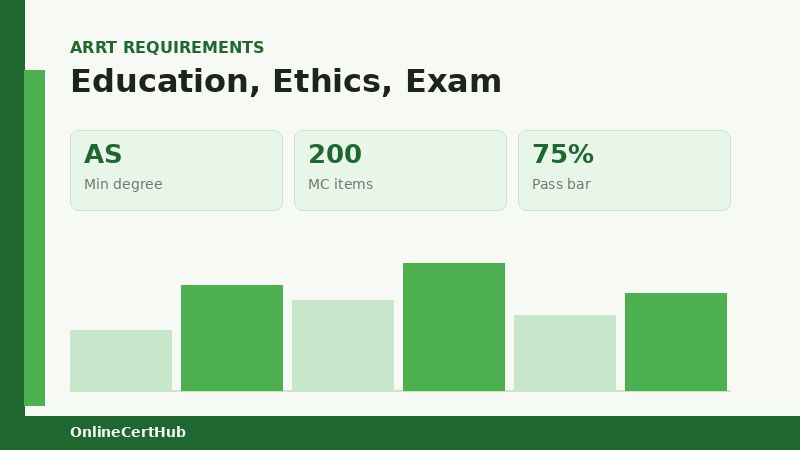
The American Registry of Radiologic Technologists is the primary certifying body. An ARRT credential in Radiography (R) is what most state licensing boards, hospitals, and imaging centers look for in 2026. The 2026 requirements break into three buckets: education, ethics, and the exam [2].
Education — a candidate must complete an ARRT-recognized radiography program. That effectively means a JRCERT-accredited associate degree, though ARRT accepts a few certificate-level programs tied to accredited hospitals. The 2026 ARRT Didactic and Clinical Competency Requirements document lists 37 mandatory procedures students must perform, plus 31 electives of which they choose 15 [2]. A bachelor’s degree isn’t required for entry-level certification but is increasingly preferred by academic medical centers.
Ethics — ARRT reviews every applicant’s history for misdemeanor or felony convictions, honor-code violations, and prior disciplinary action. About 4% of applicants face a pre-application review. Most clear it with documentation [2].
Exam — a computer-based test with 200 scored multiple-choice items across five sections (patient care, safety, image production, procedures, and equipment). The passing scaled score is 75. It’s offered at Pearson VUE centers year-round, and candidates have three attempts within three years of finishing an eligible program [2].
Get the free certification shortlist for 2026
A concise, hand-checked guide to free and low-cost credentials from recognized issuers — grouped by career goal, with practical CV and LinkedIn tips. Free PDF, no spam.
JRCERT Accredited Online and Hybrid Programs
The Joint Review Committee on Education in Radiologic Technology (JRCERT) is the programmatic accreditor ARRT recognizes. In 2026, there are about 600 JRCERT-accredited radiography programs in the U.S. [3]. “Online” is a misnomer in this field — rad tech is a hands-on clinical profession, so programs that bill themselves as online are really hybrid: didactic coursework is online, but 1,500-2,100 hours of clinical rotations happen in person at affiliated hospitals and imaging centers.
Popular hybrid programs in 2026 include those at Weber State University (UT), Indiana University, Pima Medical Institute, and Kettering College. Tuition at public in-state schools runs $6,000-$12,000 total; private and for-profit programs run $15,000-$35,000. A JRCERT program typically takes 22-24 months for full-time students. Bridge programs for certified Limited Medical Radiologic Technologists (LMRTs) compress that to 12-18 months.
It’s worth noting ARRT also certifies pathways through military training (Army/Navy/Air Force radiography schools) and through accredited bachelor’s-completion programs for currently-certified techs.
Clinical Hour Minimums by State
ARRT itself doesn’t specify an exact clinical hour count, but JRCERT-accredited programs must demonstrate that students achieve competency across the 37 mandatory procedures. In practice, accredited programs document 1,500-2,100 clinical hours over the length of the program [3]. State licensure laws add another layer — 40 U.S. states require a state license separate from the ARRT credential, and some set higher clinical hour floors.
California, New York, and Texas each run the most prescriptive licensing boards. California’s Certified Radiologic Technologist license requires ARRT certification plus an additional state fluoroscopy and radiation safety exam. New York requires 24 continuing education credits every two years. Texas accepts ARRT certification directly but adds a state-specific jurisprudence exam. Four states — Alabama, Idaho, Missouri, North Carolina — still don’t require state licensure at all; ARRT certification alone is enough to work in those markets [2].
Students selecting a program should verify that the clinical sites rotate through at least one Level 1 or Level 2 trauma center. Trauma exposure is where most graduates log the portable radiography and fluoroscopy competencies that ARRT weights heavily on the exam.
Total Cost Including Exam and Background Check
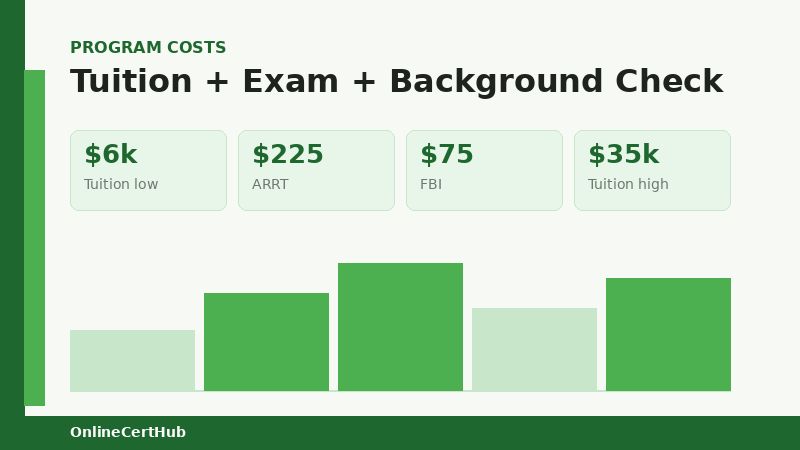
The sticker price of a radiologic technologist certification can surprise candidates. Program tuition is the biggest line item, but it’s not the only one. Here’s the realistic 2026 cost breakdown from ARRT’s published fee schedule [2] and 2026 program tuition averages:
- Program tuition: $6,000 (public in-state) to $35,000 (private, for-profit).
- ARRT Radiography exam: $225 (retake fee $200 if a second attempt is needed).
- FBI fingerprint background check: $75-$120 depending on state.
- Clinical uniforms + lead markers: $150-$300.
- Required textbooks + online exam prep: $400-$800.
- Professional liability insurance during clinical: $35-$60 per year.
- TB test, MMR titers, Hep B series: $0-$400 depending on insurance coverage.
- State licensure application (if applicable): $75-$250 one-time.
- Biennial ARRT renewal: $40 plus 24 CE credits every 2 years.
A public in-state program with full insurance coverage can land a candidate a credential for under $8,000 all-in. A private for-profit student in a licensure-heavy state can clear $37,000. ARRT offers no financial aid of its own, but Title IV federal aid covers accredited programs. WIOA and state workforce boards also reimburse completions in most healthcare-priority states [4].
Specialties After Certification: CT, MRI, Mammography
Base ARRT Radiography certification qualifies someone for general X-ray work. The pay lift comes from post-primary certifications. ARRT offers post-primary credentials in nine areas: Computed Tomography (CT), Magnetic Resonance Imaging (MRI), Mammography (M), Vascular-Interventional Radiography, Cardiac-Interventional Radiography, Sonography, Breast Sonography, Quality Management, and Bone Densitometry [2].
Each post-primary credential requires documented clinical experience (usually 125-200 procedures logged under supervision) plus a separate ARRT exam ($225 each). Completion typically takes 6-18 months of supervised on-the-job training after the initial Radiography credential.
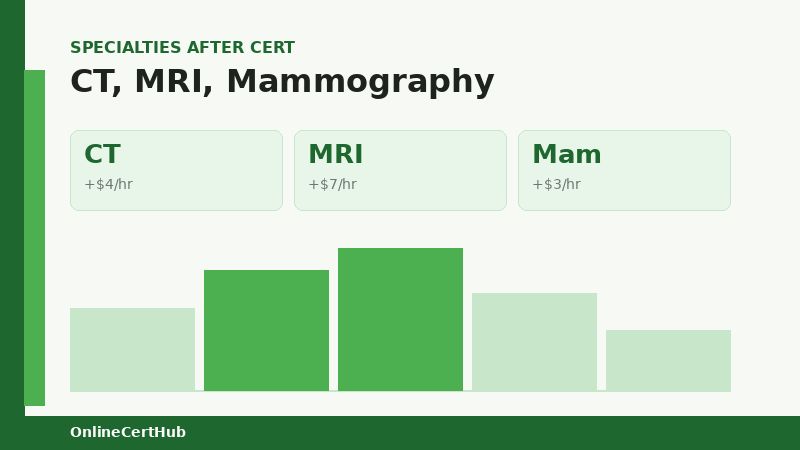
The three highest-return specialties in 2026 data are CT, MRI, and Mammography. CT certification pushes median pay roughly $4/hour higher than general radiography. MRI is the highest-margin specialty — the 2026 ASRT salary survey shows MRI-certified techs earning a median $34.80/hour versus $27.60/hour for Radiography-only [5]. Mammography adds roughly $3/hour and is the most portable between outpatient imaging centers and hospital systems.
Nuclear Medicine Technology (NMT) is a sister certification under the Nuclear Medicine Technology Certification Board, not ARRT. Techs crossing into NMT add a separate 12-24 month pathway.
Pay Progression and Shift Differentials
BLS OOH data for Radiologic Technologists shows a 2026 median annual wage of $73,410, with the top 10% clearing $104,350 [1]. These are base-rate figures. Most hospital radiography roles layer on meaningful shift differentials that the BLS number doesn’t capture.
Typical 2026 hospital differentials: +$3-$5/hour for evening shifts (3 p.m. to 11 p.m.), +$5-$8/hour for overnight (11 p.m. to 7 a.m.), +$7-$12/hour for weekend coverage, and time-and-a-half for federal holidays. A tech working three 12-hour overnight weekend shifts can clear $95,000+ in a moderate-cost U.S. market. Travel rad tech roles pay $2,200-$3,400 weekly during shortages, though those rates compressed 18% between 2024 and 2026 as post-pandemic contract demand cooled [5].
Outpatient imaging centers pay less base but offer Monday-to-Friday schedules. Mobile radiography contractors (nursing homes, skilled nursing facilities) pay hourly plus per-study incentives. Military radiography roles (Army 68P, Navy HM, Air Force 4R0X1) pay below civilian base but add housing allowances and GI Bill education benefits that often outweigh the pay gap over a four-year term.
Union hospitals in the Northeast and Pacific Coast add another premium on top. A unionized tech at Kaiser Permanente in Northern California or NewYork-Presbyterian in Manhattan typically sees contracted step-raises each year plus employer-paid pension contributions. The median total compensation (base + differentials + pension value) for a 5-year union tech in those two markets crossed $118,000 in 2026 per ASRT data [5]. Non-union imaging-center roles in the same metros sit roughly $22,000 lower for equivalent experience.
Geographic arbitrage matters too. BLS OOH reports the top-paying metro for radiologic technologists in 2026 as San Francisco-Oakland-Hayward at a mean $117,910, followed by Vallejo-Fairfield at $114,450 and San Jose-Sunnyvale-Santa Clara at $112,680 [1]. The lowest mean wages for radiologic technologist roles show up in Louisiana, West Virginia, and Mississippi metros, clustering around $58,000 for a standard day-shift position. A credential-holder willing to relocate across state lines can often bank 20-30% more base pay in year one, though cost-of-living swings offset part of that gap.
Common Mistakes Chasing a Radiologic Technologist Certification
Four mistakes show up repeatedly in candidate outcome data. The first is enrolling in a non-JRCERT program to save tuition. Non-accredited programs don’t make a candidate ARRT-eligible. A cheaper program that doesn’t feed ARRT is a wasted 24 months.
The second is underweighting state licensure rules. A candidate who trains in California expecting to work in Texas needs to check Texas jurisprudence-exam requirements before relocating. Most of this information sits on state health board websites, not on the program’s admissions page.
The third is skipping the post-primary specialty planning. Graduates who don’t have a 12-18 month post-primary plan (which specialty, which certification exam, how to log clinical hours) tend to stall at the base radiography pay band. The ones who pick CT or MRI within their first year of practice typically cross $95,000 total compensation by year three.
The fourth is missing the ethics pre-review. Any misdemeanor in the past 10 years triggers an ARRT pre-application review. Filing the pre-review early (before program enrollment) avoids the surprise of finishing a program and then learning ARRT won’t issue the credential.
Frequently Asked Questions
How much does radiologic technologist certification cost in 2026?
The ARRT exam costs $200 in 2026. Required JRCERT-accredited radiography programs cost $10,000 to $35,000 depending on format (community college vs. private). Total realistic cost including tuition, fees, exam, and scrubs runs $12,000 to $40,000.
How long does it take to become a radiologic technologist?
JRCERT-accredited programs take 24 months for associate degree or 48 months for bachelor’s. All include 1,200+ clinical hours at partner hospitals. Online-only programs are not valid — ARRT requires in-person clinical training for certification eligibility.
What is the salary for a radiologic technologist?
The BLS reports a May 2024 median annual wage of $76,020 for radiologic technologists. Specialization in CT, MRI, or mammography adds $5,000 to $15,000. Experienced techs in high-cost metros reach $95,000 to $115,000. Job growth is projected 6 percent through 2032.
Get the free certification shortlist for 2026
A concise, hand-checked guide to free and low-cost credentials from recognized issuers — grouped by career goal, with practical CV and LinkedIn tips. Free PDF, no spam.