
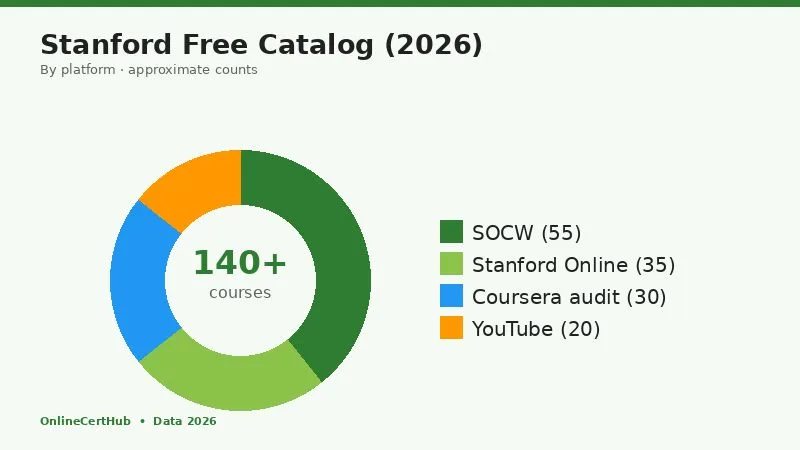
The catalog of verified free Stanford online courses in 2026 is larger than most learners realize: 140+ entirely free classes across Stanford Online, Stanford OpenCourseWare (SOCW), and Coursera’s Stanford partner space. Most never require a credit card; a few offer a cheap verified certificate if a learner wants proof of completion. The trick is separating truly free Stanford content from audit-only courses that require payment to finish.
Stanford Online vs Stanford OpenCourseWare
Two Stanford platforms host the free catalog, and they serve different purposes. Stanford Online is the official platform run by the Stanford Center for Professional Development (SCPD). It hosts both paid graduate-level professional courses and free public courses. The free section is relatively small but includes flagship lecture series like “How to Start a Startup” (with Paul Graham and Sam Altman) and several free technical courses tied to engineering research [1].
Stanford OpenCourseWare (SOCW) is a separate archive that hosts complete course materials — syllabi, lecture notes, problem sets, sometimes video — for classes actually taught on campus. SOCW isn’t as polished as MIT OpenCourseWare, but the content runs deep. CS229, CS231n Convolutional Neural Networks, and Stats 116 Probability live here with every slide and problem set available for free download. No registration required.
20 Free Stanford Courses Ranked
Ranked roughly by combined quality of material, completeness, and career relevance in 2026. Starred entries are the ones most learners should actually start with. CS229 Machine Learning (★), CS231n Convolutional Neural Networks for Visual Recognition (★), CS224n Natural Language Processing with Deep Learning (★), Stats 116 Theory of Probability, CS106A Programming Methodology (★), CS107 Programming Paradigms, Stanford Webinars (various professional topics), “How to Start a Startup” lecture series (★), Algorithms: Design and Analysis Part 1 and 2 (Tim Roughgarden, Coursera audit), Game Theory (Matt Jackson, Coursera audit), Introduction to Mathematical Thinking (Keith Devlin, Coursera audit), Cryptography I, Machine Learning (Andrew Ng, the original pre-CS229 Coursera version).
Get the free certification shortlist for 2026
A concise, hand-checked guide to free and low-cost credentials from recognized issuers — grouped by career goal, with practical CV and LinkedIn tips. Free PDF, no spam.
Also worth noting: Stanford Online’s “Technology Entrepreneurship,” “Designing Your Life,” and Stanford Graduate School of Business short lectures on YouTube. The Stanford Social Innovation Review publishes free monthly articles and occasional lectures. For humanities learners, Stanford’s Continuing Studies program opens a few free webinars each quarter, but most of that catalog is paid [2].
Free vs Paid: Certificate Options
Stanford does not issue free certificates for free courses. That single fact trips up most first-time learners who expect “free Stanford course” to also mean “free Stanford certificate.” For a verifiable Stanford-branded credential, the only realistic paths are paid Coursera Specializations ($49-$79 per course, verified certificate), paid Stanford Online Graduate Certificates ($3,000-$20,000 total), or stacked Stanford Professional Certificate programs (typically $3,000+ each) [1].
- Want to learn machine learning at graduate depth for free → CS229 on YouTube + SOCW notes.
- Want a verifiable Stanford certificate on LinkedIn → pay $49-$79 per Coursera course (not free, but cheapest route).
- Want the “feels like I’m at Stanford” experience without credit → Stanford OpenCourseWare (full course pack, no badge).
- Want free entrepreneurship content → “How to Start a Startup” lecture series on YouTube (Paul Graham, Sam Altman, Ron Conway).
- Want Coursera-style graded exercises for free → audit is possible for individual Stanford Coursera courses, but graded assignments lock without payment.
- Want to actually transfer credit to a degree → only Stanford’s paid graduate programs qualify; no free course earns transferable credit.
Prerequisites and Difficulty Warnings
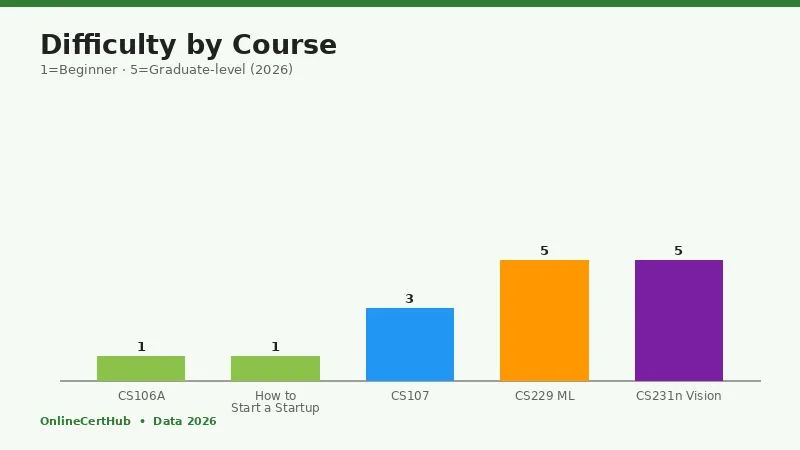
The same free Stanford Online catalog that delights career-changers also humbles them. CS229 assumes calculus, linear algebra and comfort with Python by week 2. CS231n expects the same plus prior exposure to CS229 material. CS224n’s deep learning material requires comfort with PyTorch and backpropagation math. None of these ship with gentle on-ramps — Stanford designed them for PhD students, and the free versions expose that design fully.
For complete beginners, CS106A Programming Methodology is the safest first step. It assumes zero prior programming and uses Karel-the-Robot plus Java to teach basic computational thinking. From there, learners can move to CS107 for systems-level content or to CS229 after completing Andrew Ng’s gentler Coursera Machine Learning Specialization first. Anyone starting at CS229 without the math background will stall by week 3 [2].
How to Get Academic Credit (Rare But Possible)
Free Stanford course content does not grant academic credit. No exceptions. The only Stanford programs that award transferable credit are paid: the Stanford Online Graduate Certificate programs (credit-bearing, $3,000-$20,000 total), the Stanford Summer Session (open to non-Stanford students, credit-bearing, $9,000+ for a 3-unit class), and formal matriculated degree programs [1]. Anyone seeing a claim that a free Stanford course transfers to a degree is reading marketing copy from a third-party aggregator, not an official Stanford source.
The closest legitimate workaround is Stanford’s Honors Cooperative Program (HCP) for working professionals, which lets employees at partner companies take Stanford graduate courses part-time while working. HCP isn’t free — it’s full Stanford tuition ($1,400+ per unit) — but the courses do apply toward a Stanford master’s degree if the student is later admitted as a full graduate student. For most learners, the free Stanford courses are best used as high-quality content rather than credit pathways.
Stanford Free Courses vs Coursera Stanford Specializations
The Coursera Stanford partnership creates confusion. Stanford professors teach several popular Coursera courses (Andrew Ng’s original Machine Learning, Tim Roughgarden’s Algorithms, Matt Jackson’s Game Theory), but these are Coursera products delivered by Stanford faculty, not free Stanford courses. Audit mode is available on most, which unlocks lectures and readings for free but hides graded quizzes and peer-reviewed assignments [3].
For the full graded experience including the verified certificate, learners pay Coursera pricing ($49-$79 per course, or $49/month via Coursera Plus). The Stanford MOOC catalog on Coursera is excellent, but it isn’t equivalent to a Stanford degree course. SOCW and YouTube versions of CS229, CS231n and CS224n are closer to what Stanford students actually see in class.
Related reading
- Free Harvard Online Courses: Verified 2026 List
- MIT OpenCourseWare Guide: Best Free Courses to Start With
- Best Free Online Courses With Real Career Impact in 2026
Sources
- [1] Stanford Online — Free Courses Directory (2026)
- [2] Stanford University — Academic Programs Hub (2026)
- [3] Coursera — Stanford University Partner Page
- [4] Class Central — Stanford University Course Aggregator
- [5] Stanford Engineering Everywhere — Legacy Free Course Archive
- [6] Stanford CS229 — Machine Learning Course Materials
Frequently Asked Questions
Which Stanford courses are free online in 2026?
Stanford offers free online courses via Stanford Online (CS229 Machine Learning, CS224N NLP, Algorithms), Coursera (Machine Learning by Andrew Ng, free audit), and Stanford YouTube channels. Over 40 courses are free to audit; verified certificates cost $49 to $149 per course.
Are Stanford free online courses accredited?
Stanford’s free audit tracks are not for academic credit but provide the same lecture content as on-campus courses. For academic credit, Stanford offers graduate-level certificate programs through Stanford Center for Professional Development starting at roughly $4,000 per course.
How do Stanford free courses compare to MIT or Harvard free courses?
Stanford is stronger in AI, machine learning, and entrepreneurship free content. MIT OpenCourseWare is broader across STEM and historical. Harvard’s free offerings via edX lead in business, CS50, and humanities. Learners often mix all three: Stanford for ML, MIT for math, Harvard for CS fundamentals.
Get the free certification shortlist for 2026
A concise, hand-checked guide to free and low-cost credentials from recognized issuers — grouped by career goal, with practical CV and LinkedIn tips. Free PDF, no spam.