
The Google Data Analytics Certificate costs $294 if you finish in 6 months at the standard $49/month Coursera pace. The honest question is whether that $294 plus 180 hours of your time turns into a real junior data analyst job — or whether you end up with a PDF and the same job hunt as before. This guide runs the actual numbers: total cost, BLS-projected demand, median salary uplift, payback period, and what the certificate alone won’t do for you.
Related: the complete Google Career Certificates guide — every track compared by cost, hours and entry salary.
At the Coursera-published six-month completion pace, the Google Data Analytics Certificate cost totals about $294.
Fast finishers cut the Google Data Analytics Certificate cost to $147 by completing the nine courses in three months.
Against that Google Data Analytics Certificate cost, the BLS has no separate data analyst category; the closest one, data scientists, had a median wage of $120,230 in May 2025, and entry-level analyst jobs pay less than that.
The Google Data Analytics Certificate cost can also be covered by financial aid on Coursera for learners who qualify.
Get the free certification shortlist for 2026
A concise, hand-checked guide to free and low-cost credentials from recognized issuers — grouped by career goal, with practical CV and LinkedIn tips. Free PDF, no spam.
The Google Data Analytics Certificate has one of the clearest “should I pay for it?” arithmetic problems in the certification market. The course is on Coursera, the subscription is $49 per month in the U.S. and Canada, Coursera says most learners finish in under six months, and the salary uplift is measurable in BLS and Coursera’s own reporting. The question isn’t whether the credential is “good” — it’s whether the Google Data Analytics Certificate cost pays back fast enough to matter against the alternatives.
This post runs the actual numbers: tuition vs. expected wage lift, time-to-payback in months, and how the math compares against the free path (no certificate, same curriculum). There’s a Python ROI calculator at the end that takes salary, expected lift, and months-to-complete, and returns the break-even date.
What the certificate actually costs
The Google Data Analytics Professional Certificate is sold through Coursera as a monthly subscription: $49 per month in the U.S. and Canada after a 7-day free trial (prices differ in other countries). There’s no single “lump sum” — you pay monthly until you finish, then cancel. That makes the total Google Data Analytics Certificate cost a function of how fast you complete it.
| Completion pace | Months | Total cost | Realistic for |
|---|---|---|---|
| Aggressive (10+ hr/week) | 3 months | $147 | Career-changer with full-time study time |
| Coursera’s estimate | 6 months | $294 | Full-time worker, evenings + weekends |
| Slow (4-6 hr/week) | 9 months | $441 | Parents, full-time job + commute |
| Stretched | 12 months | $588 | Inconsistent schedule, lots of pauses |
Coursera says most learners finish in under six months at under 10 hours a week, so most pay less than $300 [1]. That’s not the only way to access the content. The 7-day free trial covers the first week’s lessons. Coursera Financial Aid is available for this certificate; approved learners pay nothing for the courses it covers. Employer tuition reimbursement is the third common route.
Hidden line items
- BigQuery sandbox: Free tier is sufficient for the Capstone project. Some learners overrun it and hit a $5-$15 charge.
- Tableau Public: Free.
- Python: Free.
- Optional: Google Workspace upgrade for shareable Sheets: $6/month if you want commenter-friendly portfolio links. Not required.
How long it really takes (median vs. fast track)
Coursera lists the certificate as “over 180 hours” of instruction across 9 courses. That maps to:
- ~10 hours/week → 18 weeks (4.5 months)
- ~7 hours/week → 26 weeks (6 months)
- ~4 hours/week → 45 weeks (10+ months)
The “180 hours” figure assumes someone is genuinely new to spreadsheets, SQL, Python, and data viz. Candidates with prior Excel competence routinely finish in 100-120 actual hours by skimming Course 1 (foundations) and Course 2 (asking questions). Candidates with prior SQL exposure can compress Courses 4-5 substantially.
The wage lift: what the data shows
Google’s program graduate survey (United States, 2022) found that 75% of certificate graduates reported a positive career outcome within six months of finishing — a new job, promotion, or raise [1]. It is self-reported, and it does not say how much pay went up.
BLS data tells a parallel story. The Occupational Outlook Handbook has no separate category for data analysts. The closest one, data scientists, had a median wage of $120,230 in May 2025 [3]; that includes experienced staff, so entry-level analyst jobs pay less. If a candidate is moving from a $42K admin or customer support role into a $65K analyst role, the lift is $23K in the first year — and recurring.
The honest qualifier: the survey counts any positive outcome, not only analyst jobs, and it does not isolate the certificate. Hiring managers still look for portfolio projects and SQL practice beyond the course, so plan for both.
Free and paid alternatives
| Path | Total cost | Trade-off vs. Google certificate |
|---|---|---|
| Self-study (Mode SQL + Kaggle + free Tableau training) | $0 | Saves $294 but requires self-discipline; no completion credential |
| IBM Data Analyst Professional Certificate (Coursera) | $294 (6 mo) | Similar curriculum (both teach Python), less Sheets/Tableau |
| Microsoft Power BI Data Analyst (Coursera) | $294 (6 mo) | Power BI instead of Tableau; better for finance/consulting paths |
| DataCamp Data Analyst track | $300-$420/yr | Hands-on browser exercises; weaker capstone |
| Bootcamp (Springboard, BrainStation) | $7,500-$16,000 | 1:1 mentor + job guarantee but 25-50x the cost |
Payback period math
Payback period = total cost ÷ monthly wage lift. Two examples:
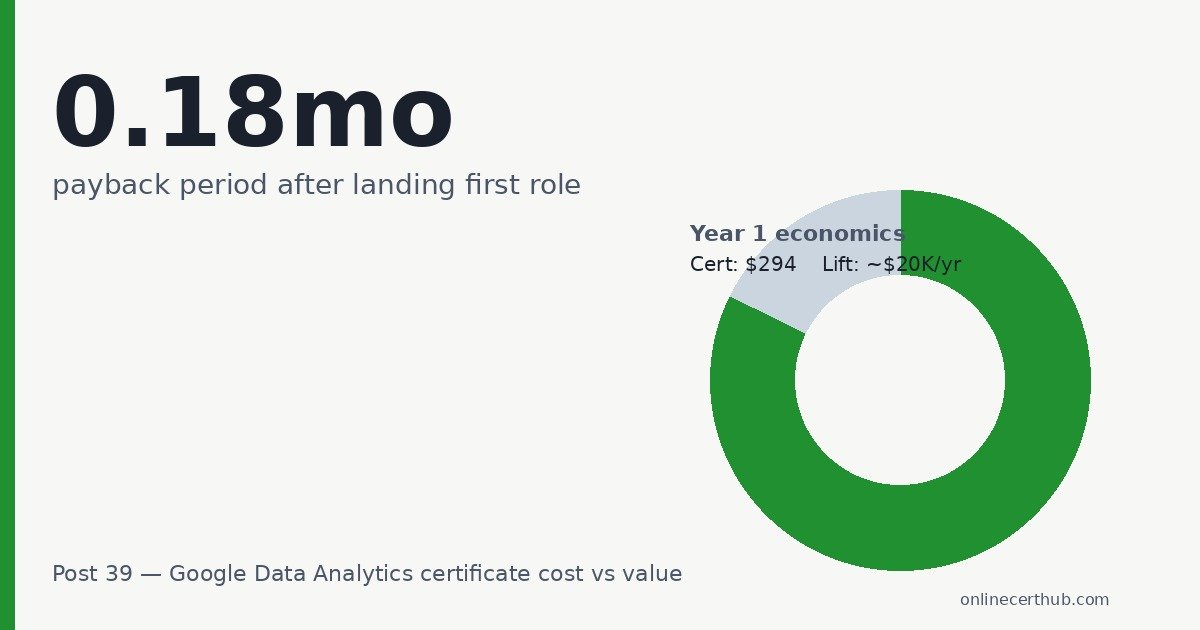
- Career changer A: Pre-cert salary $40K. Post-cert role $60K. Annual lift $20K → monthly $1,667. Total cost $294. Payback = $294 / $1,667 = 0.18 months (about 5-6 days of post-job income).
- Career changer B: Pre-cert salary $55K. Post-cert role $65K. Annual lift $10K → monthly $833. Total cost $441. Payback = $441 / $833 = 0.53 months (about 16 days).
This is a deliberately rosy framing — it ignores the months between starting the certificate and starting the new job. A more realistic framing: total opportunity cost = certificate cost + lost salary during the search. Even at 6 months of search time at $40K/year, the math still pencils out within the first year on the new job.
Python ROI calculator
This calculator computes payback period and 3-year cumulative return given certificate cost, expected annual salary lift, months to complete, and months to land a job.
# google_da_cert_roi.py
# Compute payback period and 3-year ROI for the
# Google Data Analytics Certificate.

MONTHLY_PRICE = 49  # USD per month (U.S. and Canada)

def cert_roi(months_to_complete=6,
             months_to_land_job=4,
             pre_cert_salary=42000,
             post_cert_salary=62000,
             projection_years=3):
    cert_cost = MONTHLY_PRICE * months_to_complete
    annual_lift = post_cert_salary - pre_cert_salary
    monthly_lift = annual_lift / 12

    if monthly_lift <= 0:
        return {"payback_months": None,
                "cumulative_3y": -cert_cost,
                "verdict": "no positive lift"}

    payback_months = cert_cost / monthly_lift

    # Working months over projection horizon
    months_employed = max(0, projection_years * 12 - months_to_land_job)
    cumulative = (monthly_lift * months_employed) - cert_cost

    return {
        "cert_cost_usd": round(cert_cost, 2),
        "annual_lift_usd": annual_lift,
        "payback_months": round(payback_months, 2),
        "cumulative_{}y_usd".format(projection_years): round(cumulative, 2),
        "verdict": "positive ROI" if cumulative > 0 else "negative ROI"
    }

if __name__ == "__main__":
    # Default scenario: 6 months to complete, 4 months job search,
    # $42K -> $62K
    print(cert_roi())

    # Pessimistic: 12 months to complete, 9 months search, $50K -> $58K
    print(cert_roi(months_to_complete=12,
                   months_to_land_job=9,
                   pre_cert_salary=50000,
                   post_cert_salary=58000))

    # Optimistic: 3 months, 2 months search, $35K -> $70K
    print(cert_roi(months_to_complete=3,
                   months_to_land_job=2,
                   pre_cert_salary=35000,
                   post_cert_salary=70000))
Sample output for the default scenario: cert cost $294, annual lift $20,000, payback 0.18 months, 3-year cumulative ~$53,000.
When it’s worth paying — and when it isn’t
Worth it when:
- Coming from a non-analyst role and needing a structured curriculum to commit to
- Resume needs a recognizable name to clear the first screen (Google’s brand carries weight in HR systems)
- Employer reimburses or Financial Aid is approved
- You’ll pair the certificate with 1-2 portfolio projects on GitHub
Not worth it when:
- You already have intermediate SQL and a portfolio — the certificate adds noise, not signal
- You won’t actually finish (the subscription keeps charging while you stall)
- You’re targeting a senior or specialized role where domain certifications (PL-300 for Power BI, Tableau Specialist) carry more weight
- You’re in a market where local employers explicitly require a degree (some healthcare, government, banking roles)
What’s actually inside the 9 courses
The certificate is structured as nine Coursera courses. The progression:
- Foundations: Data, Data, Everywhere. Vocabulary, the analyst role, and how analytics fits into a business. Mostly conceptual.
- Ask Questions to Make Data-Driven Decisions. Frameworks for translating business questions into data questions. Stakeholder interview templates.
- Prepare Data for Exploration. Spreadsheet basics, intro to SQL, data types, sources of bias.
- Process Data from Dirty to Clean. Data cleaning in Sheets and SQL. Validation techniques. The first course where active SQL practice begins.
- Analyze Data to Answer Questions. Aggregations, calculations, joins. Substantial SQL workload here.
- Share Data Through the Art of Visualization. Tableau Public hands-on. Story design. Presentation basics.
- Introduction to Data Analysis Using Python. Python for cleaning, analyzing and visualizing data. Google replaced the old R course with this one, and at about 27 hours it is the longest in the program.
- Capstone: Complete a Case Study. A choice of three guided case studies (Bellabeat, Cyclistic, FitBit). End deliverable is a portfolio-ready report and presentation.
- Accelerate Your Job Search with AI. A short course, about 6 hours, on using AI tools in the job search.
The Capstone is where the certificate genuinely earns its placement on a resume. A completed Capstone with a published Tableau dashboard and a posted GitHub repo is a real portfolio artifact. Skipping straight to the Capstone without engaging with the case-study process is the most common reason completers report low interview-conversion rates.
Common gotchas
Three things that catch new learners off-guard:
- The Python course (Course 7) is the longest. Learners with zero programming background often need extra weeks here. A free Python intro, such as Kaggle Learn’s, before Course 7 helps.
- Spreadsheet exercises assume Google Sheets, not Excel. Most are interchangeable, but a few formulas behave differently (ARRAYFORMULA, QUERY) and don’t translate cleanly.
- The peer-reviewed assignments delay completion. Several courses require peer reviews of other learners’ submissions, which can stall progress for days. Submitting reviews promptly often unblocks others’ reviews of your work in return.
Stacking the certificate with other credentials
The Google Data Analytics Certificate is rarely the last credential a serious analyst earns. Three common stacking patterns deliver compounding returns:
- Google DA + Tableau Specialist ($100 exam). Adds a vendor-recognized BI credential. Total spend stays under $400. Good fit for marketing analytics, retail analytics, and operations roles where Tableau dominates.
- Google DA + Microsoft PL-300 (~$165 exam). Adds Power BI proficiency. Strong fit for finance, consulting, and Fortune 500 corporate roles where Microsoft is the standard. Combined cost under $500.
- Google DA + Google Advanced Data Analytics (Coursera). The “next level” Google certificate adds Python depth, statistical inference, and intro machine learning. Adds $250-$500 over 5-7 months. Good signal for candidates targeting data scientist titles, not just analyst.
The trap to avoid is stacking too many entry-level certificates. After the second analyst-level credential, recruiters generally weigh portfolio projects and any production-data work experience far more heavily than additional certificates.
FAQ
What is the total Google Data Analytics Certificate cost?
At $49/month on Coursera in the U.S. and Canada, the total cost ranges from $147 (3 months, fast track) to $588 (12 months, slow pace). Coursera says most learners finish in under six months, for less than $300. Coursera Financial Aid is available for learners who qualify.
Is the Google Data Analytics Certificate worth the cost?
For most career-changers from non-analyst roles, yes. If the certificate helps you land an analyst role, even a modest raise pays back the cost within weeks. The math weakens for candidates who already have SQL and analyst experience.
How long does the certificate take to complete?
Coursera says most learners finish in under six months at under 10 hours per week. Aggressive learners with full-time study availability can finish in 3 months; learners with limited evening time often take 9-12 months.
Can the certificate be done for free?
Only through Coursera Financial Aid, which you apply for course by course. The 7-day free trial covers a small portion, and since August 2025 Coursera no longer offers free auditing: you can preview the first module of each course for free (Coursera).
Is the certificate enough on its own to land a job?
Sometimes, but rarely by itself. Most completers benefit from adding 1-2 portfolio projects on GitHub and active job search activity. The certificate clears the resume screen; the portfolio clears the technical screen.
Related reading
- Google Data Analytics Certificate full review
- Are Google career certificates worth it?
- Google free courses overview
- Certification cost vs ROI guide
Sources
- Google Data Analytics Professional Certificate, Coursera
- 2024 Coursera Career Outcomes Report
- Data Scientists, Occupational Outlook Handbook, bls.gov
- Google Career Certificates: Data Analytics, grow.google
- Google Career Certificates review, classcentral.com
Get the free certification shortlist for 2026
A concise, hand-checked guide to free and low-cost credentials from recognized issuers — grouped by career goal, with practical CV and LinkedIn tips. Free PDF, no spam.