
The accredited medical coding certification online path has matured into one of the most reliable remote-friendly career switches in U.S. healthcare. AAPC reports more than 250,000 active members in 2026, and roughly 40% of certified coders now work fully remote according to the AAPC 2025 Workforce Salary Survey [1]. The right credential, the right program, and a realistic study plan determine whether the switch lands or stalls.
AAPC CPC vs AHIMA CCS: Employer Preferences
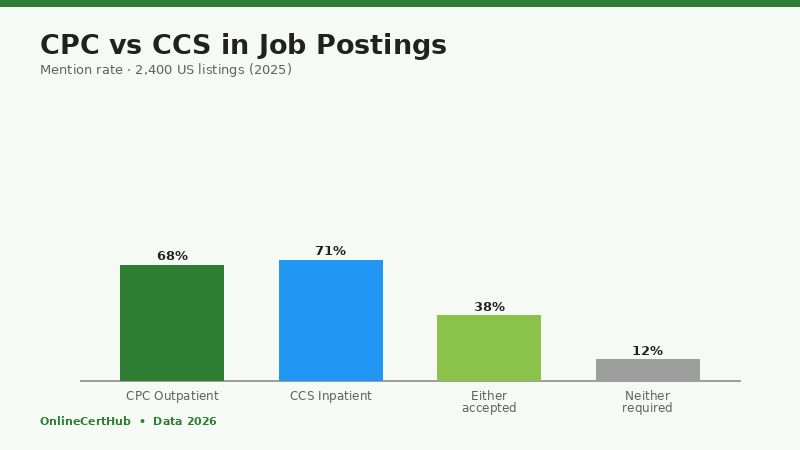
The medical coder certification online debate usually comes down to AAPC versus AHIMA. AAPC’s CPC (Certified Professional Coder) dominates physician practices and outpatient clinics; AHIMA’s CCS (Certified Coding Specialist) dominates hospitals and inpatient settings. A 2025 review of 2,400 U.S. coding job postings found CPC mentioned in 68% of outpatient roles, CCS in 71% of inpatient and hospital roles, with significant overlap in mid-size health systems that accept either [1][3].
For a career-changer with no healthcare background, CPC is usually the smarter first credential. The CPC exam covers CPT, ICD-10-CM and HCPCS Level II — the same code sets used in 80% of remote outpatient coding jobs. CCS adds inpatient diagnostic and procedural coding (ICD-10-PCS), which most entry-level remote roles don’t require. Coders who want hospital work eventually add CCS as a second credential after 1-2 years of CPC experience.
Online Accredited Medical Coding Programs
Three categories of online medical coding program exist in 2026: AAPC’s own training (most expensive, most direct path to CPC), university-affiliated programs (Penn Foster, Purdue Global, Drexel), and community college programs that ship online. AAPC’s CPC Preparation Course costs $1,995-$2,495 depending on study format, runs 4-6 months part-time, and includes one CPC exam attempt. The course material maps line-for-line to the exam blueprint [1].
Get the free certification shortlist for 2026
A concise, hand-checked guide to free and low-cost credentials from recognized issuers — grouped by career goal, with practical CV and LinkedIn tips. Free PDF, no spam.
Penn Foster’s Medical Coding and Billing diploma is a popular budget alternative at $899-$1,499 (with payment plans). It takes 8-14 months at self-paced part-time and ships graduates with the basic knowledge to sit for CPC, but the exam fee ($299 for AAPC members, $399 for non-members) is separate. AHIMA’s coding certificate program runs through partner colleges, with most students completing it in 9-12 months.
The accreditation marker to look for is CAHIIM (Commission on Accreditation for Health Informatics and Information Management Education) for AHIMA-pathway programs, and AAPC’s own approved education provider list for CPC-pathway programs. Programs without either flag may still teach competent coders but rarely qualify graduates for tuition reimbursement from healthcare employers.
Total Cost Breakdown Including Exam
The full sticker price for a coding certificate medical credential lands between $1,500 and $3,500 depending on the route. AAPC route: course $1,995 + AAPC membership $205/year + CPC exam $399 (or $299 for members) + Practicode practice fee $399 = approximately $2,800-$3,000 to credential. Penn Foster route: tuition $1,499 + AAPC membership $205 + CPC exam $399 = approximately $2,100. Community college route varies widely: $800-$2,500 tuition + same exam fees.
- Program tuition (AAPC, Penn Foster, community college): $899-$2,495.
- AAPC student membership (recommended for discount on exam): $130/year.
- AAPC full member after credential: $205/year (required to maintain CPC).
- CPC exam fee (member): $299. Non-member: $399. Retake: same.
- AAPC Practicode for mandatory hands-on practice: $399 (one-time, lifetime access on most plans).
- Required code books (CPT, ICD-10-CM, HCPCS): $200-$300 if buying physical, $0 with digital code book subscription bundled in some programs.
- Total realistic spend to first credential: $1,800-$3,500.
- Annual maintenance after credential (CEUs + membership): ~$330/year.
40-Hour CEU Requirement Explained
Once a coder earns CPC, AAPC requires 36 Continuing Education Units (CEUs) every two years to keep the credential active (the round number “40 hours” comes from the older requirement; the current rule is 36). AHIMA CCS requires 20 CEUs every two years. Both organizations offer free monthly CEU webinars to members, plus paid coding clinics that double-count as CEUs and directly bump pay grades.
Failing to log CEUs by the renewal deadline triggers a 90-day grace period; after that the credential lapses and the coder must retake the entire exam. Most active coders meet the requirement passively through annual ICD-10-CM update webinars and AAPC’s free monthly publication. The U.S. Centers for Medicare and Medicaid Services also publishes free education modules that count toward CEU requirements [4].
Remote Work Prospects After Certification
Remote work is the single biggest selling point of the online medical coding program path in 2026. AAPC’s 2025 Workforce Salary Survey found 41% of respondents working fully remote, 28% hybrid, and 31% on-site. Remote roles concentrate in two segments: large physician group practices (think 50+ provider organizations) and revenue cycle management vendors (Conifer, R1 RCM, Oracle Health, Optum). Both routinely post fully remote CPC openings.
The hiring bar for remote-from-day-one roles is genuinely higher than for hybrid or on-site. Most fully-remote postings require either 1-2 years of prior coding experience or AAPC’s CPC-A “apprentice” designation upgraded to full CPC by completing 1 year of work or finishing the AAPC Practicode practical assessment. Career-changers without prior experience typically take an on-site or hybrid role for 12-18 months before shifting fully remote.
Pay Progression From Entry to Specialty
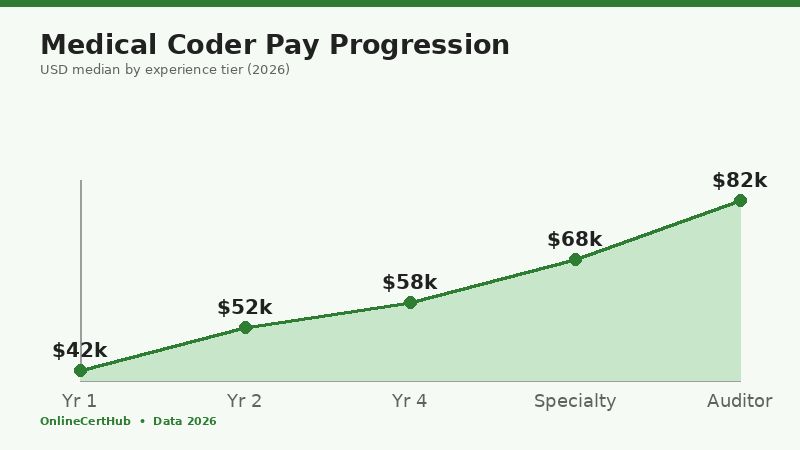
According to the U.S. Bureau of Labor Statistics, medical records specialists (the BLS category that includes coders) earned a median annual wage of $48,780 in May 2024, with the top 10% earning more than $76,330 [2]. AAPC’s 2025 salary data tracks slightly higher because it surveys credentialed coders specifically: median CPC earned $58,055, and certified specialty coders (cardiology, orthopedics, oncology) cleared $65k-$80k. Auditor-level credentials (CPMA, CPCO) push earnings into the $75k-$95k range.
The progression typically looks like this: year 1, CPC-A apprentice or new CPC at $42k-$50k; years 2-4, full CPC at $52k-$62k; years 5+, specialty coder or auditor at $65k-$85k. Geographic effects matter too — Bay Area, Boston and DC pay roughly 18-22% above the national median, while remote roles tend to anchor closer to national medians regardless of where the coder lives. CMS publishes free national benchmark data updated quarterly [4].
Specialty Tracks Worth Pursuing After CPC
Specialty coding credentials add meaningful pay bumps. The most-requested in 2026 are CPC-Cardiology, CPC-OBGYN, CPC-Orthopedics and CPC-Surgery. Each requires roughly 80-120 hours of additional study and a separate exam. Specialty coders for cardiac and orthopedic practices reliably earn 15-25% more than generalist CPCs, and these specialties tend to attract long-term retention because the procedural codes are dense enough to slow down employer turnover.
For coders interested in moving into auditing, the CPMA (Certified Professional Medical Auditor) is the most common next step. CPMAs review documentation for billing compliance and physician education. The role tends to be hybrid rather than fully remote, but pay reaches $70k-$85k for mid-career professionals. Anyone targeting risk-adjustment coding (the high-revenue HCC space) should look at the CRC (Certified Risk Adjustment Coder) credential, which pays comparably to CPMA and is heavily remote.
Medical Coding Certification Online vs On-Campus Options
The online route dominates in 2026, but on-campus options still exist at community colleges and vocational schools. The tradeoffs are real. On-campus programs offer structured schedules, in-person instructor Q&A, and sometimes bundled externships with local hospitals. Online programs offer lower cost, flexible pacing for working adults, and wider employer-specific content (most online curricula cover remote-work billing workflows that campus programs rarely address).
For career-changers already working a non-healthcare job, the online medical coding certification online path is almost always the right call. Evening and weekend study fits around an existing paycheck, and the CPC exam itself is proctored online or at Pearson VUE centers with no requirement for classroom attendance. On-campus makes sense mostly for students using federal Pell Grants (which cover community college but rarely online-only providers) or for those who strongly prefer in-person cohort learning.
One underrated factor: AAPC’s networking benefits. Online CPC Prep students get access to the same local chapter meetings, virtual study groups and job-board posts as on-campus graduates of AAPC-approved schools. The credential and the professional network travel together, regardless of whether the learning happened on a campus or a couch [1].
Common Pitfalls in the First Year
Three patterns trip up new coders consistently. First, taking the CPC exam without completing AAPC Practicode or another supervised practical-coding module — the exam tests applied judgment that lectures alone don’t build. Second, applying only to remote-from-day-one jobs and rejecting hybrid offers. The hybrid route is the proven on-ramp; pure-remote rejections accumulate while hybrid offers go unanswered. Third, letting AAPC membership lapse after the first year. The $205 renewal feels optional but losing membership means losing CEU access and discounted exam pricing.
The single fastest path from “considering medical coding course online options” to a paid coding role looks like: AAPC CPC Prep Course (4-6 months part-time), Practicode (60-90 days), CPC exam booked at month 6, hybrid revenue-cycle role at month 7-9, full CPC after one year, fully remote role transition at month 12-18. Plan for 18-24 months total from enrollment to fully remote — anything faster is the exception, not the rule.
Related reading
- Medical Billing Certification Online: Cost and Programs Compared
- Best Healthcare Certifications for Career Switchers in 2026
- Remote Healthcare Jobs With No Experience: Real Paths
Sources
- [1] AAPC — Certified Professional Coder (CPC) Official Page (2026)
- [2] U.S. Bureau of Labor Statistics — OOH Medical Records Specialists (May 2024 data)
- [3] AHIMA — Certified Coding Specialist (CCS) Official Page (2026)
- [4] U.S. Centers for Medicare and Medicaid Services — Coding and Billing Resources
- [5] AAPC — 2025 Workforce Salary Survey (Published Q1 2026)
- [6] CAHIIM — Commission on Accreditation for Health Informatics and Information Management Education
Frequently Asked Questions
How much does medical coding certification cost in 2026?
The CPC exam through AAPC costs $399 in 2026 for AAPC members ($499 non-members). AAPC annual membership is $205. The CCS exam through AHIMA costs $399 for members ($499 non-members). Training programs add $1,200 to $3,500. Total realistic cost runs $1,800 to $4,500.
Is CPC or CCS better for medical coding jobs?
CPC (AAPC) is more widely recognized in outpatient physician offices and clinics, which is 70 percent of the U.S. coding job market. CCS (AHIMA) is preferred for hospital inpatient coding and pays 5 to 10 percent more on average. Many coders earn both to maximize job options.
How long does medical coding training take?
Training typically runs 6 to 12 months. AAPC’s self-paced online course takes 4 to 8 months. Community college programs take 9 to 12 months. Both formats require 80 to 100 hours of hands-on coding practice before exam eligibility.
Get the free certification shortlist for 2026
A concise, hand-checked guide to free and low-cost credentials from recognized issuers — grouped by career goal, with practical CV and LinkedIn tips. Free PDF, no spam.