
What is the best online bachelor’s in nursing in 2026?
An online bachelors in nursing — the BSN — is the fastest route for a working RN to move into magnet-hospital roles, leadership tracks, and the 15-20% pay bump that most systems now pay BSN-holders over diploma or ADN nurses per BLS 2026 data [1]. It’s also the minimum degree for direct-entry into nurse practitioner programs. This guide covers accreditation, RN-to-BSN versus direct-entry formats, program tuition with NCLEX pass rates, clinical placement realities, financial aid, and post-BSN salary paths.
CCNE vs ACEN: Why Online Bachelors in Nursing Accreditation Is Non-Negotiable
Two accreditors matter for a BSN: CCNE (Commission on Collegiate Nursing Education) and ACEN (Accreditation Commission for Education in Nursing). Both are recognized by the U.S. Department of Education. Hospitals usually accept either, though some magnet-status academic medical centers list CCNE first. What both filters guarantee: the program’s clinical hours, curriculum, and NCLEX-pass statistics have been externally reviewed within the last 5-10 years [2].
An unaccredited online bachelors in nursing is a dead end. Not just for jobs — also for graduate school. Any MSN or DNP program worth attending requires a CCNE or ACEN undergraduate degree as a prerequisite. Check the accreditor’s public database directly rather than trusting the school’s landing page. The CCNE list is at aacnnursing.org; ACEN’s is at acenursing.org.
Online Bachelors in Nursing Formats: RN-to-BSN vs Direct Entry
The BSN isn’t one program. There are three common online formats, and the wrong match burns the most time:
Get the free certification shortlist for 2026
A concise, hand-checked guide to free and low-cost credentials from recognized issuers — grouped by career goal, with practical CV and LinkedIn tips. Free PDF, no spam.
- RN-to-BSN. For existing licensed RNs who hold an ADN or diploma. No additional NCLEX. 100% online is realistic because clinical hours are satisfied by the student’s current RN job. 12-24 months depending on pace. Most common format.
- Accelerated BSN (ABSN). For career switchers who already hold a non-nursing bachelor’s. 12-18 months full-time, hybrid online plus intensive in-person clinicals. NCLEX-RN required at the end.
- Direct-entry / Traditional BSN online. For students with no prior bachelor’s and no RN license. 32-40 months, heavy in-person clinical requirement that makes it only “online” in the lecture portion. NCLEX-RN at the end.
Students who already work as RNs should never enroll in a direct-entry BSN — they repeat content and clinicals they’ve already done. A 2025 AACN survey found 62% of BSN-online enrollees are RN-to-BSN, and that format accounts for almost all of the “100% online” marketing honestly.
Accredited Online Bachelors in Nursing Program List With Tuition and NCLEX Pass Rates
The programs below are CCNE or ACEN accredited as of the 2026 directory pull. Tuition is per program total, rounded. NCLEX first-time pass rate is the school’s most recent public number (2024 or 2025 cohort):
| Program | Format | Total tuition | Months | NCLEX pass |
|---|---|---|---|---|
| Western Governors University | RN-to-BSN | ~$10,500 | 12-24 | 94% (ABSN track) |
| University of Texas at Arlington | RN-to-BSN | ~$10,800 | 12-24 | N/A (RN-BSN) |
| Chamberlain University | RN-to-BSN | ~$23,400 | 12-36 | 87% (pre-licensure) |
| Purdue Global | RN-to-BSN | ~$18,900 | 14-24 | N/A (RN-BSN) |
| Ohio State University online | RN-to-BSN | ~$15,600 | 12-24 | 91% (pre-licensure) |
| University of Cincinnati online | RN-to-BSN | ~$14,700 | 12-24 | 88% (pre-licensure) |
| Indiana Wesleyan University | RN-to-BSN | ~$17,500 | 14-18 | 89% |
| Arizona State University online | RN-to-BSN | ~$15,000 | 12-24 | 93% |
WGU’s competency-based model lets motivated students finish in as little as 6 months if they already have most general-ed credits. That’s the cheapest and fastest route in the accredited list. Traditional semester-based programs cost more per month but offer more peer interaction and live clinical coaching.
- Confirm CCNE or ACEN accreditation in the public directory (not just the school’s site)
- Check state Board of Nursing approval for the student’s state of residence
- Request the NCLEX first-attempt pass rate for the last 3 cohorts in writing
- Confirm clinical placement support — does the school place students, or does the student arrange clinicals alone?
- Compare total tuition across 3 programs with the same format (RN-to-BSN vs ABSN vs direct-entry)
- Ask about employer tuition reimbursement partnerships (many hospital systems pre-negotiate rates)
Clinical Placement Requirements (and How Schools Help)
For RN-to-BSN students, clinicals are usually satisfied by submitting documentation of ongoing RN work hours plus a short capstone project at the student’s own workplace. That’s the real reason RN-to-BSN is the common “100% online” track. No extra clinicals means no scheduling conflict.
ABSN and direct-entry students still need 500-800 supervised clinical hours for NCLEX eligibility. Reputable online programs in 2026 either (a) partner directly with hospitals in the student’s region and arrange placements, or (b) give the student a dedicated placement coordinator. Avoid programs that expect the student to cold-call local hospitals to secure clinicals — that’s a common failure mode and stretches a 36-month program into 48 months.
Financial Aid and Employer Tuition Reimbursement
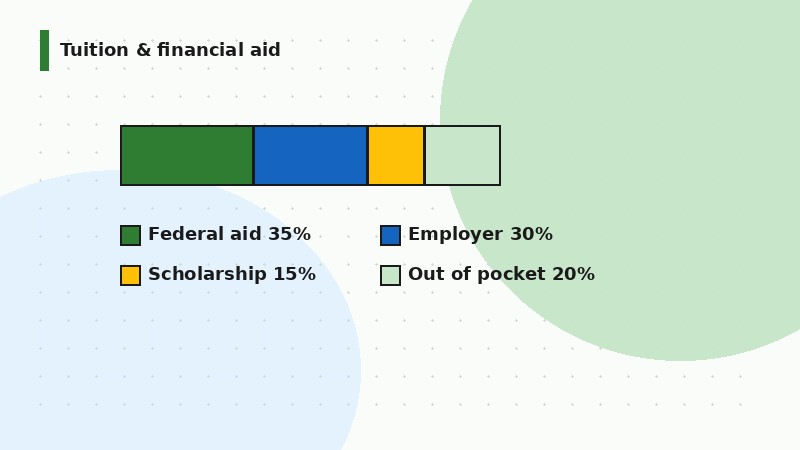
Federal aid applies to any Title IV-approved BSN program. Working RNs should file the FAFSA regardless of income because some federal loans aren’t need-based. Beyond federal aid, three BSN-specific funding sources in 2026:
- HRSA Nurse Corps Scholarship. Covers full tuition plus a monthly stipend in exchange for 2-3 years of service at a Health Professional Shortage Area site [3].
- Hospital tuition reimbursement. Most large systems (HCA, Ascension, Kaiser, Cleveland Clinic, NYC Health + Hospitals) reimburse $5,000-$10,000/year for an online BSN with a commitment of continued employment.
- AACN Foundation scholarships. AACN lists 25+ active BSN scholarships from hospital foundations and specialty nursing organizations, ranging $1,000-$7,500 per award.
Stacking two or three of these is common. A CVICU nurse working on an RN-to-BSN at WGU with $10,500 tuition plus $8,000 annual employer reimbursement ends the program with roughly $0 net out-of-pocket — that’s the actual math for a big share of RN-to-BSN completers.
Transfer Credit and Prior Learning Assessment for the Online BSN
Most RN-to-BSN enrollees already have 30-60 transferable credits from their ADN program, general-education work, or prior college attempts. How a school handles those credits is one of the biggest cost drivers. Two concepts matter:
- Transfer credit ceiling. Most online BSNs cap external transfer at 90 credits out of a 120-credit degree. A few (WGU, Excelsior, SUNY Empire) push that cap higher, which shortens time-to-degree sharply.
- Prior Learning Assessment (PLA). RNs with years of clinical experience can often test out of certain BSN courses by submitting a portfolio or passing a challenge exam. WGU’s competency-based model is essentially PLA built into every course.
Students should request a free transfer credit evaluation before enrolling. Most schools will run one in 5-10 business days. The difference between a program that accepts 75 transfer credits and one that accepts 90 can be 15 credits of tuition ($4,500-$9,000) and 6 months of calendar time.
Accelerating to MSN: How the Online BSN Sets Up Graduate School
For RNs who already know they want an MSN or DNP, the online BSN choice should be evaluated with graduate school in mind. Three signals that a given online BSN will smooth the MSN transition:
- Same school offers the MSN online. Schools like Chamberlain, Purdue Global, and Ohio State have bundled RN-to-BSN-to-MSN tracks that preserve credits and shave 6-12 months off the combined timeline.
- Strong GPA support during the BSN. MSN programs typically want 3.0+ undergrad GPA. Schools that assign dedicated academic advisors help RN students juggling 40-hour work weeks keep grades competitive.
- Research methods course in the undergrad curriculum. An undergrad research methods or evidence-based practice course makes the MSN research block far less painful later.
RNs who map the graduate goal first and pick the BSN second routinely finish the full BSN-to-MSN stack 12-18 months faster than those who enroll in the cheapest BSN and then shop for the MSN separately.
Post-BSN Career Paths and Starting Salaries
RN pay is by setting and region, not by degree level alone. But the BSN unlocks roles the ADN doesn’t. Median RN pay was $86,070 in BLS 2026 data [4], with BSN-holders averaging $9,000-$13,000 above diploma/ADN nurses in large metro areas per the 2025 Nurse.com salary survey. More important, the BSN is now required for:
- Magnet-status hospital hiring (most academic medical centers)
- School nurse roles in 34 states
- Public health nursing positions (CDC, state DOH)
- Case management and clinical informatics
- All MSN and DNP graduate paths (nurse practitioner, CRNA, nurse midwife)
Within 2 years of BSN completion, RNs commonly move into charge nurse or clinical specialist roles at $95,000-$110,000. CRNA (nurse anesthetist) remains the highest-paid path at a $215,000 median after an additional 3-year DNP. An online bachelors in nursing is the required first step toward every one of those numbers.
Red Flags in Online BSN Marketing
Not every “online BSN” search result leads to a real accredited program. Red flags worth recognizing in 2026 marketing:
- “Get your BSN in 6 months — no clinicals required.” NCLEX-eligible BSNs for non-RNs always require supervised clinical hours. Any program claiming otherwise is either an RN-to-BSN (which doesn’t need new clinicals but also doesn’t prepare for NCLEX) or misleading.
- “Accredited” without naming CCNE or ACEN. Regional accreditation of the school isn’t the same as nursing program accreditation. Both are needed; the nursing-specific one is the gatekeeper for graduate programs and magnet hospitals.
- High-pressure enrollment advisors. Reputable universities don’t rush enrollment decisions. If an advisor is pushing to enroll before the end of the call, that’s a marketing-driven for-profit with weak outcomes.
- No published NCLEX pass rates or first-year graduate employment data. Strong programs publish these numbers openly. Schools that hide them usually have reason to.
Check the state Board of Nursing website for the program’s most recent pass rate and the CCNE or ACEN public directory before signing any enrollment paperwork.
Related reading
- Online Masters in Nursing: MSN and DNP Compared
- Best Nurse Practitioner Online Programs 2026
- Accelerated Online Degrees: Where the Credit Transfers
Can you become a nurse entirely online in 2026?
No, RN licensure requires in-person clinical hours. Online BSN programs handle theory, care plans, and exam prep online but include 400 to 800 supervised clinical hours at partner hospitals. Fully online nursing degrees are not valid for NCLEX-RN eligibility.
What is the cheapest accredited online bachelor’s in nursing?
Western Governors University RN-to-BSN costs roughly $8,000 to $11,000 total depending on completion speed. Capella, Chamberlain, and Grand Canyon also offer accredited programs under $20,000. All three are regionally accredited and CCNE-approved.
How long does an online BSN take?
Traditional online BSN programs take 4 years. RN-to-BSN pathways take 12 to 24 months for current RNs. Accelerated BSN for non-nursing bachelor’s holders takes 12 to 16 months with heavy clinical load.
Sources
- [1] U.S. Bureau of Labor Statistics — Registered Nurses OOH (2026)
- [2] American Association of Colleges of Nursing — CCNE Accreditation
- [3] HRSA Bureau of Health Workforce — Nurse Corps Scholarship
- [4] Accreditation Commission for Education in Nursing — Accredited Programs
- [5] National Council of State Boards of Nursing — NCLEX-RN
- [6] ANCC Magnet Recognition Program
- [7] U.S. Department of Education — Federal Student Aid
Get the free certification shortlist for 2026
A concise, hand-checked guide to free and low-cost credentials from recognized issuers — grouped by career goal, with practical CV and LinkedIn tips. Free PDF, no spam.