
Yale free online courses split across two very different catalogs: the original Open Yale Courses (32 full lecture series from 2007-2016, always free, no certificate) and the current Yale catalog on Coursera, where you can preview courses for free but need to pay (or get financial aid) for full access and a certificate. This review covers what’s actually free, which 15 courses are worth the time in 2026, and how Yale’s free offerings compare against Harvard’s free tier.
Yale Open Courses vs Yale Online
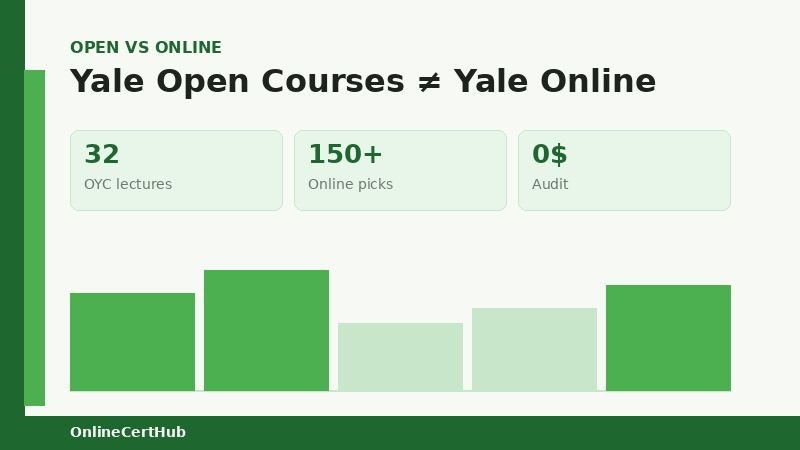
The distinction trips up most learners. Open Yale Courses (OYC) is Yale’s 2007-era open courseware initiative, hosted at oyc.yale.edu. It’s a static archive of 32 complete undergraduate courses taught by senior Yale faculty — full lecture videos, reading lists, problem sets, and exam papers. Everything is free. Nothing is graded. No certificate is issued. The content doesn’t change; Yale stopped adding new OYC courses after 2016 [1].
Yale Online is the current catalog hosted on Coursera and edX. It’s active, with new courses added each semester and existing courses revised. Since August 8, 2025, Coursera no longer offers free auditing. You can preview the first module of nearly every course for free, graded work included; full access and the certificate need a payment (per course or through Coursera Plus), a free trial where offered, or approved financial aid. Some courses also offer a Full Course, No Certificate option [2].
Both are legitimate Yale academic content. OYC suits learners who want the full course experience without any assignments or social pressure. Yale Online on Coursera suits learners who might want a certificate later or who value the cohort-style discussion forums.
15 Yale Free Online Courses Worth Your Time
A curated shortlist from the 2026 Yale catalog, weighted toward courses with 4.7+ Coursera ratings or long-standing OYC reputation:
Get the free certification shortlist for 2026
A concise, hand-checked guide to free and low-cost credentials from recognized issuers — grouped by career goal, with practical CV and LinkedIn tips. Free PDF, no spam.
- The Science of Well-Being (Coursera, Laurie Santos) — 10 hours. The most-enrolled Yale course in history.
- Financial Markets (Coursera, Robert Shiller) — 33 hours. Nobel-laureate instructor, 2013 economics prize.
- Introduction to Psychology (OYC, Paul Bloom) — 24 lectures, full undergrad course.
- Game Theory (OYC, Ben Polak) — 24 lectures, classic course.
- A Law Student’s Toolkit (Coursera) — 14 hours, pre-law primer.
- The Global Financial Crisis (Coursera, Tim Geithner + Andrew Metrick) — 18 hours.
- Introduction to Classical Music (Coursera, Craig Wright) — 29 hours.
- Roman Architecture (Coursera, Diana E. E. Kleiner) — 37 hours.
- Moralities of Everyday Life (Coursera, Paul Bloom) — 21 hours.
- Philosophy and the Sciences of Human Nature (OYC, Tamar Gendler) — 25 lectures.
- Introduction to Ancient Greek History (OYC, Donald Kagan) — 24 lectures.
- Introduction to Negotiation (Coursera, Barry Nalebuff) — 30 hours, SOM faculty.
- African American History: From Emancipation to the Present (OYC, Jonathan Holloway) — 25 lectures.
- Fundamentals of Neuroscience (OYC + Coursera cross-listed) — multiple parts.
- Managing Emotions in Times of Uncertainty & Stress (Coursera, RULER Approach faculty) — 10 hours.
The Open Yale Courses on this list are free to watch in full. The Coursera ones can be previewed for free; finishing them needs a paid enrollment or financial aid.
The Science of Well-Being: Why This One Dominates
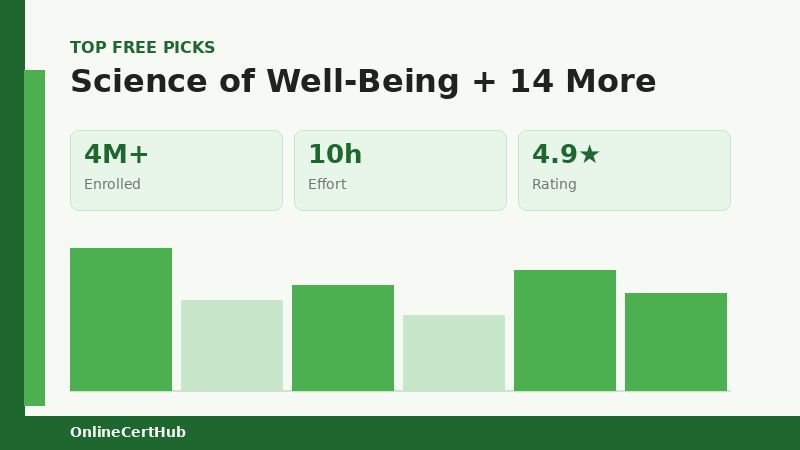
Yale’s single most-enrolled course is Laurie Santos’s The Science of Well-Being. As of 2026, it has 4.5+ million enrollments on Coursera and carries a 4.9/5 rating [2]. The course grew out of Santos’s on-campus Psychology and the Good Life lecture, which became the largest Yale undergraduate class in Yale’s 300-plus-year history the semester it launched in 2018.
Coursera no longer offers a free audit, so check the course page for the current options: the free preview covers the first module, and the page also lists financial aid and partner-supported free access. The paid track adds the graded work and the certificate. Employers rarely care about the certificate, but graduate admissions panels in psychology and education sometimes cite it on personal statements. The real value is the course itself — behavioral-science interventions for gratitude, social connection, and sleep, backed by citations to peer-reviewed research [3].
Three other Yale courses break the 500K-enrollment mark: Financial Markets (Shiller), Introduction to Psychology (Bloom), and Game Theory (Polak). All four share a pattern: tenured Yale faculty, 10-30 hour course lengths, and content that stays relevant across years. Courses built on fast-moving topics (tech, policy) tend to age faster and see lower completion rates after year two.
Prerequisites and Difficulty by Course
Most Yale free online courses are explicitly undergraduate-introductory. OYC lectures are filmed in real Yale classrooms; the pacing assumes a 300-level course load (roughly 8-12 hours per week across the semester). Coursera adaptations usually trim or re-record the content to a 4-10 hour total, designed for self-paced learners.
A rough difficulty ladder based on 2026 completion data [2]:
- Low prep needed: Science of Well-Being, Introduction to Psychology, Introduction to Classical Music, Roman Architecture, Managing Emotions.
- College-level writing expected: Moralities of Everyday Life, A Law Student’s Toolkit, Introduction to Negotiation.
- Math comfort required: Game Theory, Financial Markets (quantitative sections).
- Heavy reading load: Ancient Greek History, African American History, Philosophy and the Sciences of Human Nature.
- Technical prereqs: Fundamentals of Neuroscience (biology 101 helps), The Global Financial Crisis (basic macroeconomics helps).
Free vs Paid Certificate Options
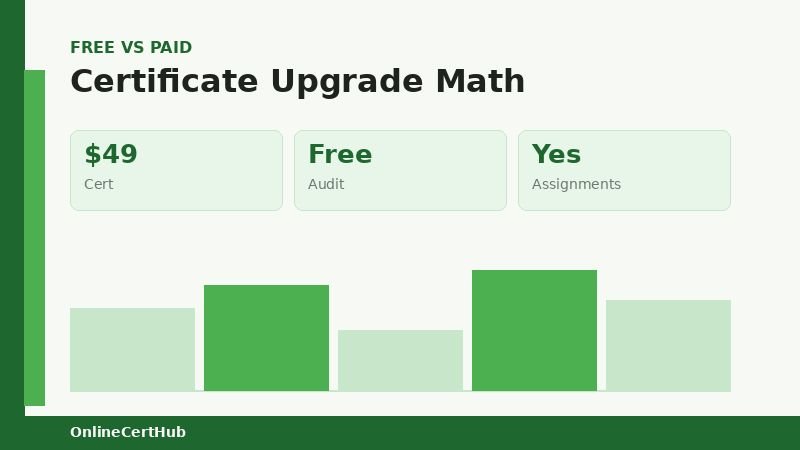
On Coursera, Yale courses now start with a free preview of the first module, and the rest of the course and the certificate are paid unless you get financial aid. The math for whether paying is worth it:
- Pay if the credential will go on a resume and the target employer actually checks online course certificates (rare — mostly HR-heavy corporate training teams).
- Pay if applying to graduate school in the course’s field — panels sometimes cite completed Yale certificates on personal statements.
- Pay if the course requires peer-graded assignments that force application of the material (Science of Well-Being rewirements, Negotiation role-plays).
- Skip the certificate if the goal is learning the material. Open Yale Courses and the free Coursera preview cost nothing, and some Coursera courses offer a Full Course, No Certificate option.
- Skip the certificate if Coursera Plus is already active — certificates are included for free across all Yale courses in that plan.
Coursera Plus unlocks the Yale certificates included in the plan. A learner planning to finish 3+ Yale courses in a year usually comes out ahead with the subscription over paying per course. For a single course, compare its price with financial aid before you subscribe.
Financial aid through Coursera covers the course fee for learners who apply and demonstrate need [2].
How Yale Free Courses Stack Up vs Harvard
HarvardX on edX is the closest peer catalog. Harvard’s free tier skews more technical — CS50 (intro computer science), Stat110 (probability), Justice (political philosophy) — and includes HarvardX certificates at similar $49-$99 price points. Yale’s catalog is broader across humanities, psychology, and the arts.
Direct overlap is limited. Both offer psychology intros; Yale’s is Bloom’s lecture-focused course, Harvard’s is a shorter video-first module. Both offer humanities intros; Yale’s Roman Architecture and Harvard’s ancient history courses complement each other rather than compete. For a learner building a self-directed liberal-arts program, pairing 3-4 Yale courses with 2-3 HarvardX courses covers more ground than either school alone.
MIT OpenCourseWare deserves mention as a third free option. MIT’s courses run heavier on math and engineering but carry no certificate option at all. OYC, HarvardX free audit, and MIT OCW are all zero-cost entry points to Ivy-caliber material [4].
Common Mistakes Using Yale Free Online Courses
Three mistakes drain value from free Ivy courseware. The first is paying before sampling. Watch the Open Yale Courses lectures or the free Coursera preview first, then decide whether the full course and certificate are worth paying for.
The second is enrollment without a schedule. Coursera’s 2026 data shows self-paced learners who don’t commit to a weekly cadence finish at less than half the rate of those who block calendar time. Treating a free Yale course like a gym membership produces the same outcome — nothing.
The third is stacking too many at once. Learners who enroll in 5+ Yale courses simultaneously complete fewer than 1, on average. Sequential completion (one course at a time, 4-10 weeks, then the next) outperforms parallel enrollment in every 2024-2026 Coursera cohort the platform has publicly analyzed [2].
Frequently Asked Questions
Which Yale courses are free online in 2026?
Open Yale Courses are free in full, and Yale’s Coursera courses can be previewed for free. Popular free picks include The Science of Well-Being (Yale’s most-subscribed Coursera course with 4M+ enrollments), Moral Foundations of Politics, Financial Markets, and Introduction to Psychology.
Do Yale free courses come with certificates?
Yale’s Open Yale Courses (Yale’s own platform) are free lecture archives with no certificate. Yale courses on Coursera offer a free preview of the first module; full access and the certificate are paid, with financial aid available. Yale also offers paid Coursera specializations bundling 3-6 courses with capstone.
Is a Yale free online course worth putting on a resume?
Mentioning completion of a free Yale course as professional development is legitimate. For hiring weight, paid verified Coursera certificates from Yale carry more credibility. The Science of Well-Being completion is widely recognized and respected by employers as a soft-skills signal.
Get the free certification shortlist for 2026
A concise, hand-checked guide to free and low-cost credentials from recognized issuers — grouped by career goal, with practical CV and LinkedIn tips. Free PDF, no spam.