
What are the best free online courses with certificates in 2026?
Finding free online courses with certificates of completion that actually carry weight in a 2026 resume takes more filtering than Google’s first page suggests. Roughly 80% of “free certificate” offers either charge a hidden fee to download the PDF or issue a badge that doesn’t appear in any employer verification system. This guide lists the 50 that do, explains what the certificate actually proves, and flags the ones worth paying to verify.
What “Certificate of Completion” Actually Means
Three different documents get called a “certificate” and only two of them move a resume. The first is a completion certificate — proof a student finished the course and submitted all required work. The second is a verified certificate — the same completion proof tied to a verified identity (usually a government ID check). The third is a “badge” or “participation award” — a low-friction branded image file with no proctoring behind it.
Employers running an ATS scan treat these differently. A verified certificate with a public verify URL shows up as a credential. A plain completion certificate shows up as learning history. A participation badge shows up as noise. The distinction matters because a candidate who lists 40 “badges” sometimes looks less credible than one who lists two properly verified credentials [3].
50 Free Courses That Give a Real Certificate
Below are six tiers of free online courses with certificates of completion that carry some employer recognition, grouped by issuer credibility. Every course on the list is free to take and free to receive the completion document (no hidden paywall fee):
Get the free certification shortlist for 2026
A concise, hand-checked guide to free and low-cost credentials from recognized issuers — grouped by career goal, with practical CV and LinkedIn tips. Free PDF, no spam.
Tier A — Government and Accredited
- FEMA EMI Independent Study (~200 courses, free certificate with unique ID) [1].
- Saylor Academy credit-eligible courses (44 courses, ACE credit recommendation for ~$25 proctoring).
- SWAYAM (Indian government + IIT/IIM, 2,000+ courses, free certificate with verification).
- CDC TRAIN courses (public health, required by many U.S. health employers).
- U.S. Department of Labor’s Apprenticeship.gov prep courses.
Tier B — University-hosted Free
- HarvardX CS50x Introduction to Computer Science (free, with a free CS50 certificate if you score at least 70% on every problem set and the final project; the edX verified certificate is paid) [5].
- MIT OpenCourseWare — no certificate but a public course completion log.
- Stanford Online free courses (selected catalog).
- Yale Open Courses (lecture library, no cert).
- Princeton on Coursera (free preview of the first module; since August 2025 the full course and the certificate are paid) [2].
Tier C — MOOC Platforms With a Free Preview or Audit + Paid Certificate
- Coursera — no free audit since August 2025: a free preview of the first module, then a paid course or subscription (or financial aid) for full access and the certificate [2].
- edX — free audit with time-limited access; the verified certificate is paid, and financial assistance takes 80% off [6].
- FutureLearn — 7-day free window per course, verify upgrade optional.
- Udacity free courses (content open, nanodegree verify paid).
Tier D — Free Certificate Out of the Box
- Alison (4,000+ free certificate courses; PDF free, parchment printed $20).
- Google Skillshop — Fundamentals of Digital Marketing, the old Digital Garage course (Google retired Digital Garage in 2025); it now ends with a Skillshop award, not the old certificate.
- HubSpot Academy (~40 free certifications, well-recognized in U.S. marketing roles).
- Meta Blueprint (free fundamentals + paid proctored exams).
- Microsoft Learn modules (free badges; some roll up to paid certification exams).
- IBM SkillsBuild (hybrid free + paid tracks).
Tier E — Industry and Nonprofit
- LinkedIn Learning (free through most U.S. public libraries).
- Cybrary (free courses in cybersecurity basics).
- CodeAcademy (free tier + paid Pro for certificates).
- freeCodeCamp (11 full curricula, each ending in a verifiable certificate).
- Khan Academy (no formal certificate but official course completion records).
How to Spot Fake Certificates
A credible certificate has four things working. First, a unique verification URL that lands on the issuer’s own domain, not a generic badge host. Second, the issuer’s legal name matches a registered entity on their About page. Third, the learner’s full name is printed exactly as supplied at enrollment. Fourth, the completion date matches a traceable session in the platform’s logs.
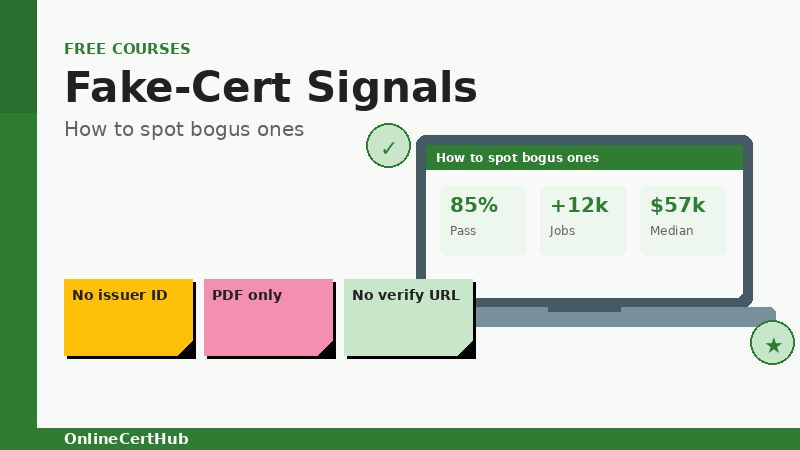
Warning signs include: no verify URL anywhere on the certificate; generic Open Badges infrastructure with no audit trail; issuer name different from the marketing brand; certificate appearing instantly with no course completion checkpoint. Certmill operations often bundle a dozen fake certifications for $29 — ATS systems and recruiters have flagged this pattern since 2023 and it now hurts candidates rather than helps [4].
- Click the verify URL on the PDF — does it resolve on the issuer’s own domain?
- Search the issuer’s legal name on the Better Business Bureau or state registry.
- Look for a unique certificate ID that the verify page returns (not just “Valid”).
- Check that the issuer is listed on LinkedIn as a school or professional certification body (not just a company).
- Run the certificate title through an ATS preview tool — does it parse as a credential, not a “skill”?
Platforms Ranked by Employer Recognition
Employer recognition sorts cleanly into three bands based on 2026 recruiter surveys and ATS parse behavior [3]. Band 1 is “hiring managers know the brand and value the cert”: FEMA EMI for emergency and public-sector roles, HubSpot Academy for marketing, Google Skillshop for Google Ads and Analytics, HarvardX CS50 for entry tech roles, freeCodeCamp for JavaScript and Python developer pipelines. Band 2 is “recognition varies by role and industry”: Alison certificates (strong in international markets, weaker in U.S. tech), Cybrary (accepted in SOC analyst pipelines), IBM SkillsBuild. Band 3 is “treated as learning, not credential”: most mass-market MOOC free completion PDFs without verify URLs.
The practical move: list one Band 1 certificate near the top of a Certifications section and use Band 2 and Band 3 courses as Projects or Continuing Education entries instead. This keeps the credentialed items at the top and prevents ATS keyword dilution.
Cost of Verification vs Cost of Course
Most major platforms split the economics between free learning and paid verification. edX and FutureLearn let you learn for free and charge to add the verified credential. Coursera is stricter since August 2025: a free preview of the first module, then payment (or financial aid) for the rest of the course and the certificate [2]. The question for learners is whether the verify upgrade pays back. The answer depends on the target role:
- Verify upgrade pays back when the course maps to a specific job keyword recruiters filter on (e.g., “SQL”, “Agile”, “AWS”).
- Verify upgrade doesn’t pay back when the course is generalist or exploratory (“Introduction to Marketing”, “Writing Better Essays”).
- Audit-only completion still provides real value for personal knowledge — just not as a resume line.
A better strategy for budget-conscious learners: stack two or three free-certificate Tier-A/D courses (FEMA, HubSpot, freeCodeCamp, Google Skillshop) in the target domain and save the certificate fee for a single strategic paid credential.
How U.S. Employers Actually Parse Free Online Courses with Certificates of Completion
ATS systems process candidate resumes before any human recruiter sees them. Understanding how they treat free online courses with certificates of completion clarifies which credentials to feature and which to skip. Most 2026 ATS platforms (Workday, Greenhouse, Lever, Taleo) parse credentials into a “certifications” object with three fields: issuer, credential name, and date. Issuer names matched against a known-entity database get recognized and scored. Issuer names not in the database get flagged as “unverified” or fall under “additional training”.
The practical implication: a FEMA EMI or HubSpot certificate parses cleanly because those issuer names sit in the database. An obscure branded completion certificate from a one-off platform parses as a text string. That’s not always fatal — human recruiters still read resumes — but it removes the automated credit that branded certs provide in the first-pass screening. Stacking Band 1 issuers at the top of the Certifications section is the most reliable way to clear this gate [3].
A second pattern matters: keyword density. Some candidates list the same free-certificate platform 6-10 times (Coursera Course A, Coursera Course B, Coursera Course C, etc.). ATS logic often collapses repeated issuer mentions into a single entry, so the extra lines don’t boost the score. Consolidating into a summary line (“Completed 7 courses on Coursera including X, Y, Z”) often scores higher and reads cleaner.
How to List a Free Certificate on LinkedIn
LinkedIn’s Licenses & Certifications section accepts any credential with a name, issuer, and date. Three rules reduce the look-spammy risk and maximize visibility:
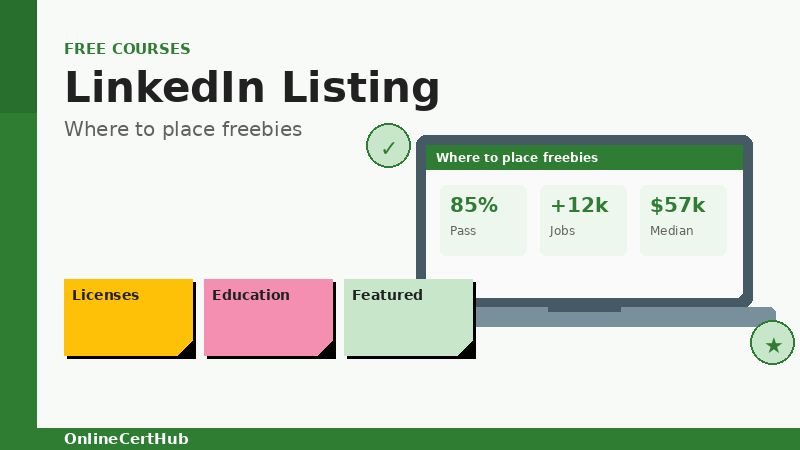
First, always attach the verify URL in the credential URL field — recruiters click these more than any other. Second, cap the Certifications section at 8-10 items; a list of 40 badges creates noise. Third, order by relevance to the current job target, not by date. Recent badges at the top only work when they are also the most relevant. For the courses without a verify URL, consider the Featured section instead — pin the certificate PDF with a short caption explaining what the learner built.
Stacking Free Certificates into a Real Credential Ladder
The biggest missed opportunity with free online courses with certificates of completion is treating each one as an isolated win. The higher-value move is stacking them into a credential ladder that tells a coherent story. For example, a candidate targeting a data analyst role might stack: freeCodeCamp Data Analysis with Python certificate, Google’s Fundamentals of Digital Marketing on Skillshop (for business-context bonus), a FEMA course in data documentation, and a paid Google Data Analytics Certificate on Coursera as the capstone. Four credentials, three free, one paid, all reinforcing the same target role.
The stack works because each credential validates a different skill or context. The ATS reads four relevant issuer names. The recruiter reads a focused story. And the candidate has spent well under $300 total. Compared to enrolling in a single $15,000 bootcamp, the stacked-free approach often produces stronger job-search outcomes for motivated self-learners.
The one caveat: free certificates can’t substitute for regulated credentials. Someone targeting a CPA, RN, or PE engineering role still needs the formal licensure path. Free certificates help supplement those paths but don’t replace them. The stacking strategy works best in software, marketing, data, design, and operations roles where formal licensure isn’t the gate.
Related reading
Which free online certificates are actually recognized by employers?
Certificates from Google Career Certificates, HubSpot Academy, Microsoft Learn, and freeCodeCamp have real employer recognition. University-backed options through Coursera and edX also carry weight, especially when paired with projects or portfolio work.
Are free online courses with certificates worth the time?
They work best as a foundation or career pivot tool. For roles requiring licensure such as nursing or accounting, free courses do not replace formal credentials. For tech, marketing, and business roles, they compress onboarding and signal initiative to hiring managers.
Do free certificates include the course completion for free or just the course?
It varies. HubSpot Academy, freeCodeCamp and FEMA Independent Study include the certificate at no cost. Google Career Certificates are paid ($49 a month on Coursera in the U.S. and Canada). Coursera now gives a free preview of the first module instead of a free audit, and edX lets you audit with time-limited access; both charge for the certificate, with financial aid available. Always check the certificate policy before enrolling.
Sources
- [1] FEMA Emergency Management Institute — Independent Study Program
- [2] Coursera — the new course preview experience (August 2025)
- [3] Class Central — MOOC and credential analytics
- [4] Better Business Bureau — issuer lookup
- [5] HarvardX CS50x — how the free CS50 certificate works
- [6] edX — verified certificates and financial assistance
- [7] American Council on Education — ACE credit recommendations
Get the free certification shortlist for 2026
A concise, hand-checked guide to free and low-cost credentials from recognized issuers — grouped by career goal, with practical CV and LinkedIn tips. Free PDF, no spam.