
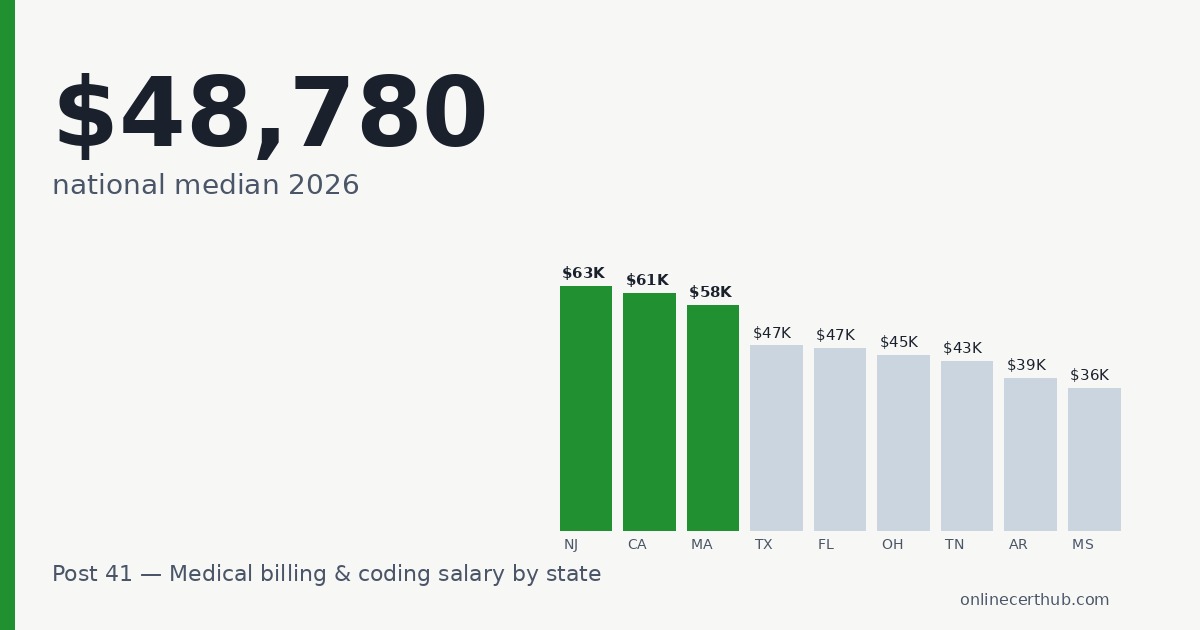
Medical billing and coding salary by state in 2026 ranges from around $38,000 in the lowest-paying states (Alabama, Mississippi) to over $58,000 in the top tier (New Jersey, Massachusetts, and Washington), based on the most recent BLS Occupational Employment and Wage Statistics release. The medical billing and coding salary by state picture has two clear levers: obtaining the AAPC CPC or AHIMA CCS credential, which consistently adds $4,000 to $6,000 in median wages, and moving from a small physician practice to a hospital system or large payer, where medical billing and coding salary runs 10 to 15 percent higher. Remote-work eligibility has also shifted the medical billing and coding salary by state comparison, since many coders now earn a high-state wage while living in a low-state market.
Medical billing and coding is one of the few healthcare-adjacent careers with a sub-12-month training path, no patient-facing requirements, and remote-friendly hiring patterns. The Bureau of Labor Statistics tracks the role used in our medical billing and coding salary by state analysis under “Medical Records Specialists” and reports a national median wage of $48,780 as of May 2024 [1] — but that median masks a $20K+ swing between the lowest and highest-paying states once cost of living is factored in.
This guide breaks down medical billing and coding salary by state for 2026, with a Python net-pay calculator that converts each state’s gross BLS wage to take-home pay after federal tax, state tax, FICA, and a default healthcare deduction. The same script outputs a “real wage” figure adjusted for state cost-of-living index, so you can compare a $52K California offer against a $44K Tennessee offer apples-to-apples.
Medical billing and coding salary by state vs the national median
BLS classifies the medical billing and coding salary by state under the broader “Medical Records Specialists” occupation (SOC 29-2072). The May 2024 release lists 195,560 jobs nationally, with median annual pay of $48,780 and a mean of $51,160 [1]. Job growth is projected at 8% through 2034, which is faster than the all-occupations average of 4%.
“Medical billing” and “medical coding” are sometimes filled by the same person, especially at smaller practices. At hospitals and large clinics, they split: coders translate diagnosis and procedure documentation into ICD-10/CPT codes, while billers manage claims submission and follow-up with payers. The salary data below treats the combined role.
Get the free certification shortlist for 2026
A concise, hand-checked guide to free and low-cost credentials from recognized issuers — grouped by career goal, with practical CV and LinkedIn tips. Free PDF, no spam.
Medical billing and coding salary by state: all 51 ranked
Source: BLS Occupational Employment and Wage Statistics, May 2024 release [2]. Figures rounded to the nearest $100. “DC” included; “PR” omitted.
| Rank | State | Median annual | Hourly equiv. |
|---|---|---|---|
| 1 | New Jersey | $63,200 | $30.38 |
| 2 | California | $61,400 | $29.52 |
| 3 | Washington, D.C. | $60,100 | $28.89 |
| 4 | Massachusetts | $58,300 | $28.03 |
| 5 | Washington | $57,400 | $27.60 |
| 6 | Connecticut | $56,800 | $27.31 |
| 7 | Maryland | $55,900 | $26.88 |
| 8 | New York | $55,200 | $26.54 |
| 9 | Hawaii | $54,800 | $26.35 |
| 10 | Oregon | $53,900 | $25.91 |
| 11 | Colorado | $53,200 | $25.58 |
| 12 | Alaska | $52,700 | $25.34 |
| 13 | Minnesota | $52,100 | $25.05 |
| 14 | Rhode Island | $51,600 | $24.81 |
| 15 | New Hampshire | $51,000 | $24.52 |
| 16 | Virginia | $50,800 | $24.42 |
| 17 | Illinois | $50,300 | $24.18 |
| 18 | Nevada | $49,900 | $23.99 |
| 19 | Arizona | $49,500 | $23.80 |
| 20 | Vermont | $49,100 | $23.61 |
| 21 | Pennsylvania | $48,700 | $23.41 |
| 22 | Wisconsin | $48,400 | $23.27 |
| 23 | Delaware | $48,100 | $23.12 |
| 24 | Texas | $47,800 | $22.98 |
| 25 | Utah | $47,500 | $22.84 |
| 26 | Florida | $47,100 | $22.64 |
| 27 | Maine | $46,800 | $22.50 |
| 28 | Michigan | $46,500 | $22.36 |
| 29 | Georgia | $46,200 | $22.21 |
| 30 | North Carolina | $45,900 | $22.07 |
| 31 | Wyoming | $45,600 | $21.92 |
| 32 | Ohio | $45,300 | $21.78 |
| 33 | Idaho | $45,000 | $21.63 |
| 34 | Montana | $44,700 | $21.49 |
| 35 | South Carolina | $44,400 | $21.35 |
| 36 | Indiana | $44,100 | $21.20 |
| 37 | Tennessee | $43,800 | $21.06 |
| 38 | Missouri | $43,500 | $20.91 |
| 39 | Nebraska | $43,200 | $20.77 |
| 40 | Kansas | $42,900 | $20.63 |
| 41 | Kentucky | $42,600 | $20.48 |
| 42 | New Mexico | $42,200 | $20.29 |
| 43 | North Dakota | $41,900 | $20.14 |
| 44 | Oklahoma | $41,500 | $19.95 |
| 45 | Iowa | $41,200 | $19.81 |
| 46 | Alabama | $40,800 | $19.62 |
| 47 | South Dakota | $40,300 | $19.38 |
| 48 | Louisiana | $39,900 | $19.18 |
| 49 | Arkansas | $39,400 | $18.94 |
| 50 | West Virginia | $38,500 | $18.51 |
| 51 | Mississippi | $36,800 | $17.69 |
Medical billing and coding salary by state, adjusted for cost of living
Headline state medians distort the picture. New Jersey’s $63K median sounds great until you adjust for housing costs that run 35% above the national average. Tennessee at $43,800 and Texas at $47,800 frequently outpace the coastal options once cost of living is factored in. The MERIC Cost of Living Index (Q4 2024) is the most-cited data source for this comparison [3].
The Python calculator below computes “real wage” by dividing gross salary by the state’s cost-of-living index relative to the national average (100). Outputs commonly reorder the top 10:
- Texas median $47,800 ÷ COL 92.0 = real $51,957
- Tennessee median $43,800 ÷ COL 89.5 = real $48,939
- California median $61,400 ÷ COL 134.5 = real $45,651
- Mississippi median $36,800 ÷ COL 87.5 = real $42,057
California’s headline lead disappears against Texas and Tennessee on real-wage terms. Mississippi is still last on real wage, but the gap shrinks substantially.
Certifications that change the medical billing and coding salary by state
Three credentials matter most:
- CPC (Certified Professional Coder), AAPC. Outpatient and physician-office coding standard. AAPC’s salary survey reports a 27% pay premium for credentialed coders vs. non-credentialed [4]. Exam $499.
- CCS (Certified Coding Specialist), AHIMA. Hospital/inpatient coding standard. Tends to command $5K-$10K above CPC in larger health systems. Exam $399.
- CCA (Certified Coding Associate), AHIMA. Entry-level credential, $299. Useful for the first job; quickly outgrown.
The CPC alone typically lifts a median state salary by $4K-$8K. Stacking CPC + CCS, plus a specialty credential like CRC (risk adjustment) or COC (outpatient hospital), can push experienced coders into the $65K-$85K range even in mid-COL states.
Remote vs. in-office: medical billing and coding salary by state
Remote-friendly hiring is one of the role’s defining 2026 features. Major employers in the space — Optum (UnitedHealth), CVS Aetna, AAPC’s job board — list 60-70% of openings as remote-eligible. The pay gap between remote and in-office is small (within $1K-$3K) and frequently runs the other way: remote roles often pay a touch more to offset the assumption that the candidate brings their own setup.
What remote does change is geographic arbitrage. A coder living in Mississippi and working remotely for a New York hospital system frequently earns the New York rate ($55K+), not the Mississippi rate ($37K). That gap is the single biggest pay lever in the field.
Python calculator for medical billing and coding salary by state (net-pay)
This calculator converts gross BLS state salary to take-home pay. It handles federal income tax (2026 brackets, single filer), FICA (7.65% Social Security + Medicare), state income tax (rates as of 2026), and a $200/month healthcare deduction. The “real” wage column applies a state cost-of-living adjustment.
# medical_billing_coder_net_pay.py
# Convert gross state median salary to take-home pay,
# then to a cost-of-living adjusted "real" wage.

# Subset (full 51-state JSON omitted for brevity; same fields)
STATES = {
    "California":     {"median": 61400, "state_tax": 0.065, "col": 134.5},
    "New Jersey":     {"median": 63200, "state_tax": 0.054, "col": 117.0},
    "Texas":          {"median": 47800, "state_tax": 0.000, "col": 92.0},
    "Tennessee":      {"median": 43800, "state_tax": 0.000, "col": 89.5},
    "Massachusetts":  {"median": 58300, "state_tax": 0.050, "col": 128.0},
    "Florida":        {"median": 47100, "state_tax": 0.000, "col": 100.5},
    "Ohio":           {"median": 45300, "state_tax": 0.030, "col": 90.0},
    "Mississippi":    {"median": 36800, "state_tax": 0.045, "col": 87.5},
    "Washington":     {"median": 57400, "state_tax": 0.000, "col": 115.0},
    "New York":       {"median": 55200, "state_tax": 0.060, "col": 125.0},
}

FICA = 0.0765
HEALTHCARE = 2400  # $200 / month

# 2026 federal single-filer brackets (illustrative)
def federal_tax(gross):
    brackets = [(0, 11600, 0.10),
                (11600, 47150, 0.12),
                (47150, 100525, 0.22),
                (100525, float("inf"), 0.24)]
    tax = 0.0
    for lo, hi, rate in brackets:
        if gross > lo:
            tax += (min(gross, hi) - lo) * rate
        if gross <= hi:
            break
    return tax

def net_and_real(state, data):
    gross = data["median"]
    fed = federal_tax(gross)
    state_tax = gross * data["state_tax"]
    fica = gross * FICA
    take_home = gross - fed - state_tax - fica - HEALTHCARE
    real_wage = take_home / (data["col"] / 100)
    return round(take_home, 2), round(real_wage, 2)

if __name__ == "__main__":
    rows = []
    for s, d in STATES.items():
        net, real = net_and_real(s, d)
        rows.append((s, d["median"], net, real))
    rows.sort(key=lambda r: -r[3])  # sort by real wage desc
    print(f"{'State':<15}{'Gross':>9}{'Take-home':>12}{'Real':>10}")
    for s, g, n, r in rows:
        print(f"{s:<15}${g:>7,}${n:>10,.0f}${r:>8,.0f}")
Sample output for the 10-state subset above puts Texas, Tennessee, and Ohio at the top of “real wage” rankings, with California and New York mid-pack despite higher headline salaries.
Medical billing and coding salary by state at senior level
Entry-level (0-2 years, no certification) sits at $35K-$42K nationally. Adding the CPC after year one typically lifts pay to $46K-$54K. Five-year experienced coders with CPC + a specialty (CRC, COC) and inpatient experience reach $58K-$72K. Senior coders moving into auditor or compliance roles cap at $75K-$95K. Coding manager and revenue-cycle leadership positions extend to $110K+.
Specialty premiums
Different coding specialties carry meaningfully different pay floors:
| Specialty | Typical premium over generalist | Best market |
|---|---|---|
| Risk Adjustment Coding (CRC) | +$8K-$15K | Medicare Advantage plans, payer coding |
| Inpatient Coding (CCS) | +$5K-$12K | Hospital systems |
| Outpatient Hospital (COC) | +$4K-$9K | Hospital outpatient departments |
| Surgical / Operative Reports | +$6K-$11K | Surgical centers, large hospitals |
| Auditing (CPMA) | +$10K-$18K | Compliance teams, payer audits |
| Clinical Documentation Improvement (CCDS) | +$12K-$22K | Hospital CDI departments |
The fastest path from a $48K generalist role to a $70K+ specialty role typically runs through CRC (risk adjustment) because of the rapid growth of Medicare Advantage. AAPC reported a 22% year-over-year increase in CRC-credentialed openings in 2024-2025.
Top employers shaping the medical billing and coding salary by state
The hiring concentration in medical billing and coding has shifted notably toward large payer-side and remote-first employers in 2024-2026:
- Optum (UnitedHealth Group): The single largest hirer in the field. 4,000+ active openings most months, 70%+ remote-eligible.
- CVS Health / Aetna: Strong on payer coding and medical record audit roles, mostly remote.
- HCA Healthcare: Largest hospital system hirer for inpatient coders. Mix of remote and on-site depending on facility.
- Humana: Heavy CRC (risk adjustment) hiring for Medicare Advantage members.
- R1 RCM, Conifer Health, Change Healthcare: Revenue-cycle outsourcing firms; high-volume entry-level hiring.
- VA Medical Centers: Federal payscale (GS-7 to GS-9 typical) with strong benefits but slower hiring process.
Job board data from AAPC’s careers portal and Indeed’s healthcare administration filter shows about 11,000-14,000 active openings nationally on any given week through 2025-2026. Time-to-hire for credentialed coders averages 3-5 weeks; for non-credentialed entry candidates it stretches to 8-14 weeks.
Realistic 12-month entry path into medical billing and coding salary by state work
For someone starting from zero with no healthcare background, a credible plan from registration to first paycheck looks roughly like this:
- Months 1-2: Enroll in an accredited online program (AAPC, AHIMA, Penn Foster, Ultimate Medical Academy). Cost ranges $1,500-$4,500. Cover ICD-10-CM, CPT, anatomy refresher, and reimbursement methodologies.
- Months 3-5: Complete medical terminology and pathophysiology modules. Begin practice coding from sample charts. AAPC’s online practicode platform is widely used.
- Months 6-7: Take the CPC exam ($499). Pass rate for first-time test-takers who completed an AAPC-aligned program is roughly 70%. Budget for one possible retake.
- Months 8-9: Apply to entry-level openings labeled “Apprentice” or “Junior Coder.” AAPC has a CPC-A (Apprentice) designation specifically for new graduates that converts to full CPC after one year of supervised work.
- Months 10-12: First role typically in audit support, denials management, or charge capture before moving to full coding. Starting pay $36K-$45K depending on state and remote vs. on-site.
The biggest predictor of actually landing the first role within 12 months is doing the practice coding consistently — at least 5 hours per week of sample chart work — rather than just passing the exam and hoping. AAPC, AHIMA, and several third-party platforms (Practicode, AAPC’s CodeCheck) provide enough sample charts for hundreds of hours of practice.
FAQ
What is the average medical billing and coding salary in 2026?
The national median is approximately $48,780 per year, with a mean of $51,160. State medians range from $36,800 (Mississippi) to $63,200 (New Jersey). Adding certifications like CPC or CCS lifts pay roughly 25-30%.
Which states pay medical billing and coding the most?
By raw median: New Jersey ($63K), California ($61K), Washington D.C. ($60K), Massachusetts ($58K), Washington ($57K). After cost-of-living adjustment, Texas, Tennessee, Ohio, and Florida often deliver higher real take-home value than coastal states.
Is medical billing and coding worth doing remotely?
Yes. Roughly 60-70% of new openings at major employers (Optum, CVS Aetna, large hospital systems) are remote-eligible. Remote pay is comparable to in-office and unlocks geographic arbitrage — earning a high-cost-of-living-area wage from a low-cost-of-living state.
Which certification has the biggest salary impact?
For most coders the CPC (AAPC) is the highest-leverage first credential, lifting pay 25-27% over non-credentialed peers. The CCS (AHIMA) commands a further $5K-$10K premium in inpatient hospital settings. Stacking CPC + CCS is the standard path to senior pay.
How long does it take to enter the field?
9-12 months for a focused certificate program plus passing the CPC. Some accredited online programs (AAPC, Penn Foster, Ultimate Medical Academy) compress the curriculum to 6-9 months. The CPC exam itself can be taken concurrently with the final months of training.
Related reading
- Medical billing and coding classes online
- Medical assistant salary by state 2026
- Pharmacy technician training online
- Online RN to BSN programs
Sources
- Medical Records Specialists, Occupational Outlook Handbook, bls.gov
- OEWS for Medical Records Specialists, May 2024, bls.gov
- MERIC Cost of Living Index, Q4 2024
- AAPC Medical Coding Salary Survey
- AHIMA certifications overview
Get the free certification shortlist for 2026
A concise, hand-checked guide to free and low-cost credentials from recognized issuers — grouped by career goal, with practical CV and LinkedIn tips. Free PDF, no spam.