
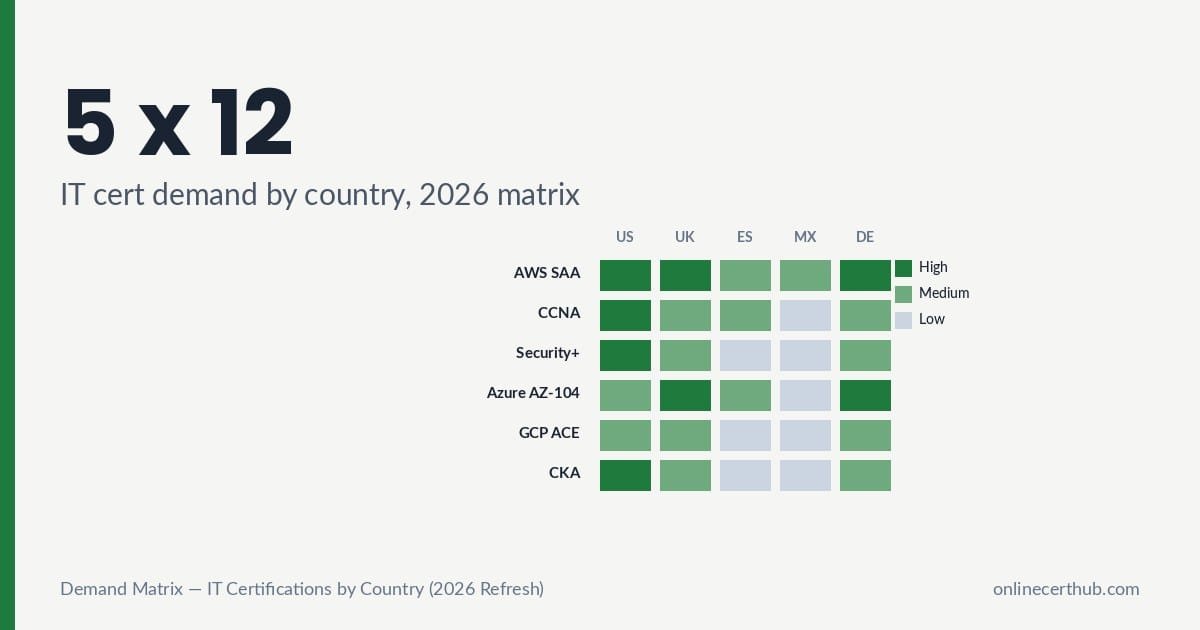
Tracking IT certification demand by country is the difference between studying six months for a credential that opens doors and one that nobody is hiring for. A certification that is red-hot in the United States may be a side note in Spain, and a credential that opens doors in Germany may be barely recognized in Mexico — which is why checking local demand before enrolling matters.
This page tracks IT certification demand by country for the top 12 credentials across five key markets — United States, United Kingdom, Spain, Mexico, and Germany — and classifies each cell as High, Medium, or Low demand. The matrix is refreshed every quarter. The last refresh date is shown below the table.
The goal of this IT certification demand by country matrix is simple: before enrolling in a certification, the reader can see at a glance whether the effort-to-employment ratio makes sense in their country.
Where the demand signals come from
The IT certification demand by country signals on this page come from public labor-market data — primarily the U.S. Bureau of Labor Statistics and Eurostat — combined with weekly job-board postings to capture both formal hiring and live demand.
How to read this page
Each cell in the matrix reflects a relative tier of demand within the country, not an absolute number of job postings. A High cell for AWS Solutions Architect in the United States is not directly comparable to a High cell for Scrum Master in Spain — the underlying market sizes are different. What the tier does say is: within this country, this certification is one of the more actively requested by employers in 2026.
Get the free certification shortlist for 2026
A concise, hand-checked guide to free and low-cost credentials from recognized issuers — grouped by career goal, with practical CV and LinkedIn tips. Free PDF, no spam.
Readers who want absolute numbers should cross-check with LinkedIn Jobs or Indeed filters by country — those platforms expose raw posting counts. The matrix is a starting point, not a replacement for that check.
The matrix
Last refreshed: April 2026 (next refresh: July 2026).
| Certification | US | UK | ES | MX | DE |
|---|---|---|---|---|---|
| AWS Solutions Architect Associate | High | High | High | Medium | High |
| Azure Administrator (AZ-104) | High | High | High | Medium | High |
| Google Cloud Associate Engineer | Medium | Medium | Medium | Low | Medium |
| AWS Cloud Practitioner | Medium | Medium | High | High | Medium |
| CompTIA Security+ | High | High | Medium | Medium | High |
| CISSP | High | High | High | Medium | High |
| CompTIA Network+ | Medium | Medium | Low | Medium | Medium |
| Cisco CCNA | Medium | Medium | High | High | Medium |
| PMP | High | Medium | Medium | High | Medium |
| Professional Scrum Master I (PSM I) | Medium | High | High | Medium | High |
| Google Data Analytics | Medium | Medium | Medium | Medium | Medium |
| ITIL 4 Foundation | Medium | High | Medium | Medium | High |
Legend: High = among the top requested certifications in that country · Medium = consistently requested but not in the top cluster · Low = occasionally requested, niche demand.
Country-by-country breakdown
United States
IT certification demand by country in the United States skews toward cloud, security and data credentials, with AWS, CompTIA Security+ and Google Data Analytics leading hiring volume.
The US market is the largest source of IT postings globally and also the most diverse. Three clusters stand out in 2026:
- Cloud-first hiring remains at the top. AWS holds roughly 31% of the global cloud infrastructure market as of early 2026, and that dominance translates directly into hiring volume. Azure follows closely in enterprise environments.
- Cybersecurity demand has kept accelerating. CISSP and CompTIA Security+ are consistently among the top-5 requested certifications across mid-size and enterprise employers.
- PMP remains the default credential for IT project and program manager roles in the US — a pattern that is different from some European markets.
United Kingdom
IT certification demand by country in the United Kingdom mirrors the US for cloud roles, with stronger weight for ITIL and PRINCE2 in public-sector hiring.
The UK job market leans more service-oriented than the US. Three patterns hold in 2026:
- ITIL 4 Foundation is more prominent in UK job descriptions than in any other country in the matrix. Service management is deeply embedded in UK enterprise IT culture, and ITIL is a near-default requirement for service desk lead and incident manager roles.
- Scrum Master (PSM I) is also strong — UK delivery teams have adopted agile ways of working at scale, and PSM I is the most-cited credential.
- Cloud demand mirrors the US pattern (AWS plus Azure at the top), though raw volumes are smaller.
Spain
IT certification demand by country in Spain is concentrated around AWS, Azure and CCNA, with PMP and ITIL appearing in mid-to-large enterprises.
Spain's IT market is heavily shaped by the national "Digital Spain 2026" agenda and by a strong outsourcing ecosystem serving the rest of Europe. This produces a specific demand profile:
- AWS Cloud Practitioner — the entry-level AWS credential — shows higher relative demand in Spain than in the US or UK, because many Spanish employers use it as a screening filter for junior cloud roles.
- CCNA remains strongly requested. Networking roles in Spain still favor Cisco fundamentals, particularly in telecom and managed services firms.
- Cybersecurity demand has been amplified by the EU NIS2 directive, which tightens security requirements across critical sectors in member states. CISSP and CompTIA Security+ are both relevant, with CISSP skewing toward senior roles.
Mexico
IT certification demand by country in Mexico is led by AWS, ITIL and CompTIA Security+, with growing demand for data analytics credentials.
Mexico's IT labor market has grown rapidly as a nearshoring hub for US and Canadian companies, which affects which certifications employers prioritize:
- AWS Cloud Practitioner and Cisco CCNA are the most requested entry-level credentials. Both are seen as proof that a junior candidate can contribute on a nearshored project.
- PMP demand is high — larger enterprise employers expect US-style project management credentials from their Mexico-based PMs.
- Google Cloud Associate shows lower demand than AWS or Azure, reflecting smaller GCP footprint in the region.
Germany
IT certification demand by country in Germany favors ISTQB, TOGAF and Azure, with strict employer preference for vendor-neutral credentials.
Germany's IT hiring reflects a large industrial base plus strict regulatory pressure:
- Cybersecurity credentials — particularly CISSP and CompTIA Security+ — are in high demand, driven by NIS2 and by Federal Office for Information Security (BSI) guidance.
- ITIL 4 is strong, matching the UK pattern in service-heavy environments.
- Cloud demand is solidly high for AWS and Azure; Google Cloud Associate is medium, reflecting slower GCP enterprise uptake compared to Microsoft.
- Scrum Master is a standard requirement in German tech teams, reinforced by the widespread adoption of agile at scale in industrial software.
What the matrix does not cover
The matrix classifies demand, not salary. A certification with High demand in a country is not automatically the highest-paying option in that country — pay depends on role, seniority, and employer, not only on the credential. For salary data, the Global Knowledge IT Skills and Salary Report and the Robert Half Tech Salary Guide remain the most-cited public benchmarks.
The matrix also does not reflect compliance-specific certifications (for example, sector-regulated credentials required only in finance or healthcare). Those should be researched role-by-role.
Finally, the matrix does not include AI-specific certifications (such as AWS AI Practitioner or Microsoft Azure AI Engineer). Demand signals for AI credentials in 2026 are still volatile — the refresh due in July 2026 will likely add a row once the signal stabilizes.
Methodology
The tier assigned to each cell reflects triangulated signals rather than a single source:
- Public industry reports. Skillsoft IT Skills and Salary benchmarks, Coursera Global Skills Report, and Robert Half Tech Salary Guide provide aggregate demand indicators for the US and international markets.
- Regional policy and regulation. Market-specific factors that shift demand materially — for example, the EU NIS2 directive amplifying cybersecurity demand across Spain, Germany, and other member states.
- Public job-posting sampling. LinkedIn Jobs and Indeed exposed posting counts by country are used as a sanity check against the reports above. Counts are sampled, not exhaustive.
- Sector overlays. A country's dominant IT employers shape the certification profile more than global trends — for example, Mexico's nearshoring base gives disproportionate weight to AWS entry credentials and CCNA.
Each cell tier is assigned when at least two of these signals agree. The matrix is re-evaluated every quarter. If market signals change significantly between quarters, the refresh date is moved up.
How to use the matrix before enrolling
The intended workflow for a reader choosing a 2026 certification:
- Start with the country row — identify which certifications are High in the country where the reader wants to work.
- Cross-check against personal background. A High-demand credential only pays off if the reader can realistically complete it. For that decision, the blog has a 6-question certification quiz that maps profile to cert fit.
- Validate with a live job search. Open LinkedIn Jobs or Indeed, filter by country, and search the certification name. If fewer than 3 out of 10 postings in the target role mention it, reconsider.
- Enroll with an official provider. The linked reviews on the blog cover each of the 12 certifications in the matrix, including the most common enrollment route in 2026.
Next refresh
The matrix will be re-evaluated in July 2026. The fields most likely to shift:
- AI-adjacent credentials entering the top 12.
- Google Cloud demand in Spain and Germany (could move from Medium to High if enterprise adoption accelerates).
- CCNA tier in the UK (currently Medium, trending down).
Sources
- Robert Half Tech Salary Guide (2026 edition) — roberthalf.com
- EU NIS2 Directive — digital-strategy.ec.europa.eu
- Digital Spain 2026 Agenda — espanadigital.gob.es
- Global Knowledge IT Skills and Salary Report — most recent edition referenced across 2026 certification comparisons.
- AWS 2026 cloud market share — industry aggregations reported in multiple 2026 trend analyses.
Disclosure: Some links on this page may be affiliate links. If you enroll in a course or certification through them, OnlineCertHub may earn a small commission at no extra cost to you. We only link to resources we have reviewed.
Frequently Asked Questions
Which certifications are most in-demand by country in 2026?
In the US: CompTIA Security+, AWS Solutions Architect, PMP. In the UK: PRINCE2, CompTIA, CCNA. In Canada: Google Career Certificates, Azure AZ-104, Salesforce Admin. In Australia: ITIL, AWS, Cisco CCNA. In Germany and France: SAP certifications, ITIL, TÜV quality certifications dominate.
How is the demand matrix calculated?
The matrix aggregates live job posting data from LinkedIn, Indeed, and Glassdoor across 20 countries, weighted by median salary for certified versus non-certified candidates. Data is refreshed quarterly using Lightcast labor market feeds and national employment statistics where available.
Are certification salary premiums similar across countries?
No. The US and Canada show the highest certified/non-certified salary premiums (15-25 percent). Western Europe is smaller (5-12 percent). In Asia-Pacific the premium for cloud and security certifications reaches 20-35 percent for roles at multinationals but is minimal at local firms.
Get the free certification shortlist for 2026
A concise, hand-checked guide to free and low-cost credentials from recognized issuers — grouped by career goal, with practical CV and LinkedIn tips. Free PDF, no spam.