
The Google Advanced Data Analytics Certificate is the second tier of Google’s data path on Coursera, designed for graduates of the original Google Data Analytics Certificate who want to add Python, statistics and basic machine learning to their toolkit. The full review below covers the seven-course breakdown, real time investment, prerequisites, and where the credential lands on a 2026 resume.
Related: the complete Google Career Certificates guide — every track compared by cost, hours and entry salary.
Google Advanced Data Analytics Certificate vs Original Google Data Analytics
The first thing to clarify in any review of the Google Advanced Data Analytics Certificate: this is a separate, more technical credential from the original Google Data Analytics Professional Certificate. The original cert focuses on spreadsheets, SQL, R for visualization, and Tableau. The advanced track replaces R with Python, drops Tableau in favor of Tableau-with-Python, and adds two full courses on statistical inference and machine learning fundamentals [1].
That shift matters for resume positioning. Recruiters in 2026 increasingly filter data analyst applicants on Python proficiency, and the original Google cert no longer signals that. The advanced certificate does. Anyone targeting a junior data analyst or junior data scientist role should treat the advanced track as the more relevant credential, even though it costs more time and effort.
Get the free certification shortlist for 2026
A concise, hand-checked guide to free and low-cost credentials from recognized issuers — grouped by career goal, with practical CV and LinkedIn tips. Free PDF, no spam.
Prerequisites: Do You Need the Basic Cert First?
Officially Google recommends completing the original Google Data Analytics Certificate before enrolling in the advanced track, but it’s not enforced. The advanced track assumes comfort with SQL, basic spreadsheet pivot tables, and the analytics workflow (ask, prepare, process, analyze, share, act). Anyone who already works with data in any form (Excel power users, BI analysts, junior consultants) can skip the original and start here without falling behind.
The single hardest prerequisite is comfort with abstraction. Modules 4 and 5 introduce probability distributions, hypothesis testing, and confidence intervals at a pace faster than most intro stats classes. Students without a previous exposure to algebra and basic probability often need to slow down through these modules and supplement with free resources from python.org tutorials or Khan Academy [2].
7 Courses in the Specialization (Time Breakdown)
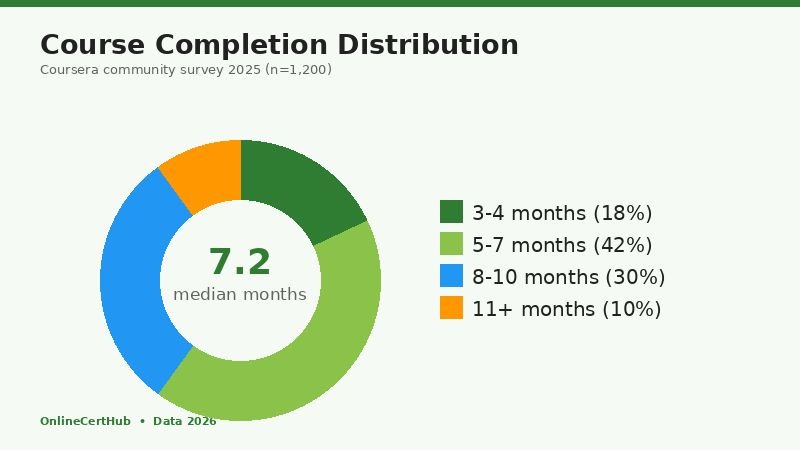
The Google Advanced Data Analytics Certificate runs across seven courses, each split into 4-6 weeks of estimated coursework. The official Coursera estimate is 6 months at 10 hours/week, totaling roughly 240 hours. Real completion times skew higher: a 2025 Coursera community survey of 1,200 enrollees reported a median completion time of 7.2 months at an average of 8 hours/week. Self-paced learners with strong math backgrounds finish in 3-4 months. Career-changers from non-quant fields take 9-12 months.
Course one (Foundations of Data Science) is largely review material. Course two (Get Started with Python) ramps from zero to functions and pandas. Courses three (Go Beyond the Numbers) and four (The Power of Statistics) are the inflection point — most learners stall here. Courses five (Regression Analysis) and six (Nuts and Bolts of Machine Learning) ship the most resume-worthy skills. The capstone course is a portfolio project students can publish on GitHub.
Python, Statistics, and ML Coverage Depth
Python coverage is genuinely solid for a beginner-friendly track. Course two takes learners from print statements to writing functions, slicing pandas DataFrames, and reading CSV files into a Jupyter notebook. By course three, students are using matplotlib and seaborn for exploratory data analysis. The depth is roughly equivalent to a one-semester intro college class, not a CS minor.
Statistics coverage runs deeper than most online certs at this price point. Topics include descriptive stats, sampling distributions, hypothesis testing, ANOVA basics, and chi-square tests. Anyone who completes course four can read and critique a basic A/B test report at work. The machine learning material in course six covers supervised learning (linear regression, logistic regression, decision trees, random forests) but skips deep learning entirely. For deep learning, students need a separate path like deeplearning.ai or fast.ai [3].
# Sample pandas + scikit-learn workflow built in module 5-6
import pandas as pd
from sklearn.model_selection import train_test_split
from sklearn.linear_model import LogisticRegression
from sklearn.metrics import classification_report

df = pd.read_csv("customer_churn.csv")
X = df.drop(columns=["churned"])
y = df["churned"]

X_train, X_test, y_train, y_test = train_test_split(
    X, y, test_size=0.2, random_state=42
)

model = LogisticRegression(max_iter=1000)
model.fit(X_train, y_train)
preds = model.predict(X_test)

print(classification_report(y_test, preds))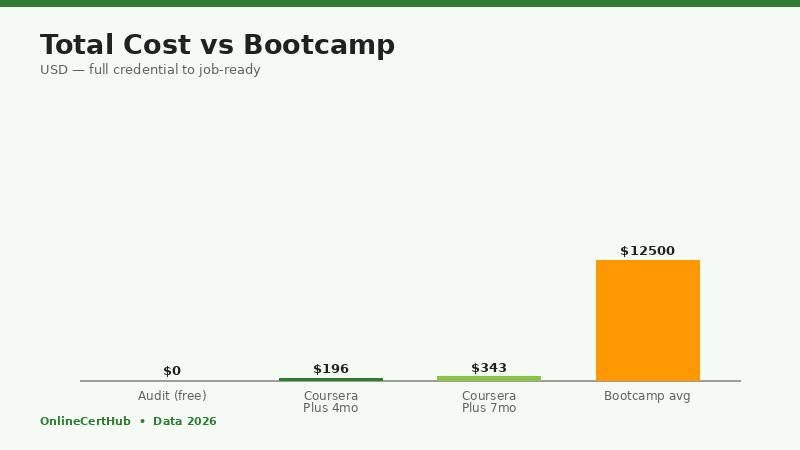
Cost and Pacing Options
The Google Advanced Data Analytics Certificate costs $49/month through Coursera Plus, the same subscription that covers the original Google Data Analytics. A learner finishing in 4 months pays roughly $196 total. A learner taking the full 7-month median pays $343. Coursera Financial Aid is available for the advanced cert too — apply, wait 15 days, and approval rates run around 60-70% for documented need [4].
The same content sold as a standalone bundle (per-course pricing) runs $59-$79 per course, totaling $413-$553. Coursera Plus is almost always cheaper unless someone finishes in under 3 months. Audit mode is available on individual courses but locks the graded assignments and capstone project, which means no certificate at the end. For pure self-learners who want only the knowledge, free auditing covers maybe 70% of the practical material.
Career Paths After the Google Advanced Data Analytics Certificate
The advanced certificate sits between two job tiers. It strengthens applications for junior data analyst roles ($55k-$80k median in 2026) and entry-level junior data scientist or ML analyst roles ($75k-$110k). The certificate alone is rarely enough for the latter — most hiring teams want a degree in statistics, math, CS or a related field, plus a portfolio of 2-3 end-to-end projects on GitHub. Pairing the cert with a strong portfolio is what moves applications past the resume screen.
According to the U.S. Bureau of Labor Statistics, employment of data scientists is projected to grow 35% from 2024 to 2034, far faster than average across all occupations [5]. Median pay for data scientists hit $112,590 in May 2024. The advanced Google cert positions a candidate to apply for those roles, but the conversion rate from “applied” to “interviewed” still depends heavily on portfolio quality and prior work experience.
Related reading
- Google Career Certificates Review: After 100+ Graduates
- Google Data Analytics Certificate: Original vs Advanced
- Best Data Analyst Certifications for 2026
Sources
- [1] Grow with Google — Advanced Data Analytics Certificate Page (2026)
- [2] Python.org — Beginner’s Guide to Python (2026)
- [3] Coursera — Deep Learning Specialization by DeepLearning.AI
- [4] Coursera — Google Career Certificates Hub (2026)
- [5] U.S. Bureau of Labor Statistics — OOH Data Scientists (2024 data)
- [6] Class Central — Google Advanced Analytics Review (2025)
Frequently Asked Questions
Is the Google Advanced Data Analytics Certificate worth it?
Yes for data analysts moving into senior analyst or entry-level data scientist roles. It covers Python, statistics, regression, and machine learning at an intermediate level. Requires the foundational Google Data Analytics Certificate or equivalent SQL and spreadsheet skills as prerequisite knowledge.
How is Google Advanced Data Analytics different from the basic one?
The Advanced certificate covers Python (pandas, NumPy), regression analysis, hypothesis testing, and machine learning with scikit-learn. The basic Data Analytics certificate focuses on SQL, R, Tableau, and spreadsheets. Advanced is targeted at learners who already completed the basic certificate or equivalent.
How long does the Google Advanced Data Analytics Certificate take?
The certificate takes 6 to 8 months at 10 hours per week. All seven courses are self-paced on Coursera with Python notebooks, graded projects, and a capstone machine learning project. Faster learners with Python background finish in 3 to 4 months.
Try Pluralsight free for 10 days →
Transparency note: some links in this article are affiliate links. If you buy through them, OnlineCertHub may earn a commission at no extra cost to you.
Get the free certification shortlist for 2026
A concise, hand-checked guide to free and low-cost credentials from recognized issuers — grouped by career goal, with practical CV and LinkedIn tips. Free PDF, no spam.