
How do you get a CNA certification online in 2026?
A complete online CNA certification path does exist in 2026 — but only for the theory half. Every U.S. state still requires in-person clinical hours before a candidate can sit the Nurse Aide Competency Evaluation exam [1]. This guide maps which programs run fully online for the classroom portion, which states accept the hybrid route, and the real cost from enrollment to first shift.
Is CNA Certification Fully Online?
No, and any program that advertises “100% online, no clinicals” is either misrepresenting the offer or is not CMS-approved. The federal Nurse Aide Training and Competency Evaluation Program (NATCEP) sets the floor: a minimum of 75 total instruction hours, at least 16 of which must be hands-on clinical practice in a long-term care facility supervised by a registered nurse [1]. States layer their own rules on top. The online half covers the classroom curriculum — anatomy, infection control, communication, resident rights, basic nursing skills in theory. The clinical half still happens in a real nursing home or skilled facility.
The distinction matters because insurance carriers, state nurse aide registries, and employers check the certification origin. A candidate with a “fully online” CNA credential from an unaccredited platform won’t appear on the state registry and can’t legally work as a nurse aide in a certified facility. Work happens under the registry, full stop [3].
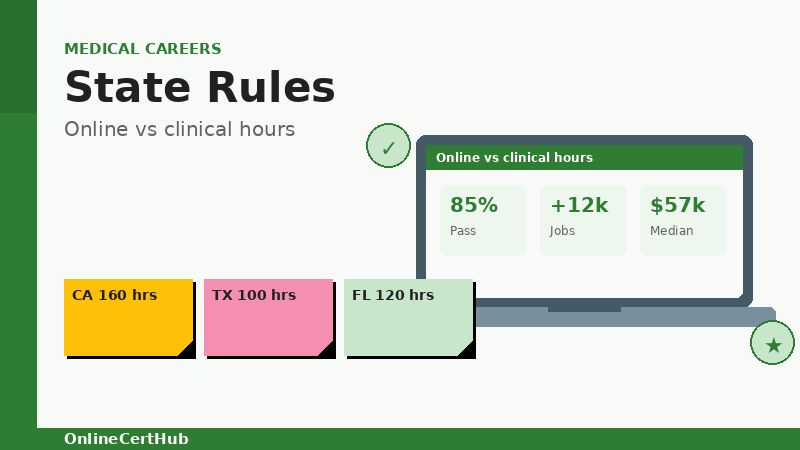
State-by-State Rules (Why Hybrid Is the Norm)
The federal 75-hour floor sits below what most states actually demand. A rough 2026 map looks like this:
Get the free certification shortlist for 2026
A concise, hand-checked guide to free and low-cost credentials from recognized issuers — grouped by career goal, with practical CV and LinkedIn tips. Free PDF, no spam.
- California — 160 hours total (60 classroom, 100 clinical).
- Texas — 100 hours (60 classroom, 40 clinical).
- Florida — 120 hours (40 classroom, 80 clinical), plus separate CNA exam.
- New York — 120 hours (approx. 70 classroom, 50 clinical).
- Illinois — 120 hours (80 classroom, 40 clinical).
- Ohio — 75 hours (the federal minimum).
Students who pick a hybrid online CNA certification path usually finish the classroom portion in 2-4 weeks on a self-paced schedule, then spend another 2-4 weeks driving to a partner facility for clinicals. The program should hand over a written clinical-placement commitment before enrollment. No commitment, no enrollment — that’s the single cleanest filter on whether an online provider is credible.
Reciprocity between states exists but isn’t automatic. Every state maintains its own nurse aide registry, and a CNA trained in Texas who moves to California has to file a reciprocity application with the California Department of Public Health before working. Paperwork takes 2-6 weeks depending on registry backlog [3].
Accredited Online CNA Program List
Below the short list of programs that pair online classroom content with in-person clinicals and that appear on state approval rosters in 2026:
- American Red Cross CNA — hybrid, available in 13 states, $1,295 average. Clinical partner facilities pre-arranged [4].
- Penn F. Nurse Aide program — self-paced online classroom; student arranges clinicals through state-approved facility.
- Ashworth College Nurse Aide — similar structure to Penn F., slightly cheaper.
- Local community college hybrids — often the best ROI; Pell grant eligible; in-state tuition under $800 in states like North Carolina and Oklahoma.
- State workforce board sponsored — free or reimbursed via WIOA in most states [5].
Watch for three red flags: programs that won’t name their clinical partner, programs not listed on a state nurse aide registry website, and programs that promise to “skip” or “waive” clinicals. All three mean the credential won’t sit on the registry.
- Is the program listed on the target state’s nurse aide registry website? (CMS-required.)
- Does the offer include a written clinical-placement commitment at a named facility?
- Do the total hours match or exceed the state minimum (75 federal, 100-160 strict states)?
- Is the instructor team led by an RN with at least 2 years of long-term care experience (federal rule)?
- Does the price include the state NNAAP exam fee (~$115) or is it billed separately?
Cost and Timeline Breakdown
Real 2026 out-of-pocket costs for a self-paid student:
- Tuition (online classroom + clinical placement): $500 to $1,500.
- NNAAP exam fee: $105 to $125 depending on state [6].
- Uniforms, stethoscope, watch: $60 to $100.
- Background check + fingerprinting: $40 to $90.
- Textbook (some programs bundle, some don’t): $0 to $80.
Total ranges from $705 to roughly $1,900 for a solo payer. Community college routes close the bottom of that range; name-brand national programs sit near the top.
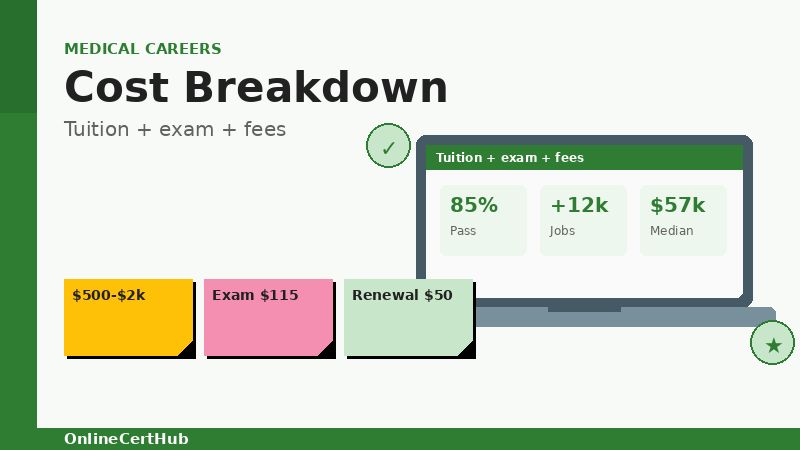
Timeline: 4 weeks at 20 hours per week is a realistic fast track. Most working adults finish in 8 to 12 weeks. The bottleneck is almost always clinical scheduling — facilities have limited preceptor capacity, so students booking clinicals in July-August (summer hiring) wait longer than those starting January or October.
CNA Exam Structure and Pass Tips
The National Nurse Aide Assessment Program (NNAAP) is the exam used by 26 states; others use state-specific versions that mirror the same structure [6]. It has two parts: a 60-question multiple-choice written test and a 5-skill hands-on demonstration. Both parts must be passed within 24 months. Pass rates averaged 77% in 2025 for first-time test takers.
The hands-on demo is what trips most candidates. Examiners pick 5 of 22 possible skills at random — handwashing is always one — and grade them against a strict checklist. Practice the full 22 at least three times each before test day. The written section leans heavily on infection control, resident rights, and safe transfer technique.
Why State Rules Make Fully Online CNA Certification Online Impossible
The question “is there a CNA certification that’s truly 100% online?” comes up constantly and the answer is worth expanding. Federal rule 42 CFR 483.152 requires that every nurse aide candidate complete at least 16 hours of supervised practical training before any direct contact with a resident [7]. The supervision must be in person, by a qualified instructor (RN with LTC experience), inside a facility that serves actual patients. No remote simulation satisfies this requirement, no matter how high-fidelity the virtual setup.
Some states allow a portion of clinical hours in a skills lab environment on campus. None allow substituting real patient contact with online video or VR. That’s the federal line. The online portion can legitimately cover anatomy, infection control, communication, resident rights, documentation, and theoretical skills instruction. Anything that involves touching a person, reading vital signs from a real body, or responding to real human cues has to happen in person.
This matters for program vetting because some marketing pages stretch the language. Phrases like “fully online with optional clinical placement” or “100% online except clinicals” are contradictions — the clinicals are the gate. A program that downplays them is either misleading prospects or cannot reliably place them at a partner facility. The cleanest test: if the program cannot hand over a written commitment to specific clinical partners before enrollment, the offer is unfinished.
Salary and Career Ladder After Certification
Median CNA pay in 2026 is $38,200 per BLS data, with the top 10% earning above $49,000 [2]. Hourly ranges vary by region: California hospitals paying $22-28/hr, rural Midwest long-term care paying $14-17/hr, travel assignments via agencies paying $25-38/hr. Nursing homes are the largest employer, followed by hospitals and home health.
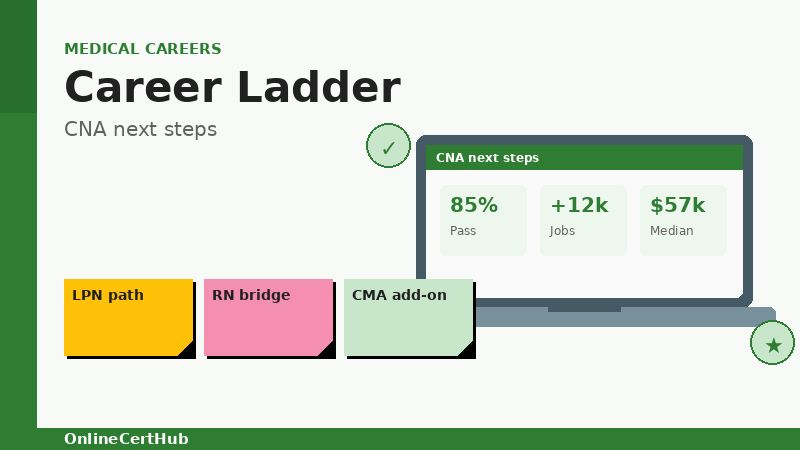
The career ladder after an online CNA certification stacks cleanly. Most CNAs add one of three next rungs: the LPN (practical nurse) license at ~12 months additional training, the RN via a bridge program at 18-24 months, or the Certified Medication Aide (CMA) add-on at 4-8 weeks. Hospitals often subsidize the bridge route for employees who commit to 1-2 years post-credential.
Common Pitfalls When Choosing an Online CNA Certification Program
Five pitfalls trap candidates every year. Each adds weeks or months to the total timeline and sometimes blocks registry listing entirely:
- Enrolling before checking the destination state’s registry website. Every state maintains an approved-program list. Programs not on that list don’t count. Candidates who skip this step sometimes finish coursework only to find the state refuses to let them sit the exam.
- Ignoring preceptor availability. Clinical hours require supervised facility placement. Some programs advertise broad geographic coverage but have one or two active preceptor partnerships. Asking “how many clinical start dates are available in the next 90 days in my zip code?” surfaces this fast.
- Skipping background check prep. Nursing facilities run fingerprint checks that take 2-6 weeks. Starting them after completing coursework adds dead time. Smart candidates file the background paperwork during the online classroom phase.
- Choosing national brands over community colleges purely on marketing. Community college hybrid programs often cost half as much and place graduates at a higher rate in their local region because the college has direct relationships with area facilities. The national brand sometimes wins on user experience but loses on placement.
- Forgetting the 24-month exam window. NNAAP rules require both exam sections within 24 months. Candidates who finish training and then delay the exam past this window have to retrain. The safest play is scheduling the exam within 2 months of finishing clinicals.
Related reading
Can you get a CNA certification entirely online in 2026?
No, CNA programs always require in-person clinical hours. Online components cover theory and some skills practice, but every state mandates supervised clinical training of 16 to 100+ hours. True 100% online CNA programs are not federally valid.
How much does a CNA program cost?
CNA programs cost $300 to $2,500 depending on format and state. Free programs exist through long-term care employers, Red Cross chapters, and some nursing homes in exchange for a work commitment after certification.
How long is CNA training?
CNA training lasts 4 to 12 weeks. Federal minimum is 75 hours of training plus state-specific clinical hours. Most programs combine 40 to 60 hours of online theory with 50 to 100 hours of in-person clinical rotation.
Sources
- [1] Centers for Medicare & Medicaid Services — Nurse Aide Training and Competency
- [2] U.S. Bureau of Labor Statistics — OOH, Nursing Assistants and Orderlies (2026)
- [3] CMS — National Nurse Aide Registry information
- [4] American Red Cross — CNA Training program
- [5] U.S. Department of Labor — WIOA workforce funding
- [6] Prometric — NNAAP Nurse Aide exam information
- [7] eCFR 42 CFR 483 — Nursing facility training reimbursement rules
Get the free certification shortlist for 2026
A concise, hand-checked guide to free and low-cost credentials from recognized issuers — grouped by career goal, with practical CV and LinkedIn tips. Free PDF, no spam.