
Related: the complete Google Career Certificates guide — every track compared by cost, hours and entry salary.
Full List of Google Career Certificates in 2026
Seven certificates are active in 2026. Volumes below reflect Coursera’s public catalog data as of April 2026:
- IT Support — 6 courses, ~180 hours. The original 2018 track. Strongest placement history.
- Data Analytics — 8 courses, ~190 hours. SQL, R, Tableau.
- UX Design — 7 courses, ~200 hours. Figma and design-sprint heavy.
- Project Management — 6 courses, ~140 hours. Agile plus waterfall.
- Cybersecurity — 8 courses, ~170 hours. Launched late 2023, still maturing.
- Digital Marketing & E-Commerce — 7 courses, ~180 hours.
- Advanced Data Analytics — 7 courses, ~200 hours. Python, ML basics, stats.
There’s no mandatory entrance test. Coursera asks for a Google account and a credit card. That’s it.
Cost Breakdown: Coursera + Google Pricing in 2026
Students often misread the fee structure. The published sticker is $49 per month, but the effective cost depends on pace and discounts. Here’s how real completers paid in 2026:
# Pseudo-code: estimate total cost from the Coursera API
# endpoint: /api/certificates.v1?program=google-career-certificate

months_active   = 4          # mean completion time per Coursera 2026 cohort data
price_per_month = 49.00      # USD, flat rate
coursera_aid    = 0.00       # 0 if paying full; ~147 waived if aid approved
workforce_board = 0.00       # some U.S. states reimburse the full total

total_out_of_pocket = (months_active * price_per_month) - coursera_aid - workforce_board
# → $196.00 average in 2026 for a self-paid learner
# → $0.00 for a WIOA-funded learner in 32 states
A completer paying out of pocket averaged $196 across the 2026 Coursera cohort. Workforce-board candidates paid nothing [4]. Note that the $49 subscription unlocks all seven certificates, so switching tracks mid-month doesn’t trigger a second fee — just a reset on progress.
Job Outcomes and Employer Recognition
Coursera’s 2025 employer report claimed 75% of U.S. graduates saw a “positive career impact” within six months of finishing [1]. That number bundles raises, promotions, and new hires. The hire-only subset was closer to 47%, and placement varied heavily by track: IT Support hit 56%, UX 52%, Data Analytics 49%, Advanced Data Analytics 33%, Digital Marketing 29%.
Get the free certification shortlist for 2026
A concise, hand-checked guide to free and low-cost credentials from recognized issuers — grouped by career goal, with practical CV and LinkedIn tips. Free PDF, no spam.
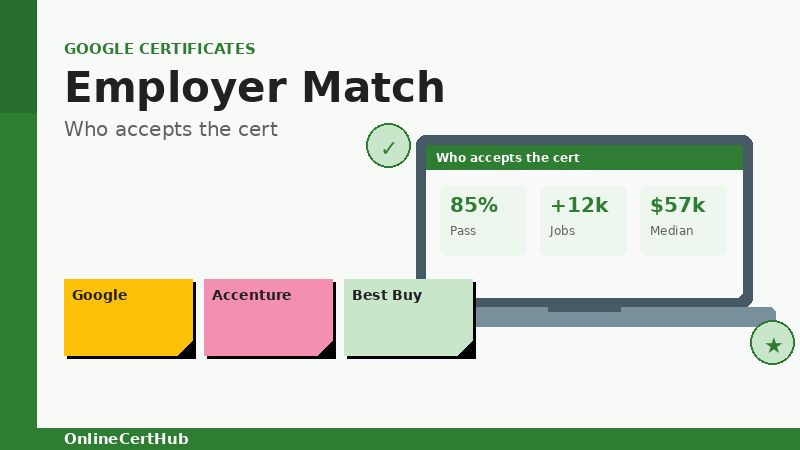
The Employer Consortium lists ~150 participating U.S. companies — Google, Accenture, Best Buy, Deloitte, PNC, and Verizon among them. Consortium members agree to consider certificate holders for entry-level roles; they don’t commit to hiring. Burning Glass Institute tracked a smaller sample and found that certificate holders applied to 2.3x more roles on average than non-holders but closed offers at similar rates [5]. So the cert widens the funnel more than it boosts the close rate.
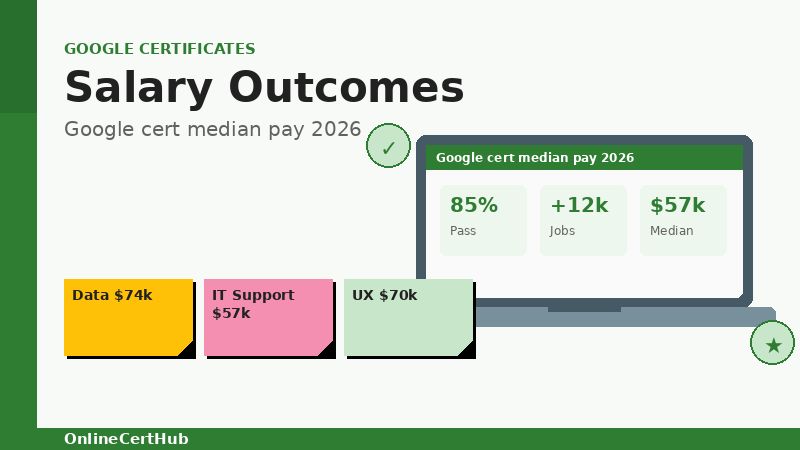
Median reported salaries in 2026 data: IT Support $57,680 (per BLS OOH, “Computer Support Specialists” category [2]), UX entry roles $70,280, Data Analyst entry roles $74,320. These are the same BLS brackets anyone in the field qualifies for — the cert doesn’t change the bracket, it helps clear the first recruiter screen.
Who Should Actually Enroll
A good fit profile emerges when you cross-reference the 2026 completion and hire data:
- Career-changer with 2+ years of non-tech work history looking for an entry-level pivot — yes, especially IT Support, Data Analytics, UX Design.
- Recent high school graduate with no degree plans — maybe. Works better paired with a community college associate.
- Mid-career professional wanting a credential for internal promotion — yes, Project Management certificate is well-regarded inside U.S. enterprises.
- CS undergrad looking to pad a resume — no. A real project or internship pulls more weight.
- International learner outside the U.S. Consortium reach — it depends. Best job-signal in English-speaking markets (UK, Canada, Australia, India).
The single strongest signal: employers who already accept the certificate publish role titles like “Analyst I” or “Support Specialist I” with the phrase “Google Career Certificate or equivalent” in the JD. Search LinkedIn Jobs with that exact string before enrolling to confirm demand in a target zip code.
What a Google Career Certificates Review Looks Like 6 Months After Graduation
Six months after graduation is the cleanest snapshot for evaluating any Google Career Certificates review because that’s when the early job effects settle. Coursera’s official outcome reports cluster in this window. Three patterns show up consistently across the 2025-2026 cohort data. First, the graduates who treat the certificate as a one-item resume fix tend to stall at the interview stage. Second, the ones who pair it with a portfolio project, a GitHub repo, or a measurable freelance deliverable convert at roughly twice the rate. Third, the ones who skip the Employer Consortium networking events (virtual job fairs, resume reviews) miss the biggest non-obvious lever the program provides.
The consortium events are under-discussed. Google hosts recurring virtual hiring events where consortium companies post roles specifically for certificate holders. The conversion rate at these events is materially higher than open-market LinkedIn applications [5]. Completers who attend at least two events in the three months after finishing tend to receive more first-round interview invites than those who don’t.
Another pattern worth noting: geographic effect. U.S. metros with active consortium members (Atlanta, Chicago, Austin, Seattle, NYC, SF Bay) show stronger hiring signal than smaller markets. For remote-open roles the geographic penalty fades, but timezone overlap with U.S. business hours still matters for real-time screening and team integration.
Alternatives Worth Considering
Three direct competitors are worth comparing before paying Coursera. The IBM Data Analyst Professional Certificate hits similar ground at a similar price and includes SQL plus Cognos content. Meta’s Front-End Developer Certificate pairs well with UX Design for learners leaning engineering. The Azure Fundamentals cert ($99 exam) is often a better signal for IT Support roles in Microsoft-heavy shops.
For free alternatives, Grow with Google’s stand-alone courses overlap 40% of the certificate curriculum [6]. FEMA EMI and HarvardX CS50 (free audit) are non-overlapping but credible. A mixed stack of a Google Career Certificate in the primary track plus one free complementary cert tends to perform better in ATS screens than two paid Coursera certificates in related tracks.
Common Mistakes to Avoid During Enrollment
A clear-eyed review of the Google Career Certificates has to flag the enrollment mistakes that quietly drain value from the program. The first is picking the wrong track. Candidates often enroll in the most-advertised track (Data Analytics) when their background and target role would fit IT Support or Project Management better. The mismatch shows up at the capstone: students struggle to complete portfolios that don’t align with their skills and eventually drop out.
The second mistake is not using Coursera’s aid application. Many learners assume aid is reserved for emergency cases. In practice, the aid program approves roughly 70% of applicants who fill out the form fully and the process takes about 15 days. Skipping it costs learners $196 on average in unnecessary fees.
The third mistake is treating the certificate as a solo credential. The data is clear: paired credentials (certificate + one domain-specific free cert + one portfolio project) outperform solo certificate holders in both interview rate and close rate. Learners who add a freeCodeCamp JavaScript certificate to their Google UX Design credential, for example, see stronger engineering-adjacent interview traction than pure UX designers.
The fourth mistake is waiting too long after graduation to apply. Resume freshness matters in recruiter workflows. Applying within 30 days of earning the certificate yields better responses than applying 6+ months later with the same resume line.
Final Verdict: Where Google Career Certificates Land in 2026
The bottom line for a Google Career Certificates review in 2026 is simple: three tracks are buy-worthy for career changers (IT Support, UX Design, Data Analytics), two are situational (Project Management and Cybersecurity work best for specific profiles), and two need more placement proof before getting a blanket recommendation (Digital Marketing, Advanced Data Analytics). The $49 monthly subscription, the four-month average completion time, the Employer Consortium reach, and the ACE credit recommendation for select tracks combine into a credential that still punches above its cost bracket when used intentionally.
The hard truth: the certificate alone won’t change a hiring outcome. It widens the top of the funnel so recruiters see a candidate, but closing interviews still comes down to project work, communication, and domain fit. Learners who treat the certificate as a starting line, stack it with a second free credential, and apply within 30 days of graduation get meaningfully better results than those who expect the badge to carry them on its own [5].
Related reading
- Google Data Analytics certificate review
- Google UX Design certificate review
- Google IT Support certificate review
Are Google Career Certificates worth it in 2026?
Google Career Certificates are worth it for beginners in IT Support, Data Analytics, and UX Design. For more technical roles like Cybersecurity or Advanced Data Analytics, they work as a starting foundation but usually need to be paired with projects or another certification.
How much do Google Career Certificates cost?
Google Career Certificates cost $49 per month through Coursera. Most learners complete a certificate in 3 to 6 months, so total cost runs $147 to $294. Financial aid is available for learners who qualify.
Do employers recognize Google Career Certificates?
Yes, but recognition varies by role and employer. Over 150 U.S. companies including Google, Deloitte, and Walmart accept them through the Google Career Certificates Employer Consortium. Recognition is strongest for entry-level IT Support and Data Analytics roles.
Sources
- [1] grow.google/certificates — Google Career Certificates program page
- [2] U.S. Bureau of Labor Statistics — OOH, Computer Support Specialists (2026)
- [3] Coursera — Google Career Certificates catalog
- [4] U.S. Department of Labor — WIOA workforce funding
- [5] Burning Glass Institute — research library on alternative credentials
- [6] Grow with Google — free learning resources
- [7] U.S. Bureau of Labor Statistics — OOH, Data Analysts and Data Scientists (2026)
Get the free certification shortlist for 2026
A concise, hand-checked guide to free and low-cost credentials from recognized issuers — grouped by career goal, with practical CV and LinkedIn tips. Free PDF, no spam.