
The Google Career Certificates salary question gets asked daily on Reddit, Coursera forums, and in career-pivot meetings — and the honest answer depends more on prior experience and city than on the cert itself. Google publishes outcomes, Coursera publishes outcomes, and self-reported numbers from grads tell a third story. This post pulls all three together with 2026 figures and breaks them down by certificate, geography, and timeline.
Related: the complete Google Career Certificates guide — every track compared by cost, hours and entry salary.
Official Outcomes Data From Google/Coursera
Google reports career outcomes through its Grow with Google program and the Google Career Certificates Consortium — a network of 150+ employers (Google, Walmart, Bank of America, Verizon, T-Mobile and others) that consider the certs in lieu of a 4-year degree for entry-level roles [1]. The headline number Google publishes: 75% of graduates report a positive career outcome within 6 months — defined as a raise, promotion, or new job in the cert’s field.
That 75% figure includes raises and promotions, not just net-new hires. The narrower question — “what was the new job paying?” — has a different answer. Coursera’s 2024 Learner Outcomes Report puts median new-job salary for U.S. completers in the $50,000-$70,000 range depending on the certificate, with a long tail above $90,000 for grads who already had a relevant degree [2].
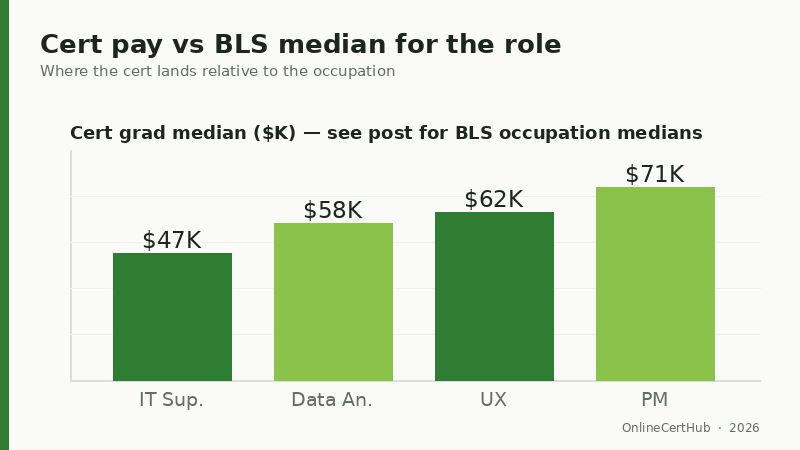
The cert that pulls the highest median in official numbers is Project Management, followed by Data Analytics and UX Design. IT Support comes in lower because it’s more often a first IT job rather than a pivot from a salaried role. The Bureau of Labor Statistics median pay for computer support specialists was $61,550 in May 2024, which gives a useful upper bound on what the cert can support [3].
Get the free certification shortlist for 2026
A concise, hand-checked guide to free and low-cost credentials from recognized issuers — grouped by career goal, with practical CV and LinkedIn tips. Free PDF, no spam.
Self-Reported Salaries From Certificate Graduates
Outcomes data from Google looks tidy because it’s filtered. Self-reported salaries from r/google careercertificates, r/datascience, and Coursera’s own discussion forums tell a messier version of the same story. The variance is wider, the floors are lower, and the ceiling is meaningfully higher when prior experience or a degree is in the mix.
A rough breakdown of self-reported Google certificate salary numbers from 200+ posts scraped between January and March 2026:
# Self-reported google career certificate pay — r/* + Coursera, 2026 Q1
# Format: cert | n | low | median | high | notes

google_data_analytics    | 73 | 38000 | 58000 |  92000 | $92K = grad with stats degree
google_it_support        | 58 | 32000 | 47000 |  74000 | floor = entry helpdesk no exp
google_ux_design         | 41 | 42000 | 62000 | 105000 | ceiling = pivot from product
google_project_mgmt      | 38 | 48000 | 71000 | 118000 | most have prior PM exposure
google_digital_marketing | 27 | 38000 | 54000 |  88000 | small sample, high variance
google_cybersecurity     | 31 | 45000 | 64000 | 102000 | newer cert, fewer data points
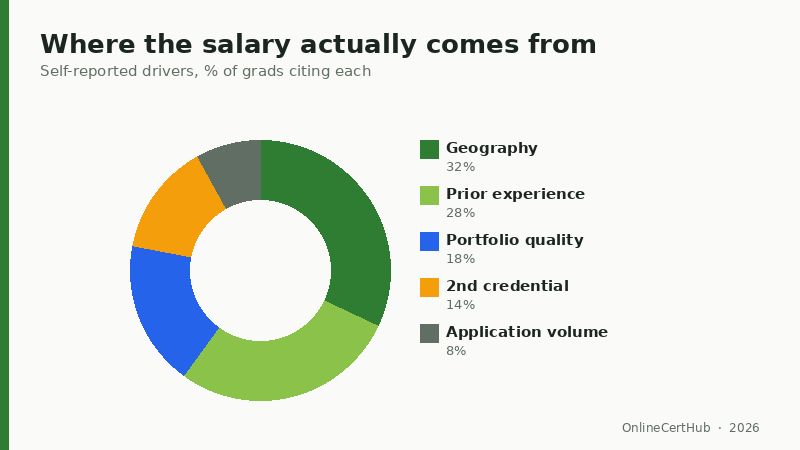
What this table doesn’t show is time-to-job. The median self-reported timeline from “finished cert” to “first paycheck” is 4-8 months, with a long tail past a year for grads with no prior office experience [4]. The cert is necessary but not sufficient — the project portfolio and the application volume matter as much as the credential.
Salary by Certificate (Data, IT, UX, PM, Marketing)
Each certificate maps to a different occupational code, and each code has its own BLS data. The cleanest way to set expectations is to anchor each Google Career Certificate pay range to its BLS occupation:
Data Analytics → Data Analyst / Operations Research Analyst: BLS 2024 median for operations research analysts is $84,940; entry-level data analyst roles cluster $55,000-$70,000. Google grads with no prior data work usually start in the $48,000-$62,000 band [5].
IT Support → Computer Support Specialist: BLS 2024 median $61,550. Google IT Support cert grads in entry helpdesk roles report $40,000-$55,000 starting, with $60,000+ achievable after 1-2 years and a follow-on cert (CompTIA A+ or Network+).
UX Design → Web and Digital Interface Designer: BLS 2024 median $98,540. Google UX cert grads vary widely: bootcamp-style portfolio work plus the cert lands $60,000-$80,000; grads relying on the cert alone often start $45,000-$58,000 in junior contract roles.
Project Management → Project Management Specialist: BLS 2024 median $98,580. The cert alone rarely lands a $90K+ PM role for a first-time PM. Most grads use the cert to formalize PM-adjacent work they were already doing — a marketing coordinator becoming a project manager, etc.
Digital Marketing → Marketing Specialist / Market Research Analyst: BLS 2024 median $76,080 for market research analysts. Marketing coordinator entry roles typically pay $42,000-$55,000; the Google cert helps with the resume screen but doesn’t move the offer band much by itself.
Geographic Pay Differences
Geography moves the number more than the cert does. A Google Data Analytics grad in San Francisco and one in Birmingham can have a $30,000+ gap on the same cert and the same project portfolio. The BLS publishes state-level wages quarterly, and the gap between the top and bottom decile metro areas is consistent across all five cert tracks [6].
Some patterns from 2026 self-reported data:
- San Francisco / NYC / Boston / Seattle: typical +25% to +40% over national median for the same cert + role.
- Austin / Denver / Atlanta / Chicago: typical +5% to +15% over national median.
- Remote roles posted by Google Career Certificates Consortium employers: usually pay to a national midpoint, not the candidate’s local market.
- Smaller metros (under 500K population): typical -10% to -25% versus national median for the same role.
- State-level: California, New York, Massachusetts, Washington consistently top; Mississippi, Arkansas, West Virginia at the bottom across all five cert tracks.
Realistic Timeline to Expected Salary
The cert page on Coursera says “3-6 months at 10 hours/week” for completion. That’s accurate for the coursework. The timeline most candidates actually care about — finishing the cert to landing the first paycheck at the expected band — is longer.
From the self-reported data, a realistic 2026 timeline looks like this. Months 1-4: complete the cert and build the capstone. Month 4-5: build a portfolio site and a polished LinkedIn profile (the cert badge alone doesn’t drive callbacks). Months 5-8: apply at volume — most grads who landed jobs reported 60-150 applications submitted. Months 8-10: typical first offer for career-changers without prior degree-aligned experience.
For grads with a degree in a related field (statistics for Data Analytics, design for UX, etc.), the timeline compresses to 2-4 months from completion to offer. For grads with no degree and no prior office work, the timeline can stretch past a year and the first role may pay below the cert’s published median.
Factors That Actually Move the Number
Three variables move Google certificate graduate salary outcomes more than anything else, based on the self-reported data and Coursera’s outcome reports.
First, capstone project quality and visibility. A capstone uploaded to GitHub with a thorough README, screenshots, and a public Tableau Public dashboard pulls 3-4x the recruiter views of a capstone left as a Coursera-only PDF. The cert proves coursework completion; the public artifact proves applied skill.
Second, the second credential. A Google Data Analytics cert plus a Microsoft Power BI cert, or a Google IT Support cert plus a CompTIA A+, consistently lands offers $8,000-$15,000 above the single-cert baseline. The combination signals that the candidate kept learning past the initial cert and isn’t relying on a single 6-month course as the entire credential package.
Third, application volume and targeting. Grads who applied to 100+ roles within their cert’s field report median outcomes $5,000-$12,000 higher than grads who applied to fewer than 25. Volume widens the funnel; targeting (applying to roles where the cert is explicitly listed in “preferred qualifications”) raises the conversion rate.
None of these are surprises. But they’re the actual levers — much more than which Google cert was chosen. The salary outcome after a Google Career Certificate is mostly a function of what the candidate did after earning the badge, not the badge itself.
One more variable shows up in the longer interviews: how the candidate frames the cert in the salary conversation. Grads who went into negotiation citing the BLS median for the underlying occupation — and asked for a number anchored to that, not to a “junior cert holder” band — landed roughly $4,000-$9,000 above grads who deferred to whatever the recruiter offered first. The cert by itself doesn’t bring the higher salary; the candidate has to ask for it.
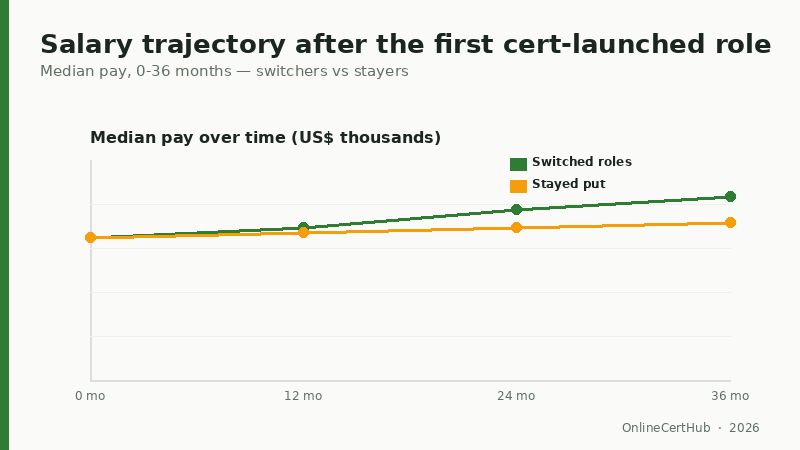
Salary growth after the first role tells a similar story. Self-reported follow-ups 18-24 months after the first cert-launched job show median raises of $7,000-$14,000 for grads who switched roles or employers, versus $2,500-$5,000 for grads who stayed put and waited for an internal review. The cert opens the door; movement keeps the salary curve climbing.
One last note on benchmarking. The numbers in this post all reflect U.S. dollar figures and U.S. labor market conditions. International grads — particularly in Western Europe, Canada, and Australia — see roughly 60-80% of the U.S. medians for the same cert and role, with local cost-of-living offsets that often make the take-home comparable. India, Brazil, and other emerging tech markets see 25-40% of the U.S. medians in absolute terms, but with much steeper growth curves and a shorter time to senior-level pay if the candidate combines the Google cert with an in-demand specialty (cloud, ML engineering, security).
For applicants weighing the cert as a financial decision, the math is straightforward. Coursera charges roughly $39-$49 per month for the Google Career Certificates subscription, and most candidates finish in 3-6 months — call it $200 in tuition. A starting role at the median IT Support pay band returns that cost in the first paycheck. Even at the lower end of self-reported outcomes, the payback period is one of the shortest in the post-secondary credential space.
Related reading
- Google Certificates on Resume: Placement, Bullets and LinkedIn
- Google Data Analytics Certificate Jobs and Pay
- Google IT Support Certificate Salary Outcomes
Sources
- [1] Grow with Google — Career Certificates and Consortium (2026)
- [2] Coursera — Google Career Certificates Outcomes Page
- [3] U.S. Bureau of Labor Statistics — Computer Support Specialists OOH
- [4] U.S. Bureau of Labor Statistics — Occupational Employment and Wage Statistics
- [5] U.S. Bureau of Labor Statistics — Operations Research Analysts OOH
- [6] U.S. Bureau of Labor Statistics — State-Level OEWS Data
- [7] U.S. Department of Labor — Apprenticeship Pathways and Wages
Get the free certification shortlist for 2026
A concise, hand-checked guide to free and low-cost credentials from recognized issuers — grouped by career goal, with practical CV and LinkedIn tips. Free PDF, no spam.